

Event Planning
Privacy-Preserving Ticketing: How It Works
Cryptography and blockchain enable anonymous, fraud-resistant ticketing—ZKPs, SMPC and digital wallets power secure issuance and fast private checks.

February 13th, 2026
•
9 min read
Privacy-Preserving Ticketing: How It Works
Privacy-preserving ticketing uses advanced cryptographic methods and blockchain to secure event ticketing while protecting user privacy. Here's how it works:
- No Personal Data Stored: Tickets are linked to cryptographic proofs, not personal information, keeping sensitive details off centralized databases.
- Fraud Prevention: Techniques like Zero-Knowledge Proofs (ZKPs) and Secure Multi-Party Computation (SMPC) ensure tickets are tied to verified human credentials, blocking bots and scalpers.
- Blockchain for Transparency: Transactions are recorded on blockchain, ensuring tamper-proof and transparent ticket management without exposing identities.
- Fast, Anonymous Verification: At events, tickets are validated using cryptographic methods, keeping identities private while preventing duplicates or revoked tickets.
This system addresses issues like counterfeit tickets, bot-driven purchases, and data breaches, offering a secure, private alternative to conventional ticketing.
Demystifying Privacy Preserving Computing | Tejas Chopra
sbb-itb-8eb1bfa
How Privacy-Preserving Ticketing Works
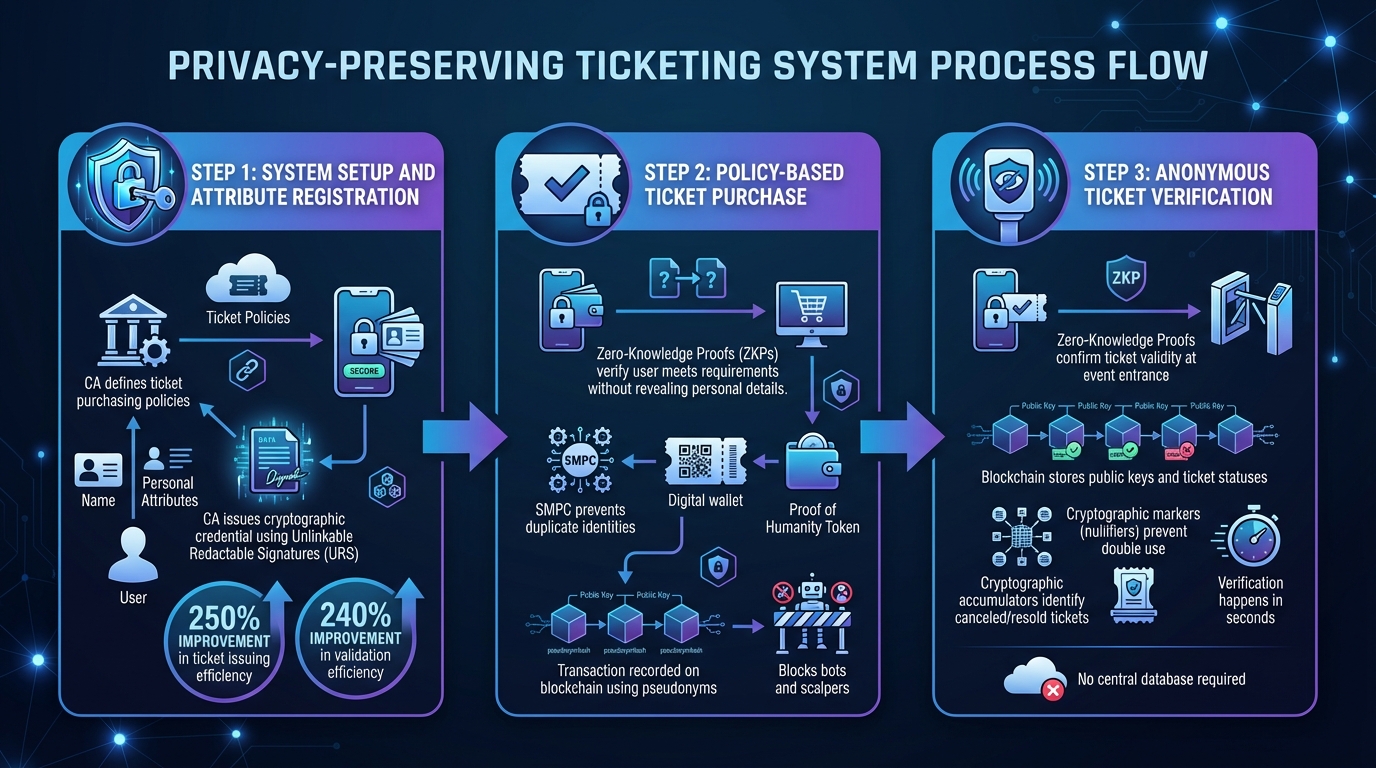
How Privacy-Preserving Ticketing Works: 3-Step Process
System Setup and Attribute Registration
When setting up the system, a Central Authority (CA) defines the ticket purchasing policies, specifying requirements like age or student status. Importantly, this process ensures your full identity stays private. During registration, you submit a set of personal attributes, which are verified and stored securely. The CA then issues a cryptographic credential, often using methods like Unlinkable Redactable Signatures (URS). These credentials are stored in a secure digital wallet on your smartphone, making it possible to keep tickets for different events unlinked. This decentralized approach reduces the risk of centralized data breaches.
Research into the PriTKT system highlights that using URS and Structure-Preserving Signatures can improve the efficiency of ticket issuing and validation by 250% and 240%, respectively, when implemented on a smartphone. This system lays the groundwork for purchasing tickets in a way that protects your privacy throughout the process.
Policy-Based Ticket Purchase
When it's time to buy a ticket, your privacy remains a top priority. You use Zero-Knowledge Proofs (ZKPs) to show that you meet the event's requirements - like being over 18 - without revealing unnecessary personal details. As Yonghua Zhan et al. explain:
"PriTKT empowers users to selectively disclose subsets of (necessary) attributes to sellers as long as the disclosed attributes satisfy ticket purchasing policies."
To prevent fraud, Secure Multi-Party Computation (SMPC) ensures there are no duplicate identities. Your ticket is linked directly to your digital wallet or a unique "Proof of Humanity" token, making it harder for bots and scalpers to exploit the system. The transaction is then recorded on a blockchain using pseudonyms, creating a tamper-proof and transparent record while keeping your identity hidden.
Anonymous Ticket Verification
Once you've purchased a ticket, verifying it at the event is just as privacy-focused. At the entrance, Zero-Knowledge Proofs confirm that your ticket is valid and that you meet the entry requirements. This process ensures your ticket's serial number and your identity remain private. The blockchain stores public keys and ticket statuses, allowing verifiers to authenticate tickets without relying on a central database.
To prevent double use, cryptographic markers (nullifiers) flag reused tickets immediately. Similarly, cryptographic accumulators in revocation registries quickly identify canceled or resold tickets. These checks happen in seconds, offering a faster and more secure alternative to traditional ID checks. Platforms like Zenao.io incorporate these privacy-preserving technologies to streamline digital ticketing for both event organizers and attendees.
Core Components of Privacy-Preserving Ticketing Systems
Cryptographic Techniques
Privacy-preserving ticketing systems rely on advanced cryptographic methods to protect user privacy while ensuring security. Zero-Knowledge Proofs (ZKPs) allow users to prove their eligibility for tickets without revealing sensitive details, while Unlinkable Redactable Signatures (URS) ensure that tickets cannot be linked across different events, maintaining anonymity.
Blind Signatures enable ticket issuers to validate tickets without accessing their content, making it impossible to track which ticket belongs to which user. Additionally, Secure Multi-Party Computation (SMPC) prevents duplicate identities from being created across decentralized systems, ensuring privacy by keeping user identities hidden from individual nodes. To verify that a ticket hasn’t been revoked, Cryptographic Accumulators allow checks without exposing the ticket’s unique identifier.
In secondary ticket markets, Commit-Reveal Schemes are used to combat bots by encrypting transaction details until a set time, preventing unfair practices like front-running. Together, these cryptographic tools form a robust framework that integrates smoothly with decentralized ledger technologies.
Blockchain as a Decentralized Ledger
Blockchain plays a central role in privacy-preserving ticketing by acting as a tamper-proof ledger. Ticket transactions are recorded via smart contracts, and when a ticket is scanned at an event, its status is instantly updated on the blockchain. This prevents ticket reuse or unauthorized resale. The blockchain also provides a transparent history, allowing buyers to confirm the authenticity of tickets.
To maintain both efficiency and privacy, only cryptographic hashes are stored on the blockchain, while larger event details are saved on decentralized storage platforms like the InterPlanetary File System (IPFS). Smart contracts can be tailored to enforce specific rules in the secondary market, such as limiting resale prices to prevent scalping or ensuring event organizers receive a share of resale profits. With the global event ticketing market valued at around $78 billion - and the secondary market accounting for $19 billion - blockchain offers a decentralized alternative to traditional systems, which are prone to single points of failure.
This distributed architecture not only improves transparency but also ensures high availability. By placing control in the hands of users, these systems prioritize the needs of event participants while enhancing trust and security.
User-Centric Design
User-centric design focuses on empowering individuals to manage their data securely. For instance, users can store identity documents in a smartphone-based digital wallet, only sharing the minimum information required for a transaction. This could mean proving student status without revealing the entire student ID.
By avoiding centralized databases, these systems reduce the risk of mass data breaches and align with privacy laws like the GDPR, which emphasizes the "right to be forgotten". As highlighted in a study:
"SSI represents a paradigm shift in digital identity management, empowering users to self-manage their identities and providing them with password-less login and digital representations of many verifiable documents." - Electronic Markets
Modern systems also prioritize efficiency to improve usability. For example, the PriTKT system demonstrated a 250% improvement in ticket issuance speed and a 240% boost in verification efficiency, making these processes fast enough for smartphones. Platforms like Zenao.io incorporate these technologies, giving users greater control over their data while ensuring a smooth and secure ticketing experience.
Benefits and Use Cases for Event Organizers
Building User Trust and Meeting Compliance Requirements
Privacy-preserving ticketing systems offer a safer alternative by eliminating centralized data storage, which often becomes a prime target for hackers. With Self-Sovereign Identity (SSI), personal data stays secure in the user's digital wallet, aligning with GDPR regulations like the right to be forgotten, while also minimizing the risk of data breaches.
Zero-Knowledge Proofs (ZKPs) further enhance privacy by allowing attendees to prove they meet entry requirements - such as age restrictions or membership validity - without exposing sensitive personal details. As Vincent Schlatt and colleagues from the Fraunhofer Institute for Applied Information Technology explain:
Since the identity information is stored by the user, data honey pots - which aggregate identity information and are a popular target for attacks - can be avoided.
By cryptographically linking tickets to verified yet anonymous identities, organizers can effectively combat ticket duplication and bot-driven exploitation. This addresses common issues like fraud and scalping that are often seen in traditional ticketing systems.
Easier Event Management
These privacy-focused systems not only build trust but also simplify event logistics. For instance, Zenao.io integrates privacy-preserving ticketing to streamline processes like digital ticketing and attendee verification. Smart contracts can enforce rules for secondary ticket sales, such as price caps, while ensuring organizers receive a share of resale profits - all without requiring manual oversight.
Signature-based ticketing methods, like Ed25519, enable quick, offline validation, which is especially useful for large-scale events where internet connectivity might be unreliable. For gatherings with over 25,000 attendees, this method eliminates the need to download massive databases onto scanning devices. Additionally, revocation registries allow organizers to cancel or invalidate tickets while keeping user information private, even during refunds or ticket resales.
Use Cases for Public and Private Events
These protocols, which prioritize privacy and secure identity verification, are versatile enough to suit a wide range of events. For public festivals, identity-binding technologies - like palm scans or SSI credentials - can enforce a "one human, one seat" policy. This prevents bots from hoarding tickets and ensures that any transfers are made to verified individuals.
Private workshops and corporate events can meet stringent compliance requirements through selective disclosure. With ZKPs, attendees can confirm eligibility criteria - such as vaccination status or professional memberships - without revealing full identity details or storing sensitive data on a public ledger. This is particularly useful for organizations working with confidential information or under strict regulatory conditions.
For community or underground gatherings, anonymous ticket verification is key. Non-Interactive Zero-Knowledge (NIZK) schemes allow participants to prove ticket ownership and authenticity without sharing personal details, shielding them from surveillance or potential data leaks. This approach is ideal for events like activist meetings or exclusive cultural gatherings where privacy is critical.
Conclusion
Key Takeaways
Privacy-preserving ticketing ensures attendee data remains secure while giving users control over their information. Zero-Knowledge Proofs play a crucial role by allowing users to verify ticket validity or age without revealing sensitive details. Similarly, Self-Sovereign Identity empowers users by storing credentials in personal digital wallets, removing the need for centralized servers and reducing the risk of "data honey pots" that attract hackers.
By linking tickets to verified identities, challenges like unauthorized duplication and bot-driven scalping are addressed. Using Decentralized Identifiers or biometric verification ensures that tickets are unique and secure.
Selective disclosure further enhances privacy by enabling users to share only the essential information required - such as proof of ticket ownership - while keeping other personal data private. This approach aligns with regulations like GDPR. Organizers also gain tools to manage secondary markets, such as enforcing price caps and verifying identities during resales, all without compromising the original buyer's privacy.
The Future of Decentralized Event Platforms
Looking ahead, decentralized event platforms are set to push the boundaries of privacy and security even further. For example, Zenao.io incorporates these privacy-focused technologies to empower both event organizers and attendees. By combining user sovereignty with cryptographic security, the platform simplifies event management while keeping data safe. A notable shift is happening in ticketing, moving from easily copied QR codes to identity-bound tokens - a step toward human-centric credentials.
As TechGig Bureau highlights:
The adoption of Verifiable Credentials in ticketing represents a shift towards privacy-first, secure, and user-controlled systems.
With open standards like W3C Verifiable Credentials gaining momentum and blockchain technology providing a decentralized trust framework, the groundwork for widespread adoption is already in place. This evolution underscores a commitment to putting users in control and establishing strong, decentralized security measures as the new norm for event platforms.
FAQs
What data stays on my phone vs. on the blockchain?
When it comes to your phone, data storage typically involves locally saved items like QR codes or digital tickets. On the other hand, blockchain takes a different approach. It securely stores items such as cryptographically verifiable tickets, transaction records, and resale policies in a decentralized system. This setup not only strengthens security but also helps reduce the risk of fraud.
How do ZKPs prove I’m eligible without showing my ID?
Zero-knowledge proofs (ZKPs) allow you to confirm you're eligible for something - like attending an event - without sharing personal details like your ID. Using advanced cryptographic techniques, ZKPs verify specific credentials or attributes, protecting your privacy while proving you meet the requirements.
What happens if I lose my phone or wallet?
Losing your phone or wallet can disrupt access to your privacy-focused tickets, depending on how the system is set up. Many systems use digital wallets or secure devices to store your credentials. If there’s a recovery process in place, you might be able to transfer your tickets or identity to another device after completing secure verification steps. In some cases, systems that rely on biometrics may require you to go through re-verification to regain access while still protecting your privacy and security.