

Governance
Zero-Knowledge Proofs in DAO Voting
Zero-knowledge proofs enable anonymous, coercion‑resistant, and gas‑efficient DAO voting with eligibility proofs, encrypted ballots, and aggregated tally verification.

January 19th, 2026
•
15 min read
Zero-Knowledge Proofs in DAO Voting
Zero-knowledge proofs (ZKPs) are transforming DAO voting by solving critical issues like voter privacy, coercion, and high gas fees. On public blockchains, voting transparency often exposes identities and choices, leading to risks like bribery and retaliation. ZKPs address this by enabling anonymous, secure, and cost-efficient voting.
Here’s how ZKPs improve DAO voting:
- Privacy: Voters can prove eligibility and cast valid votes without revealing their identity or choices.
- Security: Systems like MACI prevent vote-buying and coercion by ensuring votes remain private and unverifiable.
- Cost Efficiency: Aggregated proofs reduce gas fees by bundling thousands of votes into a single on-chain proof.
- Scalability: ZKPs support complex voting systems like weighted or ranked-choice voting while maintaining anonymity.
Despite their advantages, ZKPs face challenges such as high computational requirements, lack of standardization, and dependency on off-chain aggregators. However, tools like zk-SNARKs and recursive proof aggregation are improving efficiency and accessibility.
DAOs like Nouns DAO and platforms like Zenao are already leveraging ZKPs for private, secure voting. As the technology evolves, ZKPs are set to redefine how DAOs manage governance, privacy, and scalability.
Private Votes for Public Good: Zero Knowledge Governance
How Zero-Knowledge Proofs Enable Anonymous Voting
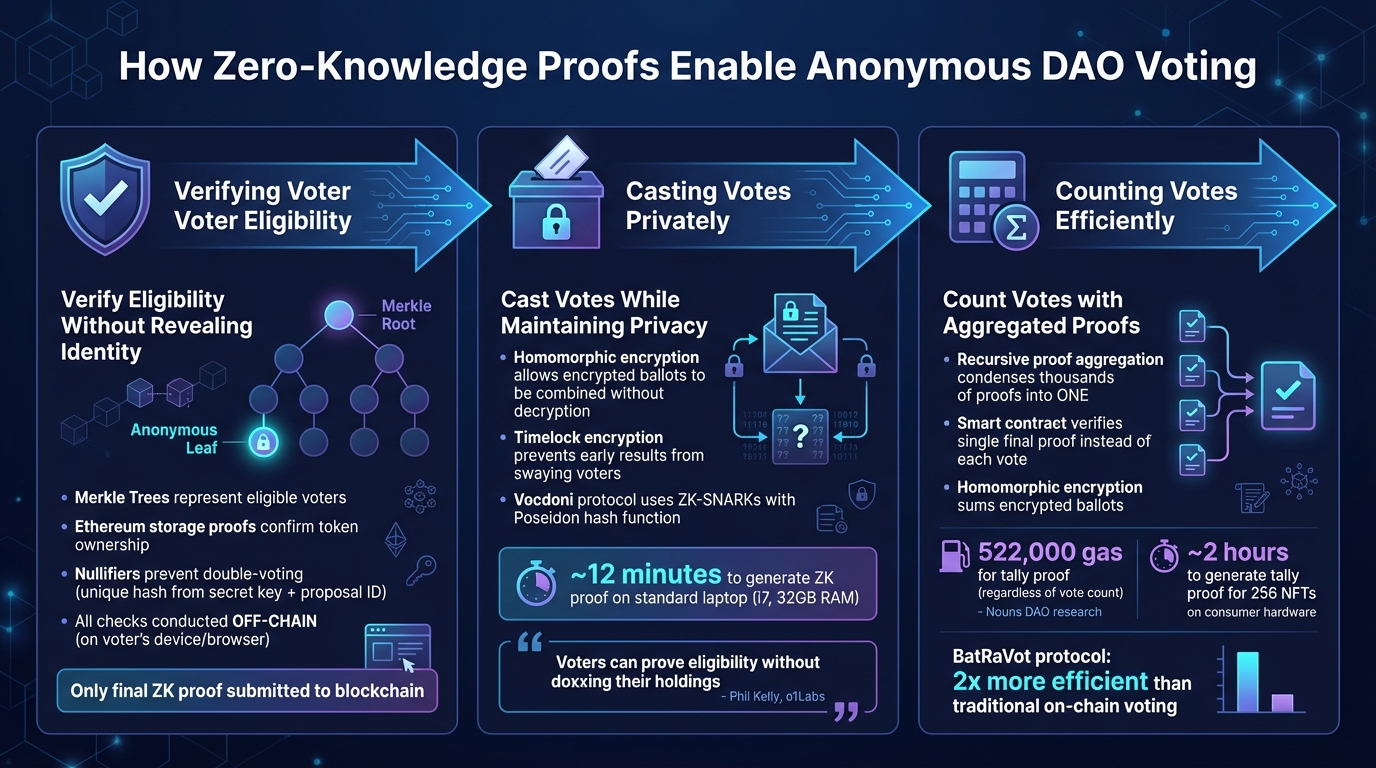
How Zero-Knowledge Proofs Enable Anonymous DAO Voting: 3-Step Process
Zero-knowledge proofs (ZKPs) provide a way for voters to participate in DAO governance without exposing their identity or voting choices. The process unfolds in three main stages: verifying voter eligibility, casting votes, and aggregating results.
Verifying Voter Eligibility Without Revealing Identity
DAOs must ensure that only authorized members vote, but traditional blockchain voting often exposes wallet addresses and token holdings. ZKPs address this by allowing voters to prove they meet the criteria without revealing which wallet they control.
Merkle Trees are used to represent the list of eligible voters, with unique leaf identifiers and a single Merkle root. Voters generate a ZK proof to show their identifier exists in the tree without disclosing which specific leaf it corresponds to. For token-based DAOs, Ethereum storage proofs confirm token ownership at a specific block height. In August 2023, Aragon ZK Research and Aztec Labs showcased this with Nouns DAO. Here, NFT holders could prove token ownership without revealing their wallet addresses. They used a "zkRegistry" that linked Ethereum addresses to BabyJubJub keys (a cryptographic format suitable for ZKPs), enabling users to prove their eligibility using a secret key that never appeared on-chain.
To prevent double-voting while maintaining privacy, ZKPs generate a nullifier - a unique hash derived from the voter's secret key and the proposal ID. Smart contracts track these nullifiers to ensure each voter participates only once, without exposing their identity.
All eligibility checks are conducted off-chain, typically on the voter's device or browser. Only the final ZK proof is submitted to the blockchain, ensuring sensitive information like token amounts or private keys remains secure.
Once eligibility is verified anonymously, the focus shifts to casting votes securely.
Casting Votes While Maintaining Privacy
ZKPs enable voters to cast ballots in ways that protect their privacy. One method is homomorphic encryption, which allows encrypted data to be mathematically combined without decryption. For voting, this means encrypted ballots can be added together to calculate the total, which is only decrypted after voting ends. This ensures individual votes remain confidential. Phil Kelly from o1Labs explains:
"By referencing on-chain data (for example, NFT holdings), a voter can prove off chain that they are eligible to vote and how many votes they are allowed... all without doxxing their holdings."
To prevent early results from swaying voters, some systems use timelock encryption. For example, the Nouns DAO proof-of-concept employed Timelock.zone, which encrypts ballots with keys that are only released after the voting period ends. Distributed randomness ensures decryption keys are made available at a specific block, maintaining fairness.
The Vocdoni protocol implemented a system using ZK-SNARKs, where voters prove their "zkCensusKey" belongs to a Merkle Tree via the Poseidon hash function, designed for ZK circuits. Nullifiers ensure no one votes twice, while votes remain anonymous. Generating a ZK proof for private voting, including NFT ownership verification, takes about 12 minutes on a standard laptop with an i7 processor and 32GB of RAM, though efforts are ongoing to improve this speed.
After votes are securely cast, the next step is efficient vote counting.
Counting Votes with Aggregated Proofs
Aggregated proofs simplify vote counting and address the cost challenges of verifying votes on-chain. Traditional methods require separate verification for each vote, which becomes costly as participation increases. ZKPs solve this with proof aggregation.
Recursive proof aggregation condenses thousands of individual vote proofs into a single, compact proof. Instead of verifying every ballot on-chain, the smart contract verifies just one final proof that confirms all votes were valid and the tally is accurate. This approach significantly reduces gas costs. In the Nouns DAO research, submitting a tally proof cost around 522,000 gas, regardless of the number of votes included.
Phil Kelly from o1Labs highlights the efficiency:
"With recursion, you essentially roll up proofs, and verify just the final recursive proof on chain, instead of verifying thousands of underlying proofs / votes."
Using homomorphic encryption, encrypted ballots are summed, and after the timelock releases the decryption key, a single proof confirms the tally. In a 2023 proof-of-concept, generating a tally proof for 256 NFTs took approximately 2 hours on standard consumer hardware.
This three-step process - anonymous eligibility verification, private voting, and efficient counting - delivers a secure and private voting mechanism. The BatRaVot protocol showcases how this method can double the efficiency of on-chain voting in terms of gas costs.
Benefits and Drawbacks of Zero-Knowledge DAO Voting
Zero-Knowledge Proofs (ZKPs) offer a modern approach to secure voting, balancing privacy, cost, and security while presenting technical challenges along the way.
Main Benefits
One of the standout advantages is privacy and ballot secrecy. With ZKPs, voters can keep their choices private, reducing risks like social pressure, herd mentality, or vote-buying attempts.
Another key strength is censorship resistance. By enabling users to generate proofs directly in their browsers through off-chain ZK circuits, voters can bypass potentially harmful intermediaries and submit their votes straight to the blockchain. Tools like MACI (Minimum Anti-Collusion Infrastructure) add another layer of protection, ensuring that bribers can't verify how votes are cast.
ZKPs also bring cost efficiency and scalability to the table. For instance, the BatRaVot protocol reduces gas costs by about half compared to traditional on-chain voting. By aggregating thousands of off-chain votes into a single succinct proof, gas fees drop significantly - sometimes enabling "gasless" voting, where an aggregator handles the fees for an entire batch.
Lastly, governance security gets a boost. ZKPs prevent early voting results from leaking, ensuring that interim tallies don't sway undecided voters. They also allow DAOs to adopt more complex voting systems, like ranked-choice or NFT-based weighted voting, without being constrained by blockchain data formats.
However, these benefits come with technical challenges that need to be addressed.
Current Limitations
One major hurdle is the high computational demand. While the final proof is compact, generating it can require significant resources, including several gigabytes of memory.
Another challenge is the lack of standardization. As Artem, a research engineer at the Aragon Zero Knowledge Guild, puts it:
"Zero knowledge proofs today can be compared to how the space of computers looked in the 70's. Back then, everyone could create their own processor. Now, everyone can create their own proving systems and their own languages, but there's no dominant solution in the market."
High barriers to entry also limit accessibility. Implementing ZKPs demands expertise in advanced fields like cryptography and number theory. Even minor adjustments to the system could undermine its security. Additionally, many ZK-SNARK systems rely on a "trusted setup", which, if compromised, could allow bad actors to forge proofs.
Lastly, aggregator and censorship risks remain a concern. Many ZK voting models depend on off-chain aggregators to batch votes, introducing the possibility of ballot censorship. These systems often need access to archive nodes for historical data and rely on external services for trusted randomness or encryption.
Pros and Cons Comparison
| Feature | Traditional On-Chain Voting | Zero-Knowledge DAO Voting |
|---|---|---|
| Privacy | Public; addresses and votes are visible | Private; identity and choices hidden |
| Cost | High; each voter pays gas | Low; costs aggregated into one proof |
| Complexity | Low; standard smart contract interactions | High; involves complex circuit design |
| Collusion Risk | High; votes are transparent | Low; MACI prevents vote verification |
| Hardware Requirements | Minimal; any web3 wallet works | Significant; requires high-performance devices |
| Scalability | Limited by block space and gas limits | High; thousands of votes in one proof |
| Security Against Coercion | Vulnerable to bribery and pressure | Resistant to coercion and vote-buying |
ZK voting is particularly appealing for situations involving sensitive decisions, such as resource allocation or elections where bribery and social coercion are concerns. However, DAOs must evaluate whether they have the expertise to handle the complexities of ZK systems or whether they should wait for more streamlined, audited solutions. Additionally, the time required for proof generation makes ZK voting better suited for longer decision-making processes rather than quick, time-sensitive votes.
sbb-itb-8eb1bfa
Examples of Zero-Knowledge Proof Voting in DAOs
DAOs are increasingly adopting zero-knowledge voting systems to ensure privacy and secure governance processes.
MACI for Encrypted Voting
Minimal Anti-Collusion Infrastructure (MACI) is a zero-knowledge voting framework designed to tackle a major issue in blockchain voting: the risk of bribery due to the public nature of votes. Originally proposed by Vitalik Buterin, MACI introduces a solution by emphasizing receipt-freeness - a mechanism that allows voters to change their voting key at any time. This feature ensures that bribers cannot reliably verify how someone voted. If a briber demands proof, voters can provide a decrypted message generated from an invalidated key, rendering the proof useless.
The system operates with the help of a coordinator who decrypts the votes and produces zk-SNARK proofs to confirm the accuracy of the final tally. According to the MACI documentation:
"While the coordinator can see the votes, they cannot censor users nor provide incorrect results."
Platforms like clr.fund have already utilized MACI in quadratic funding rounds for public goods, leveraging its privacy features to protect contributors and prevent collusion. In 2024, Aragon integrated MACI into its OSx stack. This integration allows DAOs to create proposals where members register a MACI key, cast fully encrypted votes, and verify results on-chain using zk-SNARKs. The system supports "Yes/No/Abstain" voting and uses snapshots of historical token balances to determine voting power. MACI serves as a prime example of how DAOs can enable private yet verifiable voting.
zk-SNARKs in DAO Governance
Building on MACI’s foundation, DAOs are also leveraging zk-SNARKs to enhance vote verification. In 2023, Aragon ZK Research and Aztec collaborated on a proof of concept for Nouns DAO, enabling private, weighted voting on-chain. This system allowed NFT holders to cast one vote per token, using Noir (a zk programming language) to verify Ethereum state and storage through trie proofs.
The implementation also introduced a "zkRegistry", where users registered public keys before voting. This step decoupled voter identities from their ballots, ensuring anonymity. This approach highlights how zk-SNARKs can handle complex voting rules, like NFT-based weighted voting, while maintaining voter privacy and ensuring accurate tallies. It underscores the growing role of zero-knowledge proofs in safeguarding voter confidentiality within DAO governance.
Zero-Knowledge Voting for Event-Based DAOs
Zero-knowledge proofs aren’t just limited to traditional governance - they’re also being applied in event-based DAOs to address unique polling challenges. For instance, event organizers often need to gather votes from participants while preserving individual privacy.
Platforms like Zenao are exploring these possibilities by enabling private voting for event-focused governance. Imagine a festival DAO using Zenao to let attendees vote on lineup changes or budget allocations without revealing their individual choices. Voter eligibility could be verified through on-chain data, such as participation tokens or NFTs, without exposing specific wallet addresses. These processes are managed within ZK circuits, and recursive proof aggregation combines individual votes into a single proof, significantly reducing on-chain transaction costs.
This application demonstrates how zero-knowledge proofs can extend beyond governance to solve real-world challenges for event-based decision-making, all while keeping individual privacy intact.
Using Zero-Knowledge Voting in Zenao DAOs
Zenao incorporates zero-knowledge proofs into its modular DAO framework, making it easier for event organizers and communities to adopt anonymous voting without compromising security or transparency. This approach is designed for practical applications, from festival decision-making to broader community governance.
Private Events with Zero-Knowledge Voting
Zenao provides a solution for private event voting where participants' choices remain confidential. The system employs a zkRegistry, which links Ethereum addresses to ZK-compatible public keys (like BabyJubJub keys). To maintain complete anonymity, voters are encouraged to use fresh or anonymous addresses when submitting their ZK-proof and encrypted ballot to the smart contract. A nullifier mechanism is also in place to prevent double-voting.
Additionally, Zenao can integrate time-locked cryptography through tools like Timelock.zone. This ensures votes remain encrypted until the voting period ends, at which point a decryption key is released. By preventing early results from being revealed, this feature safeguards the integrity of contentious community decisions.
These features are further enhanced by Zenao’s DAO templates, which simplify the process for communities looking to adopt this technology.
DAO Templates for Anonymous Governance
Zenao’s DAO templates remove the technical hurdles of implementing zero-knowledge voting, allowing organizers to focus on governance rather than cryptographic details. These templates support various voting formats, including yes/no, ranked choice, and NFT-weighted voting. Organizers can define eligibility criteria during the setup process, linking voting rules to event details stored on IPFS.
Voters then use ZK circuits to locally verify their eligibility in their browser. This ensures they meet the criteria to vote without disclosing sensitive information, such as their total holdings.
Phil Kelly from o1Labs highlights the value of this approach:
"When off-chain processes are wrapped in zk circuits, they become as trustworthy as on-chain activity, while escaping privacy, cost, and computational limitations that are imposed by a chain."
This governance framework integrates seamlessly with DAO vaults and execution tools, ensuring a smooth transition from voting to action.
Connecting ZK Voting with DAO Vaults and Tools
Zenao’s integration of ZK-based voting with DAO vaults and governance tools allows for secure, automated execution of decisions. Once voting concludes and results are verified, actions such as releasing funds from a vault or updating event parameters can be triggered automatically.
To keep costs low, Zenao uses recursive proof aggregation. An off-chain aggregator collects individual votes and compiles them into a single recursive proof. This means only one compact proof needs to be verified on-chain, no matter how many people vote. The BatRaVot protocol, which employs similar techniques, has been shown to be roughly twice as efficient as traditional on-chain voting in terms of gas costs.
For large-scale events, this efficiency is crucial. While wallet registration typically costs about 45,000 gas and vote submission around 690,000 gas, proof aggregation significantly reduces the cost per voter. Once the results are verified, trustless smart contracts on Ethereum or similar networks can execute the community's decisions.
The Future of Zero-Knowledge Proofs in DAO Governance
Cross-Chain Voting and Governance
Zero-knowledge proofs are transforming how DAOs manage assets across multiple blockchains, all from a single interface. A groundbreaking example came in late 2023 when Aragon integrated with zkSync and LayerZero to introduce a multichain governance plugin. This innovation lets DAO members hold governance tokens on any EVM-compatible chain while casting votes that finalize on zkSync Era rollup. The result? A single proposal can trigger actions across multiple chains at the same time, cutting down on voting power fragmentation and reducing costs for participants. Carlos, CTO at Aragon, highlights the importance of this development:
"By working on multichain governance, we're enabling Ethereum to scale by helping distribute liquidity and offloading some transactions to L2s, while protocols will still be able to live on mainnet".
These advancements in cross-chain governance set the stage for inventive voting methods that are reshaping how DAOs operate.
New Voting Methods with Zero-Knowledge Proofs
The evolution of ZK circuits is opening doors to advanced voting systems that were previously too costly or complicated to run directly on-chain. DAOs are experimenting with ranked-choice voting, where participants rank their preferences, and fixed-point distribution models, which let voters allocate a set number of points across various options. One notable example is the QV-net protocol, which showcases the speed of decentralized quadratic voting - votes can be cast in just a few milliseconds, and tallies take no more than 255 milliseconds.
Another exciting development is liquid democracy, where voters can delegate their voting power to representatives privately. Protocols like Kite allow for quick and private re-delegation or revocation of voting power, with operations taking between 7 and 167 seconds on standard consumer devices. Looking ahead, future systems may even automate result computation, allowing anyone to calculate final tallies once all ballots are submitted.
These innovations are not just about new formats - they’re about making voting processes faster, more secure, and more practical for everyday use.
Making Zero-Knowledge Voting More Efficient
Efficiency is a critical focus as zero-knowledge voting continues to advance. Recent breakthroughs in vote aggregation show major reductions in gas costs through recursive proof aggregation, with savings increasing as more votes are bundled together. At the same time, improvements in hardware and protocol design are lowering memory requirements and speeding up proof generation.
One particularly exciting shift is the move toward in-browser proving, powered by WebAssembly (WASM) and custom proving systems. This makes zero-knowledge technology more accessible than ever. Artem Grigor from Aragon ZK Research captures the current state of the field:
"Zero knowledge proofs today can be compared to how the space of computers looked in the 70's... Now, everyone can create their own proving systems and their own languages, but there's no dominant solution in the market".
As the technology matures, these advancements are bringing zero-knowledge voting closer to becoming a practical and widely adopted tool in DAO governance.
FAQs
How do zero-knowledge proofs ensure privacy and security in DAO voting?
Zero-knowledge proofs let voters confirm two critical things: that they are eligible to vote and that their vote has been accurately counted - all without revealing their identity or how they voted. This approach ensures absolute privacy and anonymity while safeguarding the integrity of the voting process.
By disconnecting voter identities from their choices, zero-knowledge proofs enhance the security and reliability of DAO voting. This gives participants the confidence to cast their votes freely, without fear of privacy violations or outside pressures.
What challenges arise when using zero-knowledge proofs in DAO voting systems?
Implementing zero-knowledge (ZK) proofs in DAO voting is no small feat, as it comes with a mix of technical and operational hurdles. For starters, the ZK ecosystem is still in its early stages. While there are plenty of tools and programming languages to work with, there’s no single, universally accepted solution. This makes it tough for developers to pick a dependable tech stack, often leading to integration headaches and delays in development timelines. Building a truly private voting system adds another layer of complexity, requiring advanced cryptographic features like storage proofs - many of which are still being refined.
Security also poses a major challenge. If votes are collected through an off-chain aggregator that generates proofs, risks like collusion or manipulation can creep in. Developing protocols that protect ballot secrecy, ensure fairness, and guarantee verifiability - all while keeping voter privacy intact - demands careful planning, rigorous testing, and a lot of expertise.
On top of that, there are practical hurdles to consider. High gas fees for verifying proofs on-chain can be a financial strain, especially for DAOs with large voter bases. Scalability is another issue, as accommodating a growing number of participants without compromising efficiency is no easy task. And then there’s the tricky balance of conducting audits that are both transparent and private. Until the ZK space matures and standardized, well-tested tools become widely accessible, DAO projects will need to invest considerable effort and resources to tackle these challenges.
How does proof aggregation help lower gas fees in zero-knowledge DAO voting?
Proof aggregation helps cut down gas fees by merging all voters' signatures into one compact zk-SNARK proof. An off-chain aggregator handles this process, while the on-chain contract only verifies the single proof. This means gas consumption stays consistent, no matter how many participants are involved, making the process both more affordable and easier to scale.