

Governance
Participative governance : Complete Guide Getting Started
Step-by-step guide to set up participatory governance: principles, proposal processes, voting systems, treasury management, tools and best practices for community-led DAOs.

December 31st, 2025
•
12 min read
Participative governance : Complete Guide Getting Started
Participatory governance is a decision-making approach that prioritizes community involvement through transparent, decentralized processes. Instead of relying on a top-down structure, it empowers individuals to contribute equally, fostering shared responsibility and collaboration.
Key Takeaways:
- Core Principles: Decentralization, transparency, and equal participation.
- Framework Components: Proposal mechanisms, voting systems, and treasury management.
-
Implementation Steps:
- Define community goals and rules.
- Choose tools like Zenao for governance setup.
- Launch processes and refine them over time.
- Best Practices: Encourage participation, ensure transparency, and scale with subDAOs for efficiency.
Participatory governance transforms decision-making, allowing communities to have a direct say in shaping outcomes. Tools like Zenao simplify the process, offering no-code solutions for creating and managing governance systems.
DAO The Governance Layer of Web3 | Explained Simply
Core Principles of Participatory Governance
Participatory governance is built on three key principles that aim to empower communities and ensure their voices are genuinely heard.
Decentralization and Community Ownership
Decentralization shifts power away from a central authority and distributes it more evenly across the community. Instead of a handful of leaders making decisions, this approach encourages collective input and shared responsibility. By involving members in shaping outcomes, organizations create a sense of community ownership. This shared ownership often leads to stronger, long-term commitment, as people feel directly tied to the results of their work. Many organizations now embrace this model to strengthen their credibility and connection with the communities they serve.
Transparency and Accountability
Transparency is the backbone of participatory governance. Communities must have unrestricted access to information about decisions, policies, and resource allocation. When processes are open and clear, members can see how their contributions influence decisions. Equally important is accountability - mechanisms must exist to track spending and ensure leaders honor their commitments. For example, participatory budgeting, introduced in 1989, has been used in over 7,000 public budgets worldwide, illustrating how open resource management builds trust on a large scale. To maintain trust, it’s essential to close the loop by showing how community input directly impacts outcomes.
Equal Access and Participation
True participation requires breaking down barriers that prevent people from getting involved. This can include offering training, providing accommodations, or addressing systemic inequalities. When everyone has an equal opportunity to contribute, decisions benefit from a wide range of perspectives and local insights that centralized systems often overlook. The Open Government Partnership highlights this by stating, "We value public participation of all people, equally and without discrimination, in decision making and policy formulation". Skilled facilitators can also play a crucial role by ensuring that quieter voices are heard, preventing more dominant individuals from overshadowing others.
These principles form the foundation for governance structures that are inclusive, transparent, and community-driven.
Key Components of a Participatory Governance Framework
A participatory governance system transforms community feedback into actionable decisions through three interconnected elements.
Proposal Mechanisms
The proposal process channels ideas into formal decisions. It often starts informally, with discussions on platforms like forums or Discord to measure interest. If the idea gains momentum, it moves to a formal Request for Comment (RFC) stage. At this point, standardized templates are used to outline critical details, including technical requirements, financial considerations, and success benchmarks.
Take ENS as an example. Their process consists of three phases: an initial temperature check on forums, a draft proposal hosted on GitHub, and final approval on Snapshot or their governance portal. To submit a proposal that can be executed, a wallet must have at least 100,000 ENS tokens (equivalent to 0.1% of the total token supply) delegated to it. Similarly, Aave employs an "Aave Request for Comments" (ARC) system, where proposals are reviewed by the community before moving to a formal vote.
Once proposals are refined, they proceed to voting systems designed to ensure community consensus.
Voting Systems and Mechanisms
Voting methods vary based on the needs of the community. Token-weighted voting (where 1 token equals 1 vote) ties decision-making power to financial investment, though it can disproportionately favor wealthier members. Alternatively, wallet-based voting (1 wallet equals 1 vote) treats all participants equally but is susceptible to Sybil attacks unless identity verification measures are in place.
Quadratic voting strikes a balance by making each additional vote cost more (e.g., 1 vote costs 1 token, 2 votes cost 4 tokens, 3 votes cost 9 tokens). This approach helps protect minority voices while allowing passionate members to express stronger preferences. Another option, optimistic governance, allows routine proposals to pass automatically unless challenged, reducing the burden of constant voting .
ENS adopts a hybrid voting model. Standard proposals require a 1% quorum with 50% approval, while constitutional amendments demand 66.6% approval. Snapshot votes are open for 5 days, while on-chain executable proposals have a 7-day voting period followed by a 2-day timelock. This delay provides the community with a chance to review the proposal before it is implemented.
Once a proposal is approved, transparent treasury management ensures its execution aligns with community priorities.
Treasury and Resource Management
Transparent treasury management is essential for building trust within the community. These treasuries, often stored in multisig wallets like Safe, typically hold a mix of native tokens, stablecoins, and traditional assets. Allocations are made collectively and follow predefined spending policies.
For example, MakerDAO decided to invest treasury funds in U.S. Treasuries and corporate bonds to generate returns - bridging decentralized governance with conventional finance. Similarly, Aave introduced a "Safety Module" where users can stake AAVE tokens as a form of insurance for the protocol. Uniswap, on the other hand, runs a structured grants program to support ecosystem development, all managed with full transparency.
sbb-itb-8eb1bfa
How to Implement Participatory Governance
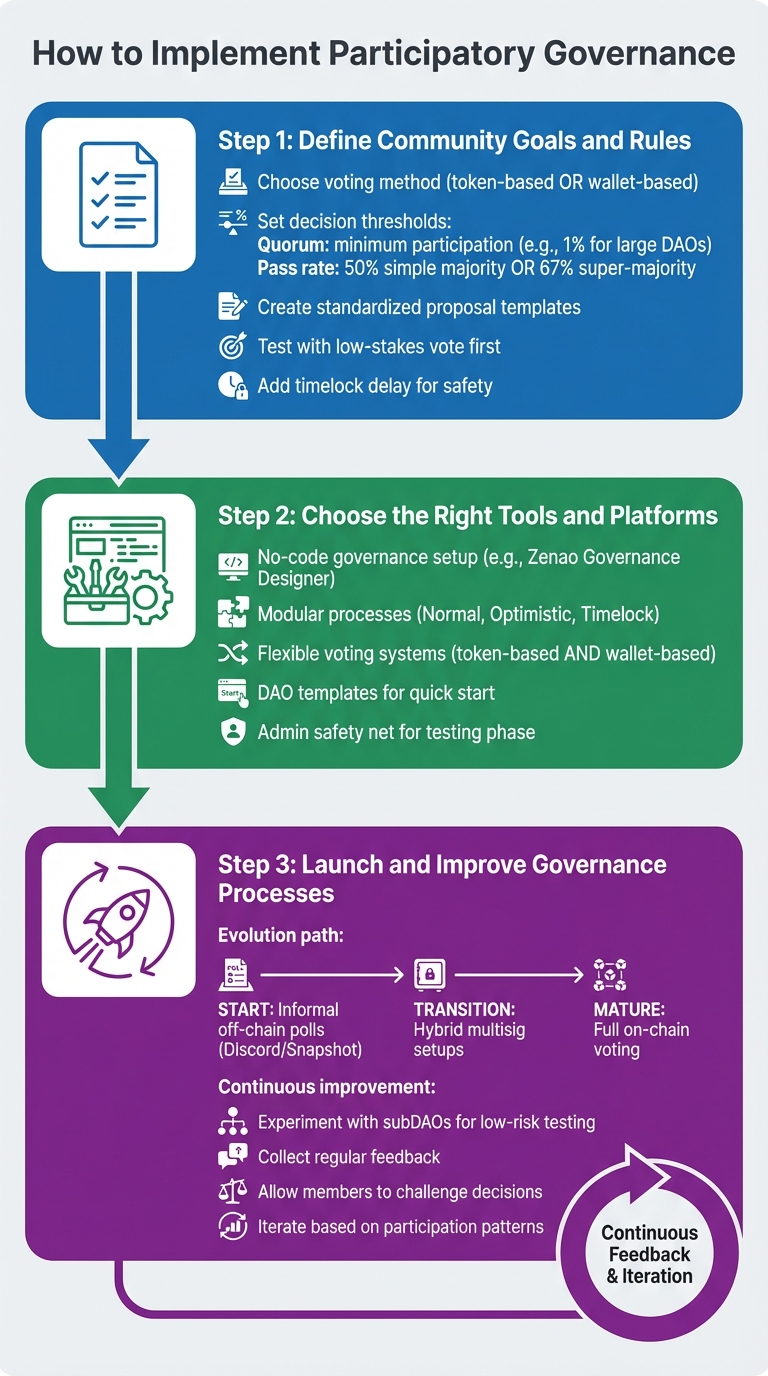
3-Step Implementation Guide for Participatory Governance Systems
To put participatory governance into action, it's crucial to establish clear decision-making processes. This phase takes the foundational principles and components we've covered and turns them into practical, tailored systems.
"DAO governance is who can make decisions and how those decisions are made" – Aragon
Here’s a straightforward approach to transforming these principles into functional governance systems.
Define Community Goals and Rules
Start by outlining the goals and rules for your community. Decide on the processes, stages, and roles involved. Select a voting method that aligns with your community's needs - whether it's token-based (to reflect stake-weighted influence) or wallet-based (to ensure equal participation, with identity safeguards in place).
Set clear decision thresholds. This includes defining a quorum (the minimum participation needed for a valid vote) and a pass rate (e.g., a simple majority of 50% or a super-majority of 67%). Many larger DAOs opt for low quorums, sometimes as low as 1%, to prevent governance deadlocks. Standardize proposal templates to include essential details like a title, description, funding request, technical specifications, and measurable outcomes.
Before implementing high-stakes decisions, test your governance parameters with a low-stakes vote. Adding a timelock delay can also protect against harmful or rushed proposals.
Choose the Right Tools and Platforms
The tools you select can make or break your governance system. Platforms like Zenao's Governance Designer offer a no-code solution for creating customized governance structures. Zenao provides modular features, such as:
- Processes tailored to specific on-chain decisions.
- Sequential proposal stages (e.g., Normal for approval-based decisions, Optimistic for auto-passing unless vetoed, and Timelock for delayed execution).
- Flexible voting systems supporting both token-based and wallet-based voting.
For communities just starting out, Zenao also includes DAO templates to speed up the setup process and an admin "safety net" for the initial testing phase. This safety net can be removed once the governance system is stable.
With the right tools in place, you’ll be ready to launch and refine your governance process.
Launch and Improve Governance Processes
Governance systems aren’t static - they evolve. Many communities begin with informal off-chain polls (using platforms like Discord or Snapshot), transition to hybrid multisig setups (where community votes are combined with decisions from elected representatives), and eventually move to full on-chain voting, whether token- or wallet-based.
Consider experimenting with subDAOs for specific projects or initiatives. This allows for low-risk testing without jeopardizing the main treasury. Regular feedback is essential - evaluate how efficient and accessible your processes are. Make sure there are avenues for members to challenge decisions and voice concerns, as this fosters trust and transparency.
Start small with basic voting mechanisms and refine them over time based on participation patterns and the community's changing needs. This iterative approach ensures your governance system remains effective and responsive.
Best Practices for Participatory Governance
Once your governance system is up and running, the real challenge begins: keeping it fair, effective, and thriving. These strategies can help maintain momentum and support growth as your community evolves.
Encourage Community Participation
Engagement drops off quickly when people feel like their input doesn’t matter. Always communicate how contributions are used - or why they’re not. When members see their ideas put into action or receive thoughtful explanations for rejections, it builds trust and keeps them invested.
Empowering members is another cornerstone of participation. Whether through tokens or direct decision-making, giving stakeholders a sense of ownership encourages long-term involvement. For example, in January 2022, BanklessDAO introduced a subDAO model, allowing members to join specialized groups like the Writers Guild or Bankless Consulting. This reduced bureaucratic barriers and gave contributors more focused roles to shine.
To avoid the "vocal minority" issue, diversify your recruitment methods. Civic lotteries - randomly selecting participants for juries or assemblies - ensure a broader range of voices are heard. Similarly, wallet-based voting systems should include identity safeguards to maintain fairness.
Strong participation sets the stage for transparent practices and scalable governance structures like subDAOs.
Maintain Transparency and Fairness
Once your community is actively participating, the next priority is transparency. But transparency isn’t just about making information available - it’s about making it understandable and actionable. Keep detailed, open records of proposals, votes, and treasury movements. Use clear templates that outline titles, descriptions, funding requests, and measurable outcomes, so everyone knows exactly what they’re voting on.
Choose voting methods that strike a balance between influence and equality. Many communities start with simple off-chain polls and gradually adopt more advanced on-chain systems as they grow.
To prevent rushed or harmful decisions, implement safeguards like optimistic stages - where proposals pass by default unless vetoed - and timelocks that introduce review periods before execution. These measures give the community enough time to identify potential issues before decisions are finalized.
"We value public participation of all people, equally and without discrimination, in decision making and policy formulation. Public engagement... increases the effectiveness of governments, which benefit from people's knowledge, ideas and ability to provide oversight." – Open Government Partnership
Scale with SubDAOs
As your governance system matures, decentralized structures like subDAOs can enhance efficiency and responsiveness. SubDAOs are smaller, autonomous groups within a larger organization that handle specific tasks or missions. By localizing decision-making, they help eliminate bottlenecks and encourage experimentation.
Between 2021 and 2022, DAO participation skyrocketed from 13,000 to 1.6 million members - a staggering 130× increase. Communities that scaled effectively often relied on subDAOs for specialized functions like marketing, development, or regional operations. For instance, in January 2022, DAO Dash joined the BanklessDAO ecosystem by issuing its own token and allocating 33% of the supply to the parent treasury in exchange for initial funding and brand support.
A modular approach can simplify subDAO creation. Start with straightforward setups like off-chain coordination or multisig wallets, then decentralize further as the subDAO proves its value. Parallel processes for different decision types, granular permissions, and clear relationships between parent and sub-organizations can all help streamline operations [9, 19].
"SubDAOs - smaller, autonomous working groups and projects within a broader DAO... are how DAOs scale without burdening the community with bureaucracy." – Frogmonkee, Core Contributor, BanklessDAO
Define economic and relational ties early to avoid confusion as you grow. Economic alignment might include revenue-sharing models (e.g., a 10% tax on subDAO income) or token swaps. Relational alignment could involve brand licensing, talent sharing, or promotional support. Clear agreements ensure everyone knows their role as your ecosystem expands.
Conclusion
The Advantages of Participatory Governance
Participatory governance reshapes how decisions are made and resources are managed, leading to more effective services, well-aligned policies, and smoother implementation processes. This approach fosters genuine trust by rooting legitimacy in the community's belief that decisions reflect the collective interest rather than benefiting only a select few.
Under this model, members shift from being passive recipients to active collaborators who are deeply invested in long-term outcomes. It also promotes accountability and transparency by allowing broader oversight of decisions, reducing resource mismanagement, and ensuring funds are directed toward actual needs.
On a deeper level, participatory governance strengthens social bonds. By embracing diverse perspectives and encouraging inclusion, it addresses gaps in democratic processes and builds stronger trust among participants.
These advantages lay the groundwork for practical application.
Launch Your Community with Zenao
To harness the power of participatory governance, Zenao provides an all-in-one, no-code platform designed to simplify the process. From proposal submissions and voting systems to treasury management and community coordination, Zenao covers it all.
You can start with Zenao's free Basic plan to establish your first community, build governance structures, and engage members using integrated social tools. As your community grows, take advantage of advanced features like DAO-vaults for managing crypto funds and customizable governance templates. Whether you're running a small group or scaling up to thousands of participants, Zenao’s decentralized framework ensures your community remains at the center of every decision.
FAQs
What makes participatory governance different from traditional governance?
Participatory governance opens up decision-making to include a wider range of voices, moving beyond the confines of a small group of leaders. Rather than depending solely on elected officials or government administrators, it invites citizens and stakeholders to take an active role. Tools like community forums, citizen assemblies, and public consultations make it possible for people to directly influence policies and decisions. This approach strengthens transparency, accountability, and collaboration by keeping the community involved at every stage - not just during election cycles.
In contrast, traditional governance tends to operate in a top-down, representative manner. Decisions are made by leaders on behalf of their constituents, with public participation often limited to voting or occasional opportunities for feedback. While this method can make the process more efficient, it risks sidelining diverse perspectives and eroding trust over time. Participatory governance takes a different path, focusing on shared authority, ongoing citizen involvement, and collective problem-solving. This ensures that public policies align more closely with the needs and priorities of the community.
What are the advantages of using Zenao to implement participatory governance?
Zenao makes setting up participatory governance straightforward with its step-by-step workflow. Whether it's identifying areas for participation or turning ideas into actionable plans, the platform brings everything you need together in one convenient space. It offers ready-made templates, questionnaires, and practical guides to save time and effort, making it easier to launch governance initiatives that are both inclusive and transparent.
By consolidating key tools like public information resources, decision-making frameworks, and monitoring systems, Zenao enhances accountability and openness. Participants can actively engage in tasks such as voting on budgets, shaping policy drafts, or tracking the progress of proposals. This streamlined approach builds trust and leads to better outcomes.
On top of that, Zenao’s digital platform enables real-time collaboration, making it ideal for teams and communities, even when members are spread across different locations. Designed with U.S. preferences in mind - like dollar-based budgeting and imperial measurements - it ensures an accessible and user-friendly experience. This encourages broader participation and helps create a governance structure that’s both democratic and effective.
What challenges arise in ensuring transparency and fairness in participatory governance?
Ensuring transparency and fairness in participatory governance is no small task. It hinges on providing open access to accurate, dependable information and creating systems that prevent power from tilting in favor of a few. A major hurdle is ensuring participants have access to clear and trustworthy data. This allows them to evaluate decisions effectively and hold leaders accountable. Without this baseline, it becomes tough to ensure decisions genuinely reflect collective input. Compounding this issue are barriers like unequal access to technology, language differences, or limited digital literacy, which can leave certain groups sidelined and compromise fairness.
Another significant challenge lies in maintaining trust and avoiding bias during decision-making. When certain individuals or groups dominate discussions - whether through informal influence, greater resources, or selective framing - it can lead to perceptions of unfairness. Problems like "groupthink" or the sway of vocal minorities can also distort outcomes, pulling them away from the broader community’s interests. Addressing these issues requires setting clear rules, implementing transparent voting processes, and actively monitoring for signs of power imbalances. These steps are crucial to safeguarding both transparency and fairness in participatory governance.