

Event Planning
Event management platforms: top 5 in 2025
Five leading 2025 event platforms compared — NFT ticketing, DAO governance, token-gating, privacy tools, pricing and scalability explained.

January 2nd, 2026
•
14 min read
Event management platforms: top 5 in 2025
Decentralized platforms are reshaping event management by integrating blockchain technology, NFTs, and DAOs. These systems offer features like NFT-based tickets, automated payments, and community-driven governance. While promising, challenges like low DAO participation persist. Here are the top five platforms leading the way in 2025:
- Zenao.io: Combines event tools with DAO integration, offering token-gated access, DAO-vaults, and privacy options.
- Blockchain-Integrated Tools: Focused on automation and security with smart contracts, NFT ticketing, and transparent financial systems.
- Community Governance Platforms: Enable co-ownership through DAOs, NFT collateral, and token-gated access for engaged communities.
- Modular DAO Architecture: Customizable governance frameworks for events, enhancing transparency and control.
- Open-Source Platforms: Self-hosted solutions with privacy-focused tools and blockchain integration.
These platforms cater to different needs, from secure ticketing to decentralized governance. Below is a quick comparison of their features:
Quick Comparison
| Platform | Key Features | Pricing Model | Scalability & Tools |
|---|---|---|---|
| Zenao.io | DAO-vaults, token-gating, privacy tools | Freemium (Pro TBA) | Modular DAO templates |
| Blockchain Tools | Smart contracts, NFT ticketing, transparency | Revenue-sharing model | API/SDK integrations |
| Community Governance | Co-ownership, token-gated access, NFT collateral | Variable | Secondary market royalties |
| Modular DAO Platforms | Custom governance, smart contracts, ZKPs | No-code tools | Testnet experimentation |
| Open-Source Platforms | Self-hosted, privacy-focused, blockchain-ready | Free (Premium options) | Full data control |
Each platform offers unique tools, so your choice depends on your event's goals and your team's expertise with blockchain systems.
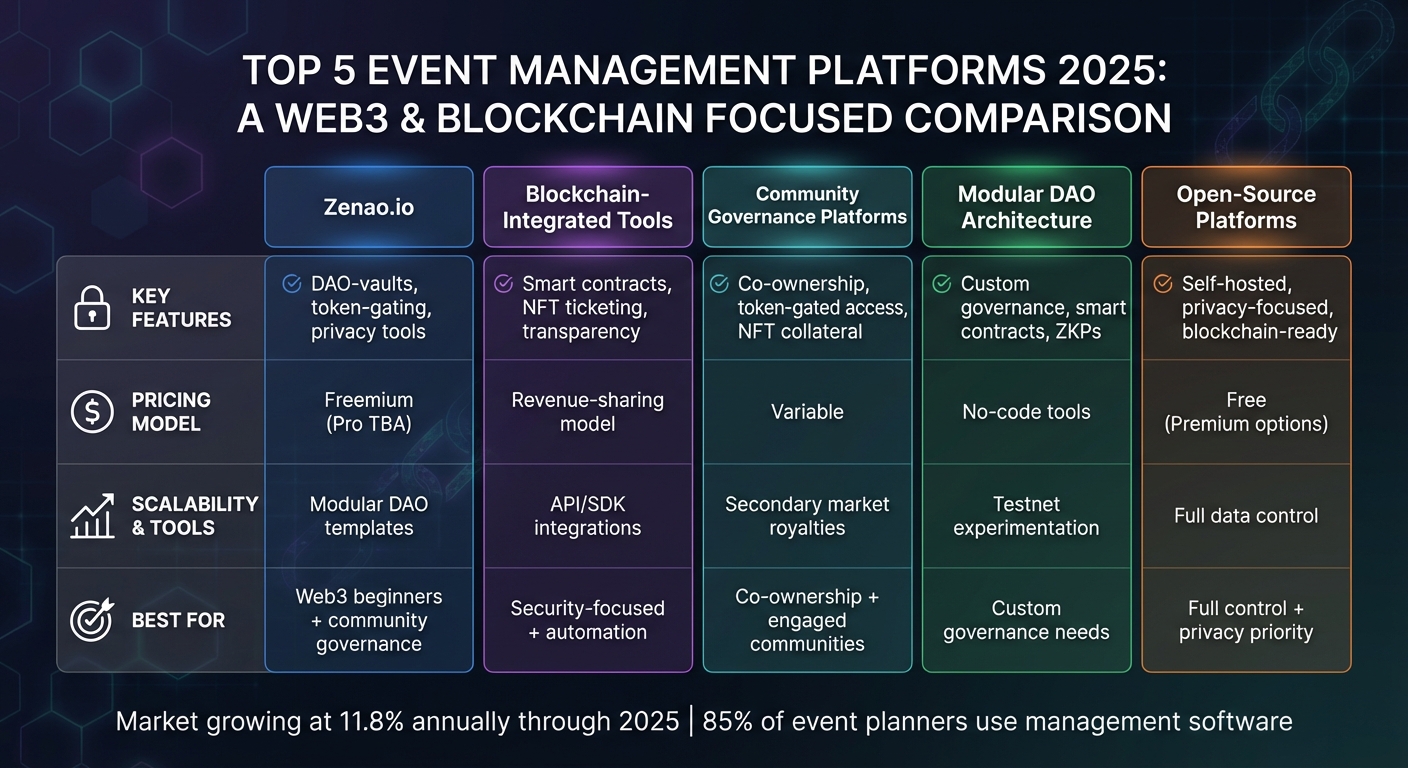
Top 5 Event Management Platforms 2025: Features, Pricing & Scalability Comparison
How to create a DAO: Best tools and platforms
1. Zenao.io
Zenao is a decentralized, open-source platform that brings a modern twist to event management. Developed by the Samouraï Coop team, this platform combines traditional event planning with Web3 technology to create a space where communities have greater control. It’s built with a focus on user sovereignty, ensuring that both attendees and organizers retain ownership of their data and participation.
Decentralization and DAO Integration
One of Zenao's standout features is its integration of Event DAOs - allowing communities to co-own and co-manage events. This setup gives participants the ability to vote on decisions, contribute to event planning, and even take part in governance. To make financial management transparent, the platform includes DAO-vaults for handling crypto funds, ensuring budgets and revenues are clearly tracked. Looking ahead, Zenao plans to offer modular DAO architecture and customizable templates, making governance easy to set up and tailor to specific needs.
This governance model is seamlessly woven into Zenao’s broader event management tools, providing a unified experience.
Event Management Features
Zenao offers a range of tools to streamline event planning. It supports both public and private community setups, offers smooth ticketing processes, and includes efficient scanning features. With token-gating, organizers can restrict access to tickets or specific areas of an event to holders of designated tokens. Social tools built into the platform help keep attendees engaged before, during, and after events. Additionally, Zenao is rolling out payment integration with Stripe and cryptocurrency options, as well as private events secured by zero-knowledge proofs to ensure confidentiality.
Pricing and Scalability
Zenao operates on a freemium model. The Basic plan is free and includes features like public/private event creation, digital ticketing, community governance, and social engagement tools. For users needing more advanced options, Pro and Enterprise plans are in the works, with pricing details to be announced. These tiers will include features like payment integration, DAO-vaults, private events with zero-knowledge proofs, and custom DAO templates designed for larger organizations.
2. Blockchain-Integrated Event Tools
Blockchain-integrated platforms are reshaping how events are managed, secured, and monetized. These tools go beyond traditional ticketing systems by embedding decentralization directly into event operations. With features like smart contracts and on-chain voting, organizers can automate processes and establish transparent financial systems without relying on centralized control. Let’s dive into how these tools improve both automation and security.
Decentralization and DAO Integration
Blockchain platforms introduce co-ownership models where attendees and contributors actively participate in decision-making alongside organizers through Event DAOs (Decentralized Autonomous Organizations). On-chain voting replaces traditional top-down management, with decisions automatically recorded and executed via smart contracts. To prevent wealthier token holders from monopolizing outcomes, some systems implement quadratic voting, where the cost of additional votes increases exponentially, or reputation-based voting, which ties voting power to contributions rather than token ownership.
"The tokenization model turns users into decentralized policymakers." - Sockin and Xiong
Privacy and Security Tools
The immutability of blockchain ensures that ticket sales and contracts cannot be altered or erased. Features like NFT ticketing and token-gating provide secure and unique access, effectively eliminating counterfeiting and unauthorized scalping. A notable example is the 2019 UEFA Super Cup, where over 80% of tickets were distributed via blockchain, significantly reducing fraud. Similarly, the GET Protocol has processed over 3,000,000 blockchain-based tickets since 2016.
Smart contracts streamline operations by automating processes like vendor payments and ticket transfers, minimizing errors and opportunities for manipulation. Advanced platforms also use in-app validation to ensure only authentic tickets are scanned at venues, effectively shutting down large-scale scalping operations.
Pricing and Scalability
Blockchain tools are shifting event monetization from traditional per-ticket fees to revenue-sharing models. Organizers can generate income through NFT sponsorships, tiered "SuperPass" access, and automated royalties from secondary ticket sales. Unlike conventional platforms, these features enable long-term revenue streams. For comparison, platforms like Whova charge 3% + $0.99 per paid ticket, while Eventbrite fees total 3.7% + $1.79 plus a 2.9% processing fee.
Scalability is achieved through API and SDK integrations, allowing organizers to embed Web3 features directly into their own websites. Virtual event spaces can be created as custom "Worlds" or by collaborating with existing digital venue owners, eliminating the need to purchase virtual real estate. For example, the Decentraland Music Festival has attracted participants from 159 countries since 2021, operating as a free, DAO-managed event. These evolving pricing models and scalability options are paving the way for more decentralized approaches to event management.
3. Community Governance and Ticketing Platform
Community-driven ticketing platforms are changing the way events are financed and managed. Instead of treating attendees as mere spectators, these systems promote co-ownership, where participants influence event decisions through Event DAOs (Decentralized Autonomous Organizations). Organizers can also tap into decentralized financing by using NFT tickets as collateral for liquidity providers, with smart contracts ensuring terms are met automatically. Token-gated access adds another layer, allowing only verified members - those holding specific tokens or NFTs - to buy tickets or access exclusive areas. This approach not only rewards loyalty but also builds a more engaged and interactive community, all while enhancing event management through blockchain integration.
Decentralization and DAO Integration
Event DAOs shift the traditional relationship between organizers and attendees, enabling communities to co-create and co-own events. A notable example is the 2022 EXIT Festival, which introduced NFT-based ticketing on the Avalanche blockchain, offering premium experiences and earning recognition in the industry. Similarly, in 2021, Dutch comedian Jochem Myjer adopted the GET Protocol to implement a ticketing system that blocked scalping, ensuring fans could buy tickets at fair prices set by the organizer.
Privacy and Security Tools
NFT-based ticketing systems offer a significant boost in security by using ERC721 tokens, which generate unique and tamper-proof digital tickets. Tools like Tokenproof’s animated in-app QR codes and Humanity Protocol’s "Human IDs" help prevent unauthorized sharing and bot activity. This is critical, as bots can snap up as much as 60% of high-demand tickets in mere seconds. As noted by the Rouge Project:
"NFT-based ticketing system is designed to be fraud-proof, ensuring that only genuine tickets are sold and used at check-in because the blockchain keeps immutable and tamper-proof record of all ticket transactions." - Rouge Project
Blockchain technology also offers transparency, with on-chain records providing a clear history of ticket ownership. Additionally, embeddable wallets allow users to interact using familiar credentials like email, reducing risks tied to managing private keys manually. These features collectively make blockchain ticketing a powerful tool against fraud.
Event Management Features
Blockchain-based platforms give organizers greater control over secondary ticket sales. They can set limits on resale prices and collect royalties on every transaction automatically, cutting out exploitative scalping practices. In traditional ticketing markets, resale prices can average 203% of the original ticket value. Beyond access, NFT tickets can evolve into digital collectibles, offering perks like exclusive content, discounts for future events, or even virtual experiences. Since 2016, the GET Protocol has processed over 3,000,000 tickets on-chain, supporting events across 121 countries. This transforms tickets from mere entry passes into long-term community membership tokens.
Pricing and Scalability
Unlike conventional platforms that charge fixed fees per ticket, blockchain solutions provide ongoing royalty streams through automated secondary market transactions. Scalability is another strength, with API and SDK integrations allowing organizers to incorporate these features into their branded websites seamlessly. For example, platforms like OPEN can handle tens of millions of tickets daily during peak demand.
sbb-itb-8eb1bfa
4. DAO Templates and Modular Architecture Platform
Modular DAO frameworks simplify governance by breaking it into customizable components. Platforms like Aragon OSx use plugins to separate governance logic, enabling event communities to personalize decision-making rules - such as defining who can approve budgets or adjust ticketing settings - without jeopardizing the system's overall security. To date, over 10,000 DAOs have been launched using this modular design, collectively managing more than $35 billion in assets.
Decentralization and DAO Integration
With modular frameworks, decentralized governance tools offer organizers flexibility and ease of use. No-code DAO launchers make it possible to configure governance structures in minutes, even without technical know-how. For example, you can set up proposal stages (drafting, reviewing, and approval), assign stakeholder groups (like token holders or multisig wallets), and enable optimistic governance, where routine decisions are automatically approved unless vetoed by someone.
In 2025, Polygon leveraged Aragon's modular framework for multi-threshold smart contract upgrades, ensuring no single entity could unilaterally alter governance. Similarly, Curve DAO has relied on Aragon contracts to secure its decentralized exchange - managing approximately $2.3 billion in Total Value Locked - for over four years.
Event Management Features
Modular architecture also enhances event management with features like token-gated access, NFT-based ticketing, and automated royalty distribution from secondary markets. Smart contracts can reward loyalty based on attendees' on-chain actions. Additionally, granular permission systems allow precise control over who can execute transactions, manage funds, or update event details. This transforms events into community-driven experiences, where attendees actively participate in decision-making through transparent, on-chain voting.
Privacy and Security Tools
Security is a cornerstone of modular DAO platforms. By isolating governance logic into plugins, the attack surface is minimized, and upgrades can be made to specific components without affecting the entire system. As highlighted in Aragon's documentation:
"In OSx everything is a permission. Permissions are the core primitive that enables scalable governance in large and complex organizations."
Privacy tools like Zero Knowledge Proofs (ZKPs) protect sensitive member information and voting records. Meanwhile, smart contracts function as self-enforcing protocols, executing collective decisions automatically and eliminating the need for central intermediaries. This approach ensures secure, transparent, and cost-effective governance.
Pricing and Scalability
Aragon offers no-code tools for launching DAOs, along with custom governance contracts and branded interfaces. While enterprise platforms can charge around $11,800 per user per year, decentralized alternatives provide a more cost-efficient solution by removing intermediary fees. Modular systems also let organizations start with simple governance structures and gradually scale as their communities grow. Testnets provide a safe environment to experiment with designs before full deployment.
5. Open-Source Event and Community Management Platform
Open-source platforms give you complete control over your event data and infrastructure. With tools like Alf.io and Hi.Events, you can host everything on your own servers, ensuring stronger data privacy. Alf.io, for instance, operates in over 20 countries and prioritizes user anonymity. As their documentation puts it:
"Open Source does not mean free of charge, it means freedom".
This self-hosted approach aligns well with decentralized governance models, offering the flexibility to integrate blockchain-driven features tailored to your needs.
Decentralization and DAO Integration
Open-source platforms extend the benefits of decentralized control by seamlessly incorporating DAO (Decentralized Autonomous Organization) capabilities. These tools empower communities by integrating features like token-gating and permission management. For example, you can set up access rules where only specific token holders can claim tickets or vote on event-related decisions. Smart contracts handle these processes automatically, as Vitalik Buterin explains:
"A smart contract is a contract that enforces itself".
This setup transforms events into co-owned experiences, where attendees not only participate but also share in revenue and have a say in shaping the event’s direction.
Event Management Features
Open-source platforms come packed with useful tools, including NFT ticketing, premium access options, and offline check-ins. Encrypted attendee lists ensure that data is only decrypted during ticket scans, adding an extra layer of security against unauthorized access. For financial transparency, platforms like Open Collective can be integrated to create public ledgers, where the community can view all ticket sales and sponsorship revenue.
Privacy and Security Tools
Alf.io takes privacy and security seriously. It integrates with payment gateways like Stripe and Mollie, ensuring sensitive credit card information is never stored and stays PCI compliant. To meet GDPR requirements, the platform obscures IP addresses and enforces Content Security Policy rules to block cross-site scripting attacks. On the governance side, smart contracts ensure granular permissions, so no single person can move funds or change rules without community approval.
Pricing and Scalability
Alf.io is available as a free, open-source solution under GPLv3 and Apache2 licenses, with a premium managed service option (Swicket) for those who prefer hosted solutions. Hi.Events also offers a free self-hosted version alongside a cloud-based option for teams that want managed infrastructure. This flexibility allows you to start small with basic governance features and expand as your community grows.
Pros and Cons
Choosing the right platform depends entirely on what you prioritize. Zenao.io stands out by blending decentralized governance with practical event management tools. It offers features like DAO-vaults and token-gating, and its free basic tier covers essential functionalities. However, some advanced capabilities - like payment integration and private events using zero-knowledge proofs - are still in development. Additionally, pricing details for its Pro and Enterprise tiers remain undisclosed.
Blockchain-integrated tools bring the advantage of on-chain transparency for DAO activities. But there's a catch: these platforms often demand a higher level of technical knowledge to set up virtual venues and manage smart contracts. For teams lacking blockchain expertise, this can slow down operations and create a steeper learning curve.
On the other hand, centralized platforms are built to handle massive scale, with some managing millions of tickets worldwide. They excel at high-volume ticketing and straightforward registration processes. However, they don’t typically support decentralized ownership models, which means they lack features like empowering communities to co-create or share event revenue. If your goal is to enhance attendee engagement - such as granting voting power or revenue stakes - these platforms may fall short.
Open-source solutions offer another layer of flexibility but come with their own challenges. Platforms like those using Aragon OSx provide robust security through isolated governance plugins and multisig wallets. While this setup is reliable and has supported over 10,000 DAOs managing assets worth more than $35 billion, it does come with a steep learning curve that can be daunting for new teams.
The main advantage of open-source platforms is the complete control they offer over data and infrastructure. You can customize and adapt them to your needs, but this comes at a cost. Hosting, updating, and securing your own servers requires technical resources, extra time, and a potentially larger budget compared to managed solutions.
Conclusion
The 2025 event management space is evolving, with decentralization and community-driven approaches taking center stage. Platforms like Zenao.io offer a blend of practical event tools and decentralized features, such as DAO-vaults and token-gating, positioning them as a strong option for stepping into Web3 event management.
Choosing the right platform depends on your community's specific needs. For Web3-native groups focused on NFT ticketing and revenue-sharing, event economy platforms are a great fit. Organizations emphasizing governance may benefit from DAO-integrated solutions with proposal-based voting. Meanwhile, brands seeking a tailored experience should explore white-label platforms. The key is aligning the platform's capabilities with your community's vision and goals.
With over 85% of event planners now using event management software and a projected annual market growth of 11.8% through 2025, these tools have become indispensable for successful event planning.
Platforms vary in complexity, so it's important to consider your team's experience and your audience's preferences. Managed services are ideal for those new to blockchain, while experienced teams may prefer more advanced on-chain tools. Additionally, factors like your audience's familiarity with technology, the need for multilingual support, monetization strategies, and the level of community governance should guide your decision. The right platform goes beyond event management - it helps create a thriving, connected network where attendees become active participants in your community's success.
FAQs
How does blockchain improve event management on these platforms?
Blockchain technology is transforming event management by offering secure and transparent solutions. Take ticketing, for instance - tickets can be issued as NFTs (non-fungible tokens), which are unique digital assets. This approach eliminates counterfeiting and empowers organizers to enforce resale policies or even collect royalties automatically through smart contracts. These contracts can also streamline operations by automating tasks like issuing refunds or releasing payments once specific conditions - such as speaker confirmations - are met. The result? A system that’s tamper-proof and builds confidence among attendees and sponsors alike.
Another exciting application is community-driven decision-making through decentralized autonomous organizations (DAOs). With DAOs, token holders can vote on important event decisions, like selecting speakers or choosing venues. This ensures events align with the preferences of their community, creating a more inclusive planning process. Beyond this, blockchain enables the creation of digital collectibles, such as virtual merchandise or exclusive access passes. These collectibles can be traded or showcased in metaverse environments, opening up fresh revenue opportunities while delivering unique experiences for participants.
By integrating NFT ticketing, automated workflows, and decentralized governance, blockchain lays the groundwork for a more secure, efficient, and community-centered approach to event management.
What are the advantages of using NFT-based tickets for events?
NFT-based tickets come with a host of advantages for both event organizers and attendees. Each ticket is minted as a one-of-a-kind, tamper-resistant token on a blockchain, effectively eliminating the risk of counterfeit tickets and safeguarding revenue. Event organizers can also set rules for resale, curb scalping, and even earn royalties from secondary-market transactions. This ensures tickets end up in the hands of real fans while opening up fresh revenue streams.
But the benefits don’t stop at security. NFT tickets can offer exclusive perks like digital collectibles, backstage passes, or discounts for future events. They can even provide access to private online communities or unique fan experiences, fostering stronger connections and loyalty among attendees.
On top of that, the blockchain data tied to NFT tickets delivers real-time insights into ticket ownership and transfers. This helps organizers fine-tune marketing strategies, improve capacity planning, and personalize experiences - all while respecting user privacy. These features position NFT ticketing as a cutting-edge approach to modern event management.
How do DAOs enable community-driven event planning?
Decentralized Autonomous Organizations (DAOs) are transforming event planning by putting decision-making power directly into the hands of the community. Instead of relying on a central authority, members actively participate in key decisions - like setting dates, choosing venues, managing budgets, and securing sponsorships. Ideas are proposed, votes are cast using token-based systems, and every decision is recorded transparently on the blockchain.
Through the use of smart contracts, approved decisions are executed automatically. Whether it’s allocating funds, creating NFT tickets, or adjusting event details, these automated processes ensure everything runs smoothly while staying transparent and accountable. This approach not only reflects the collective will of the community but also fosters a more collaborative and decentralized way to plan events.