

Event Planning
Organize a community event 7 key steps
Guide to planning decentralized community events: set goals, governance, member engagement, smart contracts, logistics, and post-event feedback.

December 30th, 2025
•
21 min read
Organize a community event 7 key steps
Want to bring your community together for an event? Whether it's in-person or virtual, creating a meaningful gathering requires careful planning and collaboration. This guide breaks down seven steps to help you organize a successful community event, from setting clear goals to using smart contracts for transparency. Here's a quick rundown:
- Define Purpose & Goals: Understand what your community needs and set measurable objectives.
- Establish Governance: Use decentralized frameworks to involve participants in decision-making.
- Engage Members: Recruit the right people and keep them involved through targeted outreach.
- Leverage Technology: Use smart contracts and blockchain tools for secure, efficient management.
- Plan Logistics: Collaborate on budgets, venues, and timelines with community input.
- Run the Event: Ensure smooth operations with real-time monitoring and participant engagement.
- Gather Feedback: Collect insights to improve future events.
Key takeaway: A well-organized event strengthens connections and fosters collaboration within your community. Let’s dive into the details.
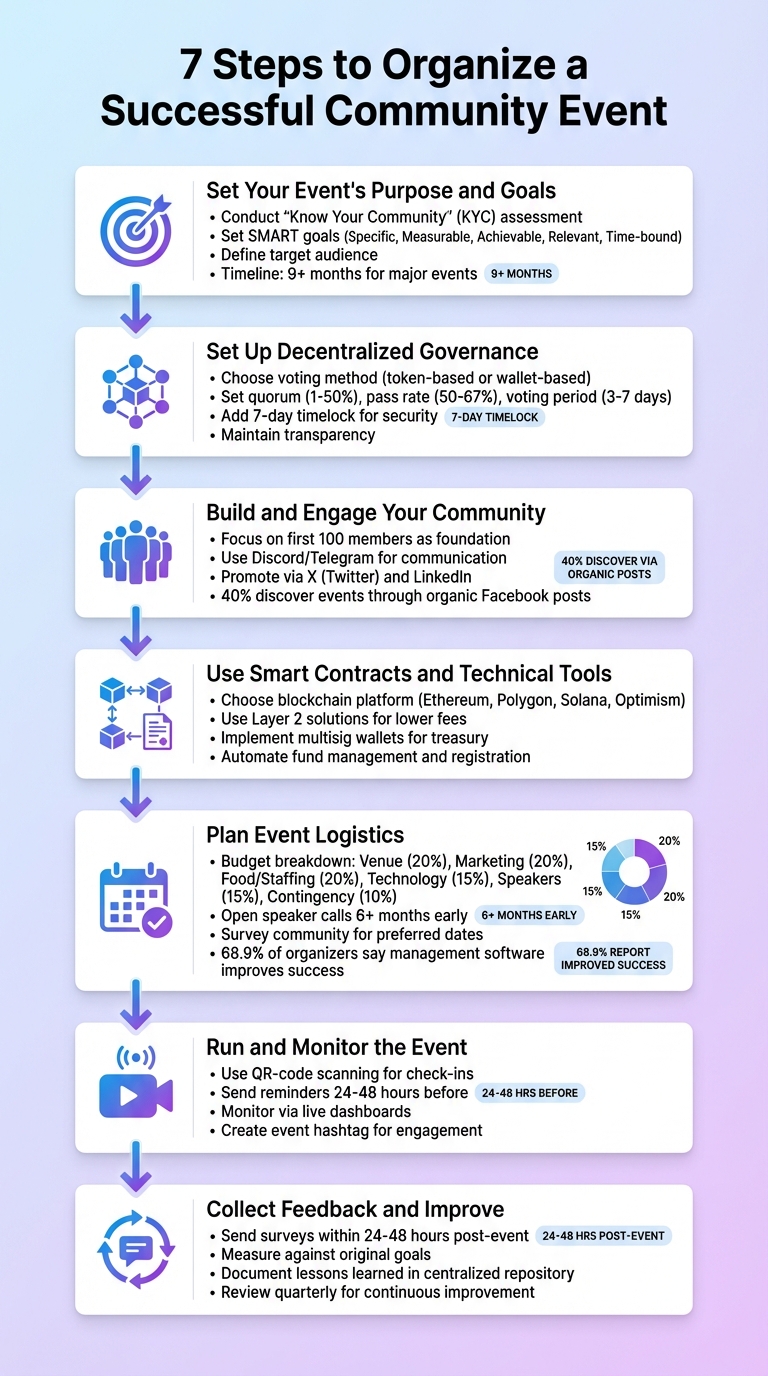
7 Steps to Organize a Successful Community Event
How to Plan, Prepare, and Implement a Community Event
sbb-itb-8eb1bfa
Step 1: Set Your Event's Purpose and Goals
Before diving into invitations or venue bookings, ask yourself: why are you organizing this event? As the Aragon community wisely notes:
A community without a clear purpose won't become a healthy community.
This step ensures you're addressing what your community actually needs - not just what you think they might want.
Pinpoint the Problem or Opportunity
Start by conducting a thorough "Know Your Community" (KYC) assessment to uncover genuine needs. Go beyond surface assumptions and figure out what’s truly missing in your ecosystem.
Look for existing activity in your niche. Audit local startups, browse Meetup.com and Luma for active groups, and explore platforms like X (formerly Twitter) and LinkedIn for advocates. This research helps you distinguish between a "scene" (individuals working in isolation) and a real "community" where collaboration and mutual support thrive.
To better understand your audience, visit digital spaces where they hang out - Reddit threads, Discord servers, LinkedIn groups. Engage directly with members to learn what they want from a community centered on their interests. In decentralized governance setups, these outreach efforts also help identify key stakeholders who can participate in decision-making.
As Alima, a Community Manager, explains:
The realization of what the community needs are is the most important thing to tackle first.
Set Clear, Measurable Goals
Once you've identified the problem or opportunity, turn it into SMART goals - Specific, Measurable, Achievable, Relevant, and Time-bound. Instead of vague objectives like "high attendance", aim for something concrete, such as "50+ registered participants" or "40% of active DAO members attending".
Align your goals with your organization’s broader mission. Work closely with founders or core team members to ensure the event supports the DAO’s overall purpose.
Goals can be binary (achieved or not) or quantifiable. For example, you might aim for 80% of surveyed attendees to report satisfaction with the event. Keep in mind, major community events often require at least nine months of planning, so build realistic timelines into your objectives.
Define Your Target Audience
Your purpose and goals only matter if you’re clear on who you’re trying to reach. Your target audience shapes everything: event format, promotional strategies, and the depth of the content.
Different groups need different approaches. For example, game nights work well for gamers, deep-dives attract developers, and listening parties engage music fans. Use tools like Google Forms or discussion channels to ask potential attendees about their interests and challenges.
In new organizations, the first 100 members are especially critical - they form the foundation of your community. As Emilie, a Community Writer, puts it:
The first 100 [members] are the seeds of your community's garden - how you plant them is very important.
Take your time onboarding these early members to ensure they align with the mission and can help build a thriving community.
Consider creating content tracks tailored to different experience levels, from beginners to seasoned professionals. If you’re targeting university students, reach out to technical or economics faculties through student clubs. For rural communities, prioritize central locations with parking; in urban areas, focus on venues near public transit.
| Event Type | Primary Goal | Best For |
|---|---|---|
| Local Meetup | Building networks & socializing | Like-minded individuals, informal education |
| Lecture/Panel | Public education | Simplifying complex topics for a broad audience |
| Workshop/Study Group | Skill development | Early adopters and active contributors |
| Hackathon | Innovation & hands-on projects | Developers and builders |
| Rally/Protest | Media attention | Amplifying a public message |
With a clear purpose and defined audience, you’re ready to move forward with establishing a decentralized governance framework.
Step 2: Set Up a Decentralized Governance Framework
To ensure your community collaborates effectively, establish a decentralized governance framework. This approach shifts decision-making power from a single organizer to the participants, promoting trust and inclusivity. By aligning decisions with your event's purpose, this structure allows the community to actively shape the event, ensuring it addresses their real needs.
Choose Your Voting and Consensus Methods
Start by selecting a voting model. Token-based voting (1 token = 1 vote) is common in larger decentralized groups, as it reflects financial investment. Meanwhile, wallet-based voting (1 wallet = 1 vote) ensures equal representation, making it ideal for smaller, identity-focused communities aiming to prevent concentrated influence.
Once you’ve chosen a model, define three key parameters:
- Quorum: Sets the minimum participation needed. For large groups, this might be as low as 1% of token holders to avoid stalemates, whereas smaller communities might require 50% or more.
- Pass rate: Determines the percentage of "yes" votes needed. Routine decisions often need a simple majority (50%+), while critical ones, like budget approvals, may require a super-majority of 67%.
- Voting period: Typically lasts 3–7 days, giving members across time zones ample time to participate.
For more nuanced decision-making, some communities explore advanced methods like quadratic voting, which weighs votes based on the square of tokens spent, or liquid democracy, where participants delegate their votes to trusted individuals.
Create Timelines for Proposals and Decisions
A clear process for proposals ensures smooth operations. Begin with informal brainstorming on platforms like Discord or Telegram, move to detailed discussions on Discourse, and finalize with an official vote. Use a proposal template to standardize submissions, including fields for title, funding, technical details, and KPIs. For events requiring lengthy planning - up to nine months - work backward from the event date to set deadlines for key milestones like venue selection, speaker approvals, and budget votes.
Introduce a seven-day timelock after voting. This delay allows time to address malicious proposals or dissenting opinions before funds are released or decisions are implemented.
A great example of this structured approach is the Cardano community’s Constitutional Convention in December 2024. Held in Buenos Aires and Nairobi, the three-day event brought together 450 attendees and 63 elected delegates from 51 countries. Their governance model received 95% delegate approval, and when the proposal went to on-chain ratification in February 2025, it achieved an 85% approval rate, surpassing the required 75%.
"We have so many people now in the ecosystem who care about governance, who know about the Constitution and have read it, and that's a really great foundation to start from."
- Danielle Stanko, Secretary, Cardano Civics Committee
Maintain Transparency and Open Participation
Transparency is critical in decentralized governance. Once you’ve established timelines, ensure all processes are well-documented and accessible. Use tools like Notion or GitHub to create a central repository for meeting notes, proposals, and decisions. This prevents information silos and helps new members quickly catch up. Tools like Zenao, with built-in governance features, can also simplify real-time tracking.
Early on, define clear rules: who can submit proposals, how payments are handled, and the code of conduct. These boundaries create a safe and inclusive environment.
Before managing large budgets, conduct a test vote with minimal or no funds. This trial run helps you identify and fix any issues with quorum settings, voting periods, or technical infrastructure before making high-stakes decisions.
| Governance Component | Common Standard | Purpose |
|---|---|---|
| Voting Period | 7 Days | Ensures members across time zones can participate |
| Quorum | 1% to 50% | Prevents a small group from dominating decisions |
| Pass Rate | 50% or 67% | Defines the level of agreement needed |
| Timelock | 7 Days | Adds a security buffer before executing decisions |
With your governance framework established, you’re well-positioned to engage your community and bring your event vision to life.
Step 3: Build and Engage Your Community
Once governance is in place, the next step is to bring together and engage the right people. A thriving community doesn’t just participate - it actively shapes decisions and drives success. To make this happen, you need a deliberate approach to recruitment, communication, and promotion. The goal? Build a network of like-minded individuals who are invested in your event’s mission and ready to contribute.
Find and Recruit Community Members
Start by defining exactly who you want in your community. Look for people who are naturally motivated - those who join because they want to learn, connect, or support a cause, not just for financial incentives.
"The first 100 are the seeds of your community's garden - how you plant them is very important."
- Emile Kormienko, Community Builder
Take your time onboarding your first 100 members. These early adopters set the tone for everyone who follows, so it’s worth investing in one-on-one video calls to understand their goals and ensure they align with your mission. If your event has a tech focus, consider reaching out to university departments, student organizations, and professors to tap into young, enthusiastic talent.
It’s also important to understand the difference between a "scene" and a "community." A scene consists of independent individuals or companies, while a true community is a network of people who collaborate and support one another.
Enable Collaboration Through Online Platforms
Once you’ve recruited members, the next step is to equip them with tools that encourage communication and collaboration. Engagement matters more than sheer numbers - it’s better to have 900 active participants in a group of 1,000 than a large but inactive roster. Use platforms like Discord or Telegram for real-time conversations, and tools like Notion, Trello, or Asana for managing tasks . For an all-in-one solution, platforms like Zenao combine governance, project management, and social features, making it easier to run your event and keep your community connected.
To create a sense of belonging, establish rituals like daily greetings, weekly calls, or icebreaker activities. A well-structured onboarding process with personal interaction can reduce drop-off rates. Clear guidelines for posting, handling proposals, and managing payments ensure your community feels safe and organized.
Promote Your Event Through Targeted Outreach
Promotion is where you generate buzz and connect with your audience. X (formerly Twitter) is a go-to platform for Web3 and tech events, while LinkedIn is ideal for reaching professionals and potential sponsors . Organic reach is powerful, too - 40% of users discover products or events on Facebook through unpaid posts.
Work with local startups, tech communities, and global organizations like DAOs to expand your reach and secure support, whether financial or in-kind. Partner with influencers who align with your event’s mission, and use newsletters, Web3 media outlets, and polished PR campaigns to gain visibility.
Build momentum by hosting smaller events - such as meetups or study groups - leading up to your main event. These smaller gatherings help establish trust and keep your community engaged. After each event, share highlights, photos, and takeaways to maintain interest and excitement for what’s next. You can also use strategies like waiting lists, ticket giveaways, or discounts to keep your audience eager to participate.
"Word of mouth is the strongest form of advertisement. A community engaged with meaningful interactions can become a sales team in disguise."
- Shawn, Community Builder at Aragon
Step 4: Use Smart Contracts and Technical Tools
Once your community is engaged and eager to participate, it’s time to set up the technical framework that enables decentralized event organization. Smart contracts are key here - they automate processes like fund management and registration in a way that's both efficient and transparent. This infrastructure ensures funds are tracked accurately and decisions are executed securely, all while maintaining the level of transparency that decentralized governance thrives on.
Choose the Right Blockchain Platform
Selecting the right blockchain platform is crucial for smooth operations and minimizing costs for participants. Platforms like Ethereum, Polygon, Solana, and Optimism are popular choices for supporting DAO tools. However, keep in mind that Ethereum's high gas fees can discourage participation. In such cases, Layer 2 solutions are a great alternative, offering lower transaction fees without sacrificing security.
Your choice of platform should align with the governance model you’ve already established. For instance, token-based voting works well for larger communities where financial stakes matter, while wallet-based voting (multisig) is better suited for smaller, identity-linked teams. If you’re planning to implement on-chain ticketing, focus on L2 networks to avoid situations where transaction fees exceed the ticket price.
"Mission and values (MV) create guidelines for all future decisions and bring alignment to contributor actions. MV defines what the roles are, what the tech stack is going to be, who gets what permissions, how governance should work, and much more." - Flowscience, Community Manager, MedDAO
Create Smart Contracts for Key Tasks
Smart contracts are the backbone of automating key event functions. For example, they can release funds automatically once a vote meets the required quorum and approval rate. This is especially helpful for managing budgets - community members can monitor expenditures in real-time using on-chain tools, ensuring full transparency .
Tools like Guild, Collab.land, and POAPs can streamline access control and attendance tracking. If your event is virtual and hosted on platforms like Decentraland, you can use "Scene Admin" smart items to manage video screens, switch streaming links, and moderate participants - all through a decentralized interface.
Before going live, conduct a test vote with minimal funds to ensure everything functions as expected.
Secure Your Systems and Reduce Risks
Security measures are vital for safeguarding your event’s technical setup. Use a multisignature wallet (such as Gnosis Safe or Squads) for treasury management. This setup requires multiple authorized members to approve any transaction, ensuring decisions aren’t controlled by a single individual . Adding a timelock period (e.g., seven days) after a vote passes but before execution can act as a safety net, giving the community time to intervene if necessary.
To avoid "whale domination", where a few individuals with large financial stakes control outcomes, consider quadratic voting - a system where the cost of votes increases nonlinearly - or reputation-based voting tied to non-transferable Soulbound Tokens. You can also use tools like Gnosis SafeSnap or the Zodiac Reality module to ensure that multisig transactions reflect the results of off-chain community votes.
Here’s a quick look at some key tools and their purposes:
| Tool Category | Common Choices | Purpose |
|---|---|---|
| Treasury/Multisig | Gnosis Safe, Squads | Securely manage and execute fund transfers |
| Voting (Off-chain) | Snapshot | Low-cost community signaling and sentiment checks |
| Voting (On-chain) | Aragon, Tally | Immutable, automated execution of decisions |
| Gating | Guild.xyz, Collab.Land | Restrict access based on token or NFT ownership |
If you’re looking for an all-in-one solution, platforms like Zenao offer a combination of governance, project management, and social tools. They also include DAO-vaults for managing crypto funds, reducing the need to juggle multiple tools.
Step 5: Plan Event Logistics with Community Input
Once you've established decentralized governance and implemented the necessary technical tools, it's time to focus on the practical side of things - planning the event itself. This step connects the decisions made during governance votes to the actual execution of the event. It covers everything from budgeting and timelines to ensuring transparency and keeping everyone in the loop.
Distribute Budget and Resources
When budgets are created collaboratively, the results are often more precise. Why? Because the people directly involved in the work are the ones determining the costs and priorities. By allowing community members to define their own spending needs and justify them, you not only create a sense of ownership but also foster a better understanding of financial trade-offs.
Start by dividing expenses into two categories: "absolutes" (essentials like venue deposits and insurance) and "fun additions" (extras like premium swag or added entertainment). This breakdown helps the community make informed choices, especially when funds are tight. A typical event budget might look like this: Venue (20%), Marketing and Promotion (20%), Food, Beverage, and Staffing (20%), Event Technology (15%), Speakers and Entertainment (15%), and a Contingency Fund (10%). That contingency fund is key - it gives you a safety net for unexpected costs.
Set clear rules for how funds are handled. Decide who can submit funding proposals, who approves payments, and how much can be spent without requiring a full community vote.
“Decentralized budgeting, if done well, empowers members of the entire management team to make their own cases and tell their stories directly by entering their budgets into the system.” - Mike McCann, Finance Director at OpenGov
Once the budget is locked in, shift your attention to scheduling and organizing the event's activities.
Manage Timelines and Logistics
Timing can make or break an event. Survey your community to find out their preferred dates and times. Be sure to avoid overlaps with major industry conferences or local holidays. For speaker submissions or program proposals, open the call at least six months before the event to ensure quality and alignment with community interests.
When choosing a venue, consider accessibility. Urban locations should have public transit options and comply with ADA standards, while rural venues need ample parking. Before finalizing a location, gather input from your community to address specific needs and preferences. Announce a "save-the-date" early to gauge interest and get feedback on what attendees are most excited about.
Use backward mapping to create your timeline. Start with the event date and work backward to identify when each task needs to be completed. Assign a logistics lead - someone experienced in event planning who can anticipate and address potential issues. If your budget is tight, look for in-kind partnerships with local businesses. For example, a nearby restaurant might donate catering, or a local printer could cover the cost of flyers. These arrangements not only save money but also strengthen community ties.
Track Progress with Transparency Dashboards
As your plans come together, keeping track of progress is crucial. Use platforms like Notion, Trello, Asana, or Google Sheets to monitor tasks and ensure everyone is on the same page.
For financial tracking, tools like Spendesk, FreshBooks, or blockchain-based options like Zenao's DAO-vaults provide real-time visibility into spending.
“Responsiveness is one of the best qualities of decentralized teams. When employees know that they're trusted to make on-the-fly resolutions... you have a better shot of reacting well to crisis situations.” - Patrick Whatman, Spendesk
For attendance, consider QR-code check-ins to manage real-time tracking. Set milestones based on your timeline and maintain regular communication with partners and vendors. It's worth noting that 68.9% of organizers believe event management software significantly improves overall success. Choosing the right tools early on can prevent last-minute chaos as your community and event grow.
Step 6: Run and Monitor the Event in Real-Time
The big day has arrived, and it’s time to put your plans into action. With your decentralized tools and governance framework in place, your focus shifts to managing the event on the ground. This means ensuring smooth operations, addressing issues as they arise, and keeping everyone engaged. The goal? To create an enjoyable and seamless experience while staying adaptable to any surprises.
Finalize Participant Registration
A chaotic or slow registration process can sour the mood before the event even begins. To avoid this, streamline check-ins with digital tools like QR-code scanning for quick and trackable entries.
"Digital check-ins and QR-code scanning to streamline entry and track attendance in real time." - Nicole Murta, Content Creator, Timely
Make sure your ticketing system supports both traditional payment methods and cryptocurrency. Send a final reminder 24–48 hours before the event, including login links for virtual sessions or practical details like directions and parking for in-person venues. Assign team members or volunteers to handle registration desks and provide technical support for digital access. This ensures any entry issues are resolved quickly. Before the doors open, test critical systems like QR scanners, AV equipment, and access codes to avoid last-minute hiccups.
Once registration is running smoothly, you can turn your attention to monitoring the event in real time.
Monitor and Fix Issues Quickly
After attendees are checked in, the focus shifts to identifying and resolving any problems as they come up. Use the technical setup you established earlier (Step 4) to stay on top of things. Live reporting dashboards, such as those offered by Timely or Zoom, allow you to track registrations, participation, and Q&A activity throughout the event. For internal communication, set up a private channel on platforms like Telegram, Discord, or Zoom Team Chat to coordinate with your team without disrupting the event.
Hold a quick pre-event meeting with your team to confirm roles, review the schedule, and go over contingency plans for any technical or logistical issues. If you’re hosting a virtual event, utilize the "practice session" feature in your webinar platform to let hosts and panelists test their audio and video setups before going live. Assign clear points of contact for emergencies to ensure swift action when needed. For decentralized communities, tools like Aragon Voice can be used to take quick polls and address concerns or adjust strategies mid-event.
Keep the Community Engaged During the Event
Engagement is key to a successful event. Incorporate interactive elements like "Open Space" sessions, where attendees lead their own discussions, or host "Ask Me Anything" (AMA) bars and "Birds of a Feather" lunch tables to bring together people with shared interests. For those unable to attend in person, keep them in the loop with live blogging, session recaps, and real-time interviews with speakers.
Create a unique event hashtag and encourage attendees to use it across platforms like X (formerly Twitter). This helps participants connect and follow the event’s storyline. If your event operates on a decentralized framework, you can use simple tools like Discord emoji reactions to gauge community sentiment quickly during sessions. At the end of each day or major segment, share summaries highlighting key activities and any surprises to keep the energy high. Regularly post photos and short video clips from both organizers and attendees to maintain a sense of connection and excitement.
"Give members a frictionless and informative experience to keep participation levels high." - Aragon
Step 7: Collect Feedback and Improve Future Events
Once your event wraps up, it’s time to gather feedback and turn those insights into a roadmap for better events down the line. By capturing what worked and what didn’t, you can refine your approach and ensure continuous improvement. Documenting feedback also aligns with the decentralized approach, encouraging growth at every stage.
Run Post-Event Surveys
Send out surveys within 24–48 hours after the event to capture participants’ fresh impressions. Online tools like SurveyMonkey or Typeform are great for this, allowing you to combine numerical ratings with open-ended questions. This mix encourages attendees to provide both measurable feedback and detailed suggestions.
For decentralized communities, platforms like Aragon Voice can help you run transparent, quick polls to gauge overall sentiment. Additionally, one-on-one interviews with key stakeholders - like speakers, sponsors, or highly engaged attendees - can provide deeper insights. To encourage responses, send personalized thank-you emails along with your feedback request. Tailor these emails based on roles or ticket types to make them feel more relevant. Don’t forget to collect testimonials from respected community members during this process; these can double as promotional content for your next event.
Measure Results Against Your Goals
Evaluate your event’s performance by comparing it to the goals you set in Step 1. As the saying goes, “What gets measured gets managed”. Dive into the numbers: ticket sales, check-in rates versus registrations, and social media engagement metrics are all key indicators. For decentralized communities, track metrics like voter participation in governance proposals or how many new members stayed engaged after onboarding.
Create a detailed debrief report that highlights both wins and challenges. For example, note any last-minute venue changes or budget issues to avoid repeating similar problems in the future. Use event management platforms to generate reports showing where ticket sales came from and which promotional strategies worked best. If you had sponsors, calculate their ROI using a dedicated template to demonstrate how the event met their business goals. Share a "Top 10 Learnings" summary with your community to show that their input matters and is shaping future planning.
Record Best Practices and Lessons Learned
Keeping a clear record of lessons learned is key to improving future events. Don’t wait until the event is over - document insights throughout the entire planning process. Use tools like Notion, Trello, or Google Docs to create a centralized, searchable repository that everyone on the team can access. Organize these findings by functional areas, such as catering, AV setup, or registration, to make future referencing easier.
Focus on refining processes rather than pointing out individual mistakes. This approach fosters a blame-free environment where team members feel safe sharing honest feedback.
"Lessons Learned should be continuous and constructive... Focus on processes, not individuals, to foster a blame-free culture".
To dig deeper, use techniques like the "Five Whys" to identify root causes and develop actionable recommendations. Assign clear owners to follow up on each action item. Review and update your repository quarterly to keep it relevant and accurate. Finally, share updates on how feedback has been applied to maintain trust and momentum for future events.
Conclusion
Creating decentralized events requires building trust, encouraging collaboration, and empowering your community to take ownership.
The key to success lies in establishing a strong community foundation rather than relying on a loose network of individuals. As ethereum.org explains:
A successful Ethereum conference is built on an active and engaged community. If you already have one, you're ahead of the game - but if you don't, the essential pre-step is to build that foundation.
If your community is still in its early stages, consider starting with smaller, informal gatherings like meetups or study groups. These smaller efforts can help lay the groundwork for scaling up to larger events, such as conferences.
What sets decentralized events apart is their emphasis on transparency and open participation. Allowing the community to see how funds are allocated, vote on major decisions, and contribute ideas fosters a sense of ownership. This not only deepens engagement but also helps distribute responsibilities, reducing the risk of organizer burnout. Transparency also creates opportunities for meaningful feedback, fueling continuous improvement.
By establishing a strong feedback loop, you can turn individual events into stepping stones for future success. This process strengthens community ties and builds a knowledge base that benefits everyone involved.
Focus on understanding your community’s unique needs, encourage active participation, and create events that leave a lasting impact well beyond the closing remarks.
FAQs
How does decentralized governance make community event planning more effective?
Decentralized governance gives everyone in a community a voice when it comes to planning, funding, and managing events. By relying on transparent, blockchain-based decision-making systems - like token-based or reputation-based voting - it creates a more inclusive process that aligns with the group’s shared objectives. This method builds trust, keeps everyone accountable, and lowers the chances of decisions being made that don’t reflect the community’s true needs.
Some standout benefits include open proposal submissions for idea-sharing, community-driven resource allocation through voting, and automated tools like smart contracts for payouts or logistics. These features not only keep members actively involved but also simplify event management and allow for adjustments when necessary, helping ensure a smooth and collaborative outcome.
How do smart contracts help manage community events?
Smart contracts are game-changers when it comes to managing community events, particularly in decentralized setups like DAOs. They take over repetitive tasks by automating essential processes - everything from setting event rules and handling registrations to managing payments and distributing rewards. And all of this happens without relying on middlemen.
These contracts bring a level of transparency and trust that simplifies coordination, ensures agreements are followed, and allows decisions to be carried out seamlessly. The result? Less manual work, smoother collaboration, and an event that's both fair and secure from start to finish.
How can I effectively engage and keep community members involved?
Building meaningful engagement begins with a clear and shared purpose that helps members align with the community’s goals and see how they can actively contribute. When people feel like they belong, they’re more likely to participate and stay committed. Tools like Discord, forums, or newsletters are great for keeping communication open - use them to share updates, gather feedback, and build trust within the group.
After hosting events, follow up quickly with thank-you messages, event summaries, and actionable next steps. This could mean sparking a discussion, sharing a poll, or inviting members to volunteer for future activities. Recognizing individual contributions and celebrating group successes can go a long way in making members feel appreciated and motivated to stay engaged.
For ongoing connection, focus on creating opportunities that are easy and enjoyable. Casual chats, collaborative projects, or even gamified rewards can keep things fun and interactive. Regular touchpoints, like weekly check-ins or monthly challenges, add energy and consistency to the community. And by planning inclusive events, you ensure everyone feels welcome and encouraged to take part.