

Governance
5 Principles of Quadratic Voting for DAOs
How quadratic voting lets DAOs express preference intensity, curb whale dominance, resist Sybil attacks, and allocate treasury resources more fairly.

January 12th, 2026
•
11 min read
5 Principles of Quadratic Voting for DAOs
Quadratic voting (QV) is a voting system where the cost of votes increases quadratically, making it harder for large token holders to dominate decisions. This method helps DAOs balance influence among members, prioritize community interests, and manage resources effectively. Here’s a quick breakdown of its key principles:
- Expressing Intensity, Not Just Preference: Members allocate "voice credits" to show how strongly they feel about issues, with additional votes costing more (e.g., 3 votes = 9 credits). This forces voters to prioritize their choices.
- Limiting Whale Influence: QV reduces the power of large token holders by using a square-root formula for voting power, ensuring smaller stakeholders still have a voice.
- Preventing Fake Accounts: Identity verification tools like Gitcoin Passport combat Sybil attacks by ensuring each voter is unique without compromising privacy.
- Efficient Resource Allocation: Members use credits to prioritize funding or other resources, revealing what the community values most.
- Implementation Challenges: DAOs must educate members, integrate compatible tools, and address risks like collusion or technical issues.
DAOs can start small with QV, using it for decisions like ranking proposals or allocating funds. Tools like Gitcoin and Civic Pass make implementation smoother, ensuring fairness and efficiency in governance.
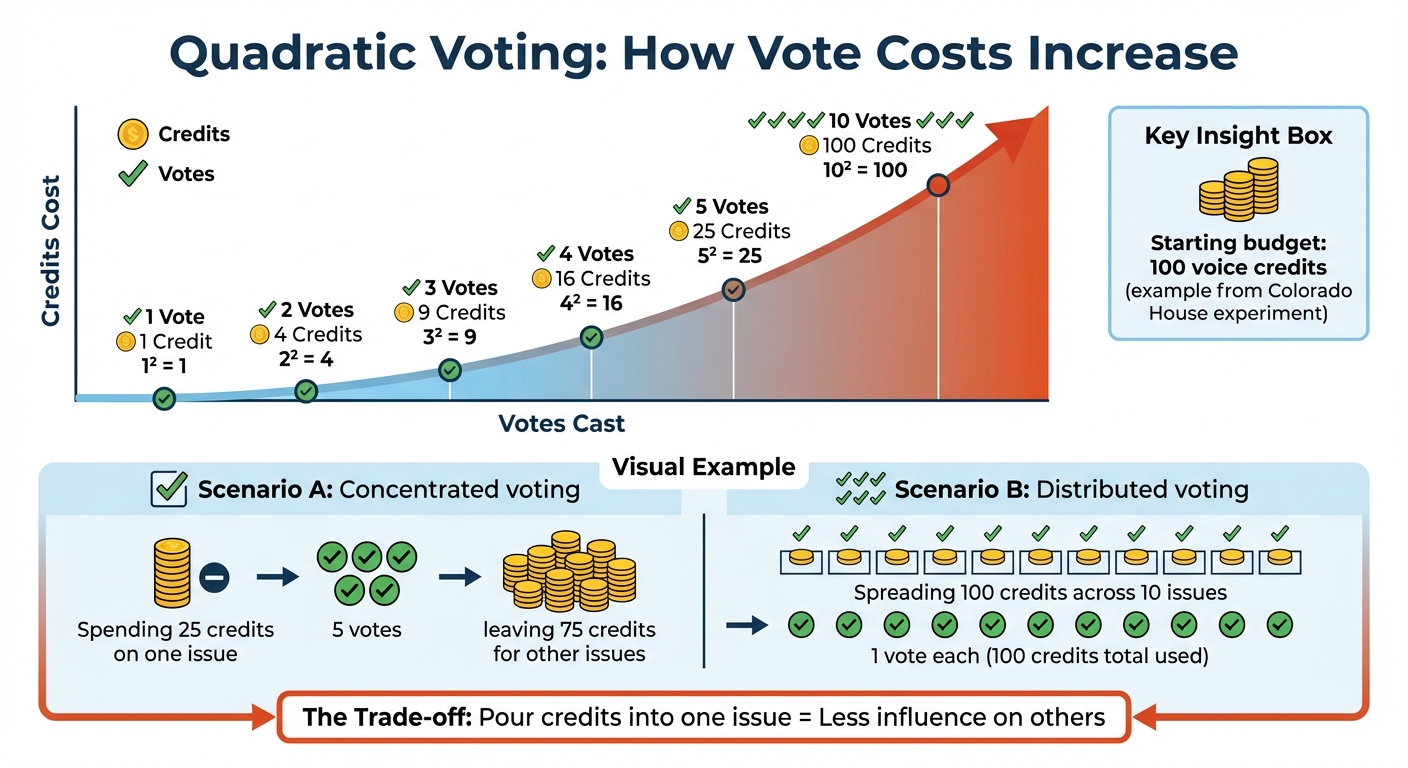
How Quadratic Voting Works: Cost vs Votes Explained
The Hidden Problem with 'One Person, One Vote' & Why DAOs Are Using This Smarter System
1. Showing How Much You Care, Not Just Yes or No
Traditional voting systems often limit your choices to a simple "yes" or "no", leaving no room to express how strongly you feel about an issue. Quadratic voting flips this idea on its head by giving DAO members a budget of voice credits to distribute across various proposals. Here's the twist: the cost of voting increases quadratically. For example, casting 3 votes on a single proposal costs 9 credits, while 5 votes will set you back 25 credits.
This system introduces an important trade-off. If you pour a large portion of your credits into one issue, you'll have much less influence on others. A real-world example of this happened in April 2019, when the Colorado House of Representatives experimented with quadratic voting on 107 legislative bills. Each of the 41 Democratic lawmakers was given 100 virtual tokens. The Equal Pay for Equal Work Act (Senate Bill 85) came out on top with 60 votes, but interestingly, no one spent their entire budget on a single bill.
"Voters receive budgets of 'voice credits,' which they allocate to different questions on the ballot to signal the intensity of their conviction."
The mechanics of quadratic voting make it especially effective. While your first vote costs just 1 credit, each additional vote costs more - your fourth vote, for instance, requires 16 credits. This escalating cost ensures that votes are meaningful. You can’t just mark everything as "strongly support" like you would in a typical survey. Every decision you make comes at the expense of your ability to influence other issues, forcing voters to prioritize what they care about most.
Platforms like Zenao demonstrate how this works in practice. Even a small, passionate group can have a big impact on decisions - whether it's deciding on workshop topics, resource allocation, or event programming. This approach ensures that active, engaged members can shape outcomes that matter to them, while also safeguarding minority opinions from being overshadowed by larger token holders.
2. Reducing Whale Power While Keeping Stake Relevant
DAO governance often faces the challenge of whale domination. Under a linear voting system, those with large token holdings can easily overshadow smaller stakeholders. A stark example of this occurred in 2022, when an attacker exploited a flash loan to take control of the Beanstalk DAO, approving a proposal that resulted in the theft of $182 million.
Quadratic voting offers a way to address this imbalance. By applying a square-root formula to voting power, it reduces the influence of large token holders. For instance, instead of 100 tokens granting 100 votes, they provide just 10 votes (√100 = 10). Meanwhile, 99 individual members with 1 token each retain 1 vote apiece, collectively adding up to 99 votes - enough to outweigh the whale's influence.
"Quadratic voting aims to address several challenges in blockchain governance, such as preventing a single entity or a small group from amassing a majority of tokens to exercise undue control or censorship."
- Mashal Waqar, Gitcoin
This system doesn’t disregard larger stakes entirely - it simply ensures they don’t dominate. For example, 25 tokens translate to 5 votes, while 4 tokens equate to 2 votes. This approach creates a middle ground between plutocracy, where wealth dictates decisions, and pure democracy, where stake size is irrelevant.
The Fantom Foundation showcased this balance during its distribution of 750,000 FTM tokens through the Gitcoin Grants Stack. Using quadratic voting and a specialized GitcoinVote token, the community allocated funds across nine projects in a fair and democratic manner. Large holders still had influence, but the system ensured all stakeholders had a meaningful voice in the decision-making process.
3. Identity Verification and Preventing Fake Accounts
One of the biggest challenges with quadratic voting is the Sybil attack. Here's how it works: because the cost of votes increases quadratically, someone could manipulate the system by creating multiple fake accounts. For example, instead of spending 100 tokens for 10 votes from a single account, a bad actor could create 10 accounts and pay just 1 token per vote. This loophole essentially turns quadratic voting into a one-token-one-vote system, undermining its fairness.
"Participation of a fake identity in the voting process could lead to unfair results, which is why proof of identity is a key necessity with quadratic voting."
- Limechain
Decentralized identity solutions offer a way to address this issue without requiring users to disclose personal information. Tools like Gitcoin Passport assign scores based on on-chain activity and social verification, helping filter out bots while preserving user privacy. For instance, the Fantom Foundation used this method to distribute 750,000 FTM tokens across nine projects. To participate in the quadratic voting round, users needed a qualifying Gitcoin Passport score. Similarly, Civic Pass ensures that each participant is unique. These solutions significantly reduce the risk of fake accounts by leveraging decentralized identity technologies.
Another approach involves verifiable credentials - cryptographic proofs that confirm a user's unique identity. These credentials are stored in private wallets rather than centralized databases, allowing users to stay pseudonymous while proving they are real individuals. Some systems even go a step further, linking one biometric marker, like a facial scan, to a single digital identity. This ensures that each person gets only one vote, maintaining the integrity of the process.
DAOs can also strengthen security by requiring specific on-chain actions, such as holding a particular NFT for a set period of time. Combining identity verification with participation thresholds makes it much harder for a small group of fake accounts to push through harmful proposals.
sbb-itb-8eb1bfa
4. Managing Budgets and Treasury Resources
One of the biggest hurdles for DAOs is figuring out how to fairly distribute limited treasury funds across a range of competing proposals. Quadratic voting offers a clever way to tackle this issue by encouraging members to make deliberate trade-offs. Instead of voting on each proposal separately, DAOs can group related proposals into a single ballot and give each member a fixed budget of voice credits. Members then use these credits to prioritize projects, with the cost of additional votes increasing exponentially. This system sheds light on how voting costs influence funding decisions.
Here’s how it works: by requiring members to allocate their limited votes strategically, the method reveals what the community values most.
Quadratic voting also levels the playing field by preventing wealthy token holders from dominating decisions. For example, casting 10 votes on a single proposal costs 100 credits, but spreading 100 credits equally across 10 proposals results in just 1 vote per proposal. Glen Weyl from Microsoft summed it up well:
"Quadratic voting... draws out exactly how much you care. You are incentivized to have a little bit of influence on a lot of things. But if you care a ton about certain things, then it makes sense to spend your credits for those particular types of things".
The Fantom Foundation showcased this approach using the Gitcoin Grants Stack. They allocated 750,000 FTM tokens across nine curated projects through quadratic voting. To make the process more inclusive, they introduced a valueless GitcoinVote (GCV) token for that round. This allowed the community to decide which builders received funds generated from transaction fees, based on the intensity of their preferences rather than the size of their wallets.
Interestingly, this concept isn't limited to money. It can also be applied to other scarce resources like development hours, meeting agendas, or product roadmap decisions. By treating any finite resource as a "budget" and using voice credits for allocation, DAOs can get a clearer sense of what truly matters to their members.
5. Implementation Methods, Real Uses, and Common Problems
To implement quadratic voting in DAOs, specialized plugins are needed. These plugins calculate voting power based on the square root of tokens and incorporate identity verification tools, such as Civic Pass or Gitcoin Passport, to prevent users from splitting tokens across multiple accounts. Proper integration of these tools is crucial to maintain the integrity of the voting process. For instance, Dabra's Quadratic Voting Plugin simplifies the process by automating these calculations.
Quadratic voting has already been applied in various real-world scenarios. Platforms like Zenao utilize it for event planning and community governance, helping members prioritize workshops, activities, or festival features that matter most to them. Similarly, the Codeless Conduct Web3 Hackathon used this voting method to evaluate submissions and achieve decentralized consensus on winners. These examples demonstrate how adaptable quadratic voting can be across different use cases.
However, voter education is essential for the system to succeed. Quadratic voting introduces a cost structure that differs from traditional voting - 1 vote costs 1 credit, 2 votes cost 4 credits, and 3 votes cost 9 credits. This unfamiliar approach requires members to learn and adapt. As Colony points out:
"Ensuring members understand this more complex system is crucial for its success in DAO governance, requiring education and adaptation".
Technical challenges also pose difficulties. DAOs must ensure their governance software is compatible with quadratic voting plugins. If the software version is incompatible, it could lead to decision deadlocks that are difficult - or even impossible - to resolve. Additionally, transparency in voting can create risks of collusion or bribery, as it may incentivize voters to act in biased ways. Tools like Minimal Anti-Collusion Infrastructure (MACI) are being developed to address these vulnerabilities, though they are not yet widely adopted.
Despite these hurdles, successful implementations highlight the potential of quadratic voting to revolutionize decision-making. For example, DoraHacks has distributed about $18 million in prizes to nearly 3,000 projects using quadratic governance systems. Similarly, Gitcoin Grants has directed over $60 million to more than 3,000 open-source projects as of 2022. These achievements underline the importance of careful planning and execution. Starting small, providing clear tutorials, and leveraging established frameworks like the Gitcoin Grants Stack can help DAOs minimize technical challenges and maximize the benefits of this innovative voting method.
Conclusion
Quadratic voting introduces a fresh approach to governance for DAOs by addressing some of the limitations of traditional voting systems. It allows members to express not just their preferences but the intensity of those preferences. By making additional votes quadratically more expensive, it helps curb the influence of large token holders while still keeping token stakes relevant. However, its effectiveness relies heavily on robust identity verification to prevent Sybil attacks and on proper allocation of resources to reflect the community's true priorities.
Real-world applications have already shown its potential. For instance, Gitcoin Grants has successfully used quadratic principles to direct substantial funding toward open-source projects. These examples highlight how, when thoughtfully implemented, quadratic voting can reshape the way communities make decisions.
For DAOs grappling with challenges like the dominance of large stakeholders or the underrepresentation of minority voices, quadratic voting could provide a solution. Ask yourself: Does your DAO face issues where the strength of individual preferences should play a role in decision-making? If so, this system is worth exploring.
To get started, DAOs can test quadratic voting on smaller, less critical decisions - like ranking feature requests or prioritizing event topics. Educating members on how the cost curve works (e.g., 1 vote = 1 credit, 2 votes = 4 credits, 5 votes = 25 credits) is essential. Additionally, tools like Gitcoin Passport can help ensure strong identity verification, maintaining the integrity of the system.
While quadratic voting may not suit every DAO, it offers a sophisticated way to balance individual conviction with collective wisdom. For communities seeking a more nuanced and representative governance model, this method is a compelling option to consider. The question is - are DAOs ready to embrace its complexity and potential?
FAQs
How does quadratic voting ensure fair decision-making in DAOs, even with large token holders?
Quadratic voting introduces a way to balance influence by making voting power grow slower than the number of tokens someone owns. Instead of a direct one-to-one relationship, voting power increases with the square root of the tokens held. In practice, this means that casting extra votes becomes increasingly costly for those with large token holdings.
This system helps curb the dominance of major token holders, promoting fairer decision-making. It ensures that smaller participants in decentralized autonomous organizations (DAOs) can still have a meaningful say in governance, creating a more inclusive and balanced approach to collective decision-making.
How can quadratic voting systems prevent fake accounts?
To make sure quadratic voting mirrors the true preferences of a community, tools like Proof-of-Personhood (PoP) systems play a key role. PoP ensures that each voter is a unique individual without exposing their personal information. This creates a Sybil-resistant system, effectively blocking bots and duplicate accounts. As a result, every vote is tied to a real person, preserving the fairness of the voting process.
Additional safeguards include on-chain reputation systems and token-gating. These methods set specific requirements for voters, such as holding a minimum token balance or having prior involvement in the community. Together, these strategies work to protect the integrity of quadratic voting within DAOs.
What are the best ways for DAOs to overcome technical challenges when implementing quadratic voting?
To make quadratic voting (QV) work effectively in a DAO, tackling technical challenges with smart planning and dependable tools is key. For instance, smart contracts can handle the square-root calculations needed to convert voter credits into votes. This not only ensures precision but also cuts down on the risk of human errors. Pair this with a user-friendly interface that displays credit balances and the cost of each additional vote, and members can participate with clarity and confidence.
Addressing Sybil attacks - where individuals create fake identities to game the system - is equally important. DAOs can counter this by using on-chain identity verification tools to confirm that each voter is unique, safeguarding the fairness of the process. Adding measures like credit limits and spending caps can further strike a balance between encouraging participation and maintaining security. With these combined efforts, quadratic voting can become a secure, transparent, and accessible method for all DAO members.