

Governance
Low participation: 8 solutions to mobilize people
Proven tactics to boost participation in DAOs: simplify governance tools, use templates, run events, enable delegation, reward engagement, track metrics.

January 11th, 2026
•
19 min read
Low participation: 8 solutions to mobilize people
Low participation in decentralized organizations weakens decision-making and invites risks. Here’s how to tackle it:
- Simplify Governance Tools: Platforms like Zenao.io streamline voting, proposals, and event management.
- Clear Templates: Provide structured formats for proposals to lower entry barriers.
- Organize Events: Host workshops and calls to foster direct connections.
- Delegated Voting: Let members assign their votes to trusted representatives.
- Reward Engagement: Use tokens or recognition to incentivize participation.
- Track Metrics: Monitor participation rates and proposal outcomes to identify issues.
- Mobile Accessibility: Ensure governance tools work on smartphones for broader access.
- Collect Feedback: Regularly gather input to refine strategies.
These steps address barriers like complexity, time costs, and lack of motivation, ensuring greater involvement and stronger governance.
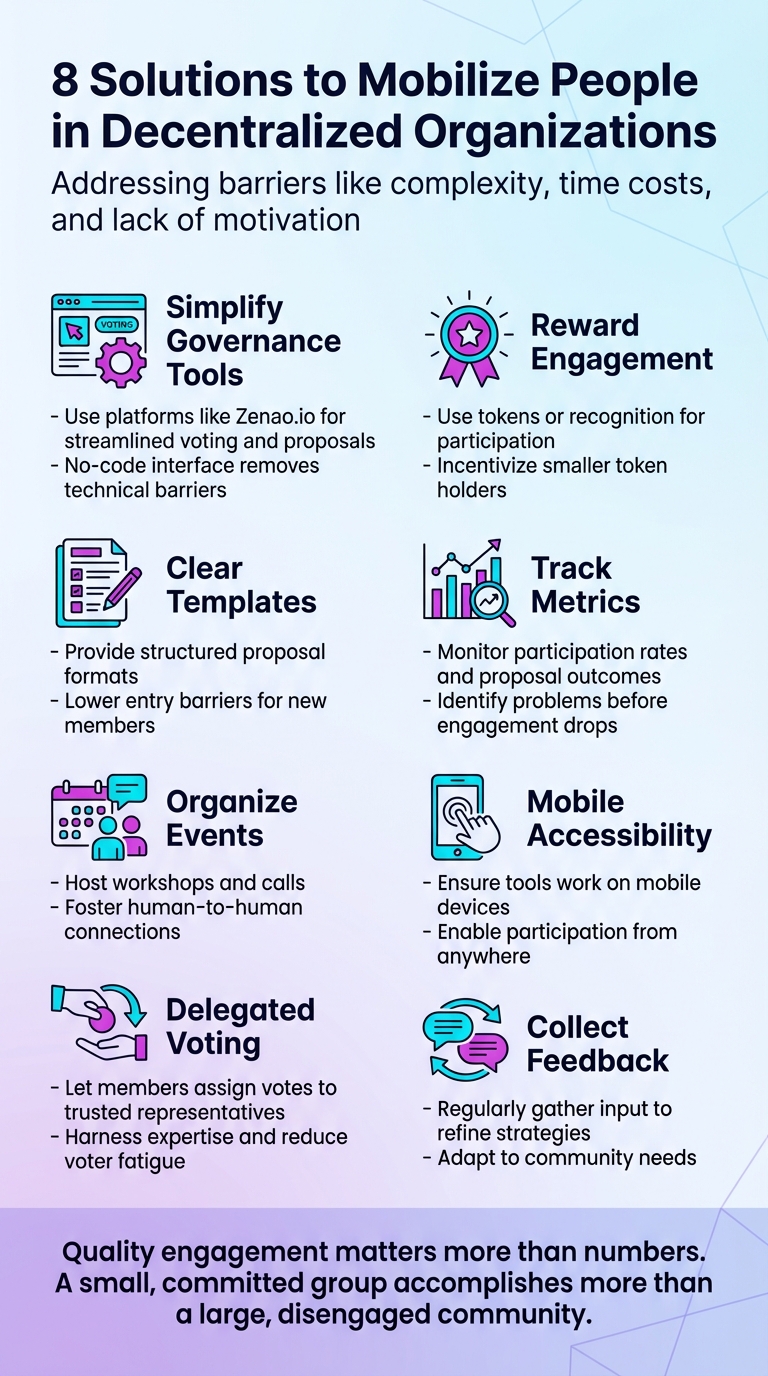
8 Solutions to Increase Participation in Decentralized Organizations
DAO Governance Explained: How Voting & Proposals Work in DAOs
Understanding Why People Don't Participate
Engagement barriers like friction, complexity, and feelings of powerlessness often discourage participation. These challenges aren't necessarily rooted in apathy but are structural issues that weaken effective governance and demand targeted solutions.
One major hurdle is the "cost of voting" - the time, focus, and mental energy needed to review and evaluate proposals. When proposals are presented in a disorganized way, with inconsistent voting periods or overly complicated language, members can quickly feel overwhelmed.
In one-token–one-vote systems, smaller token holders often feel their voices are drowned out by larger holders. As highlighted by Aragon:
Small token holders may feel lower motivation to participate... the whales might not vote in the best interest of the smaller token holders.
This dynamic can lead to a "free-rider" problem, where some members benefit from a DAO's progress without actively contributing to its governance.
Communication issues make matters worse. Many organizations struggle to effectively notify voters about upcoming decisions or maintain direct contact with them. Privacy concerns, such as fears of being identified through KYC requirements, further discourage participation. On top of that, technical challenges - like complex blockchain interfaces and the need for digital literacy - create additional barriers.
Analytics tools offer a way to address these problems. By analyzing on-chain data, organizations can better understand the true costs of participation and identify behaviors like vote herding. For instance, in November 2023, researchers Andrew B. Hall and Eliza R. Oak studied 1.2 million wallet addresses in the Optimism ecosystem following a $28 million token distribution to over 300,000 participants. They found that reward schemes had a more pronounced impact on smaller token holders. Analytics can also uncover patterns, such as where participants drop off during the voting process or which proposal formats cause confusion. These insights are invaluable, as noted by Ethan Bueno de Mesquita and Andrew Hall:
The resulting data would be valuable for understanding governance more generally because, as a byproduct of its design, the mechanism produces data on the distribution of voting costs.
1. Use Zenao.io for Governance and Event Management
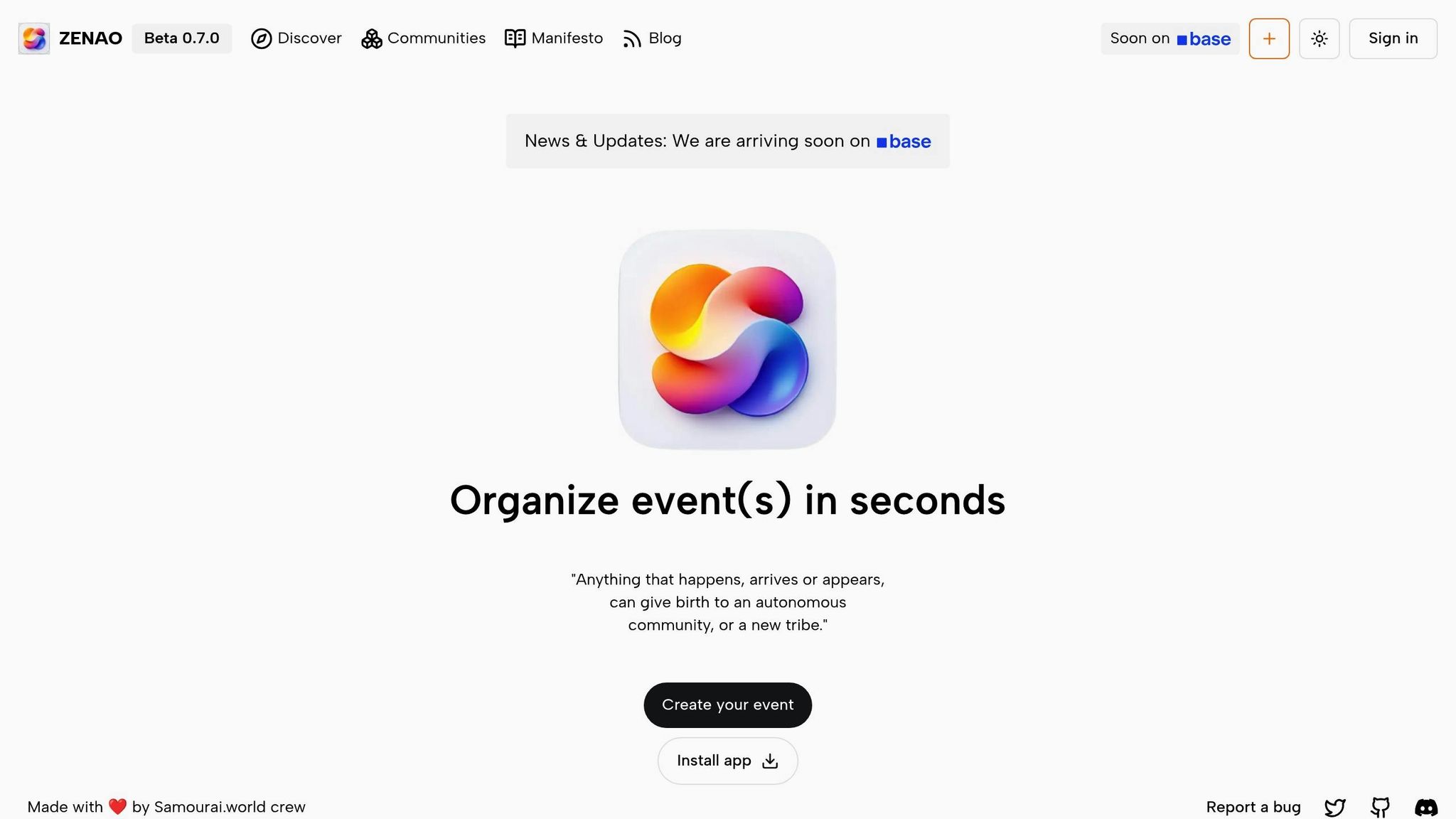
Breaking Down Barriers to Participation
Zenao.io makes it easier for everyone to get involved in decentralized governance by removing technical hurdles. With its no-code interface, communities can launch on-chain actions, manage treasuries, and create proposals - all without requiring advanced technical skills. This approach addresses one of the biggest challenges for non-technical participants in decentralized ecosystems.
The platform also offers flexible voting systems, allowing DAOs to choose between token-based voting (where 1 token equals 1 vote) or wallet-based voting (where 1 wallet equals 1 vote). This adaptability helps tackle voter apathy and ensures that decision-making isn’t dominated by a small group of highly active participants. By combining these features, Zenao.io seamlessly integrates governance and event management into a single, user-friendly platform.
Simplifying Governance and Event Management
Zenao.io streamlines the process of organizing events and governance votes by offering tools like digital ticketing, scanning, messaging, polls, and media sharing - all in one place. This makes it easier for communities to manage decentralized activities without juggling multiple tools or platforms.
Built to Grow with Your Community
As communities expand, decision-making often becomes slower and more complex. Zenao.io is designed to scale alongside these growing needs. Its modular DAO architecture, upcoming DAO-vaults for managing crypto funds, and customizable templates ensure that governance structures can evolve as the community grows. Whether you're managing a small group or a large, diverse community, Zenao.io provides the tools to keep things running smoothly.
2. Provide Clear Governance Templates
Effectiveness in Increasing Participation
Breaking down barriers to participation often starts with addressing the challenge of getting started. Clear governance templates offer a solution by guiding members through the proposal process step by step. Without such guidance, many members may feel overwhelmed by a blank page and abandon their ideas altogether. A well-structured template ensures that every proposal includes key components like the title, summary, financial considerations, success metrics, and team details.
"A proposal structure is what needs to be included in the body of each proposal to be considered and voted on by the DAO. This ensures all proposals provide the information necessary for the community to make a decision." - Aragon
A great example of this in action is the Cardano ecosystem. In February 2025, after months of global workshops and collaboration with elected delegates, Cardano ratified its first governing constitution with an impressive 85% on-chain approval rate. This milestone highlights how clear governance structures can drive participation and engagement.
Ease of Implementation in Decentralized Ecosystems
For templates to be effective, they must be easy to access and use. Consider placing them in highly visible locations, such as pinned forum posts, dedicated Notion pages, or directly within your governance platform. A simple starting structure might include sections like Motivation, Technical Specifications, Funding Request, and Success Metrics/KPIs. Overcomplicating the process early on can discourage participation, so it's better to keep things straightforward, especially for newer communities.
To ensure members feel comfortable with the templates, you could hold a "tester vote" with minimal stakes. This allows participants to practice using the format and identify areas that might need clarification. Assigning a governance lead to review and update templates quarterly based on feedback keeps them relevant and aligned with the community's evolving needs. Additionally, setting a low quorum - many DAOs use a 1% minimum - can prevent governance deadlocks and encourage more proposals to advance.
This approach not only simplifies onboarding for new members but also creates a foundation that can grow alongside the community.
Scalability for Diverse Communities
One of the biggest advantages of templates is their scalability. Whether your DAO has 50 members or 50,000, a consistent format ensures everyone follows the same process. This standardization makes it easier to review and audit proposals, which becomes increasingly important as treasuries grow and decisions carry more weight.
Different DAOs adapt their templates to reflect their unique priorities. For instance, Index Coop places emphasis on "Motivation" and "Test Cases" to ensure technical readiness, while BanklessDAO prioritizes "Mission and Brand Alignment" alongside "Success Metrics" to effectively manage distributed teams. As your organization expands, templates can also empower subDAOs to operate independently while staying aligned with the broader community's principles.
3. Organize Events That Encourage Involvement
Effectiveness in Increasing Participation
Events create the kind of direct, human connections that text-based communication just can't replicate. While online messages are useful, they often fall short when it comes to inspiring real engagement. As Shawn, a community builder at Aragon, explains:
"It takes human-to-human connection by way of events, rituals, and discussions to light the flame of your community".
Consider the example of Optimism in November 2023. They ran a governance experiment involving 1.2 million unique wallet addresses and distributed $28 million in tokens to over 300,000 participants. A Stanford study highlighted how event-driven strategies like this can mobilize new users and encourage broader participation in voting. Simple practices, such as weekly calls and icebreakers, also play a crucial role in creating a sense of stability and familiarity.
Ease of Implementation in Decentralized Ecosystems
Events are a natural extension of streamlined governance and are relatively simple to organize in decentralized setups. For instance, BanklessDAO hosts a weekly community call every Friday at 11:00 AM Eastern to discuss key topics and recap the week's events. For newer DAOs, "tester votes" can act as low-pressure events to document processes and fine-tune parameters before tackling more significant decisions.
Platforms like Zenao.io make event organization even easier by combining governance and event management into one tool. With features like digital ticketing and options for both public and private events, it eliminates the hassle of switching between multiple systems. To keep participation accessible, meetings can be recorded for later viewing, ensuring everyone has a chance to stay involved. This seamless integration bolsters engagement and complements other strategies for fostering community participation.
Scalability for Diverse Communities
Events are highly scalable, especially when the responsibility for organizing them is shared across the community. A great example is the Cardano Constitutional Convention, organized by Voltage Control in December 2024. This event took place simultaneously in Buenos Aires and Nairobi, with Kenya's Kijiji Yeetu enlisting local ambassadors through workshops to engage underrepresented groups. Over two years, workshops were held in 50 countries, leading to 63 elected delegates and an impressive 85% on-chain approval rate in February 2025, surpassing the required 75% threshold.
Recruiting local ambassadors is a smart way to scale events as your DAO grows. Another effective approach is to establish specialized subDAOs that can host their own events while staying aligned with the larger community's mission.
4. Enable Delegated Voting and Define Member Roles
Boosting Participation
Delegated voting is a smart way to tackle voter fatigue. By allowing token holders to assign their voting power to trusted experts, participation rates can significantly improve. A great example of this was seen in February 2023 during a token distribution event, where reward systems encouraged broader engagement .
Defining member roles - like grant reviewers, marketing contributors, or technical advisors - helps members focus on tasks where they excel. Organizing these roles through sub-DAOs or councils creates a clear structure for meaningful involvement . Andrew Hall from Stanford University highlights the importance of this approach:
"Delegation is a logical way to harness expertise and encourage participation. It also avoids asking tokenholders to do too much, cognitively speaking."
This combination of delegation and defined roles lays the groundwork for practical implementation.
Simplifying Implementation in Decentralized Systems
Setting up delegated voting is easier than you might think, especially with tools like Snapshot, which operate off-chain and eliminate gas fees. Start by creating delegate profiles that showcase candidates' expertise, voting history, and values. Platforms like Optimism Agora and Uniswap Agora have successfully used this method.
Defining member roles can begin with a simple multisig or allowlist for core team wallets. To avoid confusion, consolidate role descriptions into a central document . You might also introduce "election days", where the community can periodically review and update delegation decisions and role assignments to ensure accountability.
Staying True to DAO Governance Principles
Delegated voting aligns perfectly with the core values of DAO governance. It reflects the principles of liquid democracy by blending direct and representative decision-making while keeping individual agency intact. Unlike traditional systems, token holders can revoke or reassign their voting power anytime, maintaining control while leveraging expert insights . As Aragon puts it:
"Delegation has emerged as the primary mechanism for DAOs to boost governance participation and make decisions more effectively."
However, unchecked delegation can lead to power imbalances. To prevent this, consider implementing delegation caps and reputation-based systems to curb excessive influence .
Adapting to Growing Communities
Delegation and well-defined roles naturally scale with the size of the community. As your organization grows, you can establish specialized sub-DAOs for areas like marketing or technical development. These sub-DAOs can create their own role structures while staying aligned with the larger mission. Using permission management systems to assign specific rights - such as treasury access - ensures clarity and accountability as your community transitions from a small team to a global network.
sbb-itb-8eb1bfa
5. Reward Participation with Tokens and Recognition
Effectiveness in Increasing Participation
Token rewards offer a practical way to boost participation by providing tangible incentives, especially for smaller token holders who might feel their contributions don't carry much weight. Researchers Ethan Bueno de Mesquita and Andrew Hall highlight the benefits of this approach:
"Directly rewarding people to participate in decentralized governance makes the project more robust to governance attacks, creates stronger democratic legitimacy, and increases decentralization."
This strategy not only combats low engagement but also strengthens the governance process as a whole.
Ease of Implementation in Decentralized Ecosystems
Reward systems are straightforward to set up and highly effective for encouraging participation in decentralized communities. Simple mechanisms like bounties can reward tasks such as submitting proposals, attending meetings, or reviewing content. Tools like Coordinape allow for peer recognition during specific time periods, while smart contracts can automate rewards through direct revelation mechanisms - where token holders report their "cost of voting" and receive payments automatically if they participate. For larger communities, algorithmic tools like Sourcecred can track contributions across platforms such as Discord or GitHub, eliminating the need for manual oversight. When distributing reward tokens, using larger denominations (e.g., 1,000 tokens from a pool of 1 million) can be more motivating than smaller fractions, as larger numbers tend to have a stronger psychological impact.
Alignment with DAO Governance Principles
Reward systems work well within the framework of DAO governance, particularly when they go beyond the traditional one-token, one-vote model. Reputation-based systems, for instance, can assign voting power based on an individual’s contributions and expertise rather than just their financial stake . Non-transferable reputation tokens or NFTs can serve as on-chain records of contributions, adding another layer of accountability. Balancing extrinsic motivators like tokens and recognition with intrinsic ones - such as opportunities for learning, networking, and working toward a shared mission - is crucial. While many contributors may initially join for the rewards, they often stay for the sense of community and purpose.
Scalability for Diverse Communities
As communities grow, reward systems can scale effectively. Snapshot mechanisms can identify active participants by capturing wallet activity - such as transaction frequency or token holdings - at specific times, ensuring that only engaged members receive rewards. Automated processes further streamline distribution, reducing administrative overhead. A real-world example of this is the Cardano ecosystem, which successfully scaled its governance model. After two years of global workshops and development, Cardano ratified its Constitution in February 2025 with an 85% on-chain approval rate, surpassing the required 75% threshold. This milestone reflected input from 450 attendees and 63 elected delegates across 50 countries.
To maintain fairness as your community expands from dozens to thousands of members, tailor reward systems to fit different needs. Use bounties for task-specific contributions, peer-to-peer tools for recognition, and KPI-based systems for measurable outcomes. These approaches ensure that participation stays rewarding without requiring a proportional increase in administrative effort.
6. Track Metrics to Find Participation Problems
Effectiveness in Increasing Participation
Keeping decentralized governance active and effective requires a keen eye on participation metrics. One key indicator is the Network Participation Rate - the ratio of active members to total token holders. As Emile Kormienko aptly puts it:
"I think engagement is the best metric to track, not growth. Growth is definitely important, but would you rather be part of a huge community where barely anyone talks or a smaller group with dynamic conversations and infectious energy?"
This sentiment is backed by a study of 21 governance systems, which revealed that 17 of them were dominated by fewer than 10 participants. To address power imbalances, it’s worth monitoring decentralization metrics like the largest token holder's share and the Gini Coefficient. Additionally, keeping tabs on your Proposal Approval Rate (aim for above 70%) and Average Voting Duration (3–14 days) can help strike the right balance between efficient decision-making and thoughtful deliberation.
Ease of Implementation in Decentralized Ecosystems
Focusing on 3–5 core metrics - such as voter participation, onboarding retention, and event attendance - can simplify tracking and make it more actionable. Tools like Statbot, Terminal, DAO-Analyzer, and Dune offer robust ways to collect and analyze participation data .
Unlike traditional analytics, Web3 attribution ties interactions to pseudonymous wallet addresses rather than cookies or email lists. This approach preserves user privacy while maintaining transparency. These metrics not only highlight participation challenges but also reinforce transparent governance practices.
Alignment with DAO Governance Principles
In decentralized systems, transparency is baked in, with all governance activities recorded on an immutable public ledger. This openness helps identify genuine, mission-driven participants while filtering out bots or "mercenary" users chasing quick rewards. It’s also beneficial to monitor informal discussions in forums before proposals advance to formal voting stages, as these can reveal potential gatekeeping behaviors.
Victoria Kozlova and Ben Biedermann emphasize the human element of decentralization:
"Decentralisation is not solely a protocol-level feature, but an ongoing social process that requires intentional cultivation of trust, belonging, and epistemic plurality."
To gauge member sentiment, Member Net Promoter Score (NPS) surveys can be a valuable tool, offering insights into how likely members are to recommend your community. These efforts build a foundation for tracking participation at scale.
Scalability for Diverse Communities
As your community grows, manual tracking becomes impractical. Automated tools and cohort analysis can help identify patterns in member behavior over time, distinguishing long-term contributors from those who disengage early. Tools like Karma GAP and Wonderverse streamline tracking by automatically logging milestones and task completions .
To truly measure engagement, focus on active wallet addresses, voter participation, and token distribution . As Idkcrypto succinctly states:
"I would rather have 1,000 members with 900 participating every week."
This focus on meaningful participation ensures a thriving and engaged community, whether it’s 100 members or 10,000.
7. Choose Tools That Work on Mobile Devices
Making Participation Easier
When tools are designed to work smoothly on mobile devices, participation in governance becomes far more accessible. Mobile accessibility allows members to vote, comment, and engage from anywhere, eliminating the need for a computer. Take Chengdu, China, for example. In 2023, the Participation Center introduced a WeChat "mini app" to support participatory budgeting. Deputy Section Chief Mr. Chang explained how this mobile-first strategy dramatically expanded participation to over 3 million people:
"Previously, PB [participatory budgeting] was often inconvenient for residents, since they had to get out and go places. So, it was difficult to achieve a high rate of registration and opinion collection. We maybe got 10%. This is why we moved online".
By making the process mobile-friendly, the city aimed to double its participation rate to 20% in 2023. Similarly, in Chile, the National Youth Institute (INJUV) adopted a mobile-friendly CitizenLab platform the same year. Participant Gonzalo Vera Santis shared his experience:
"I found [the platform] entertaining and user friendly. I was able to not only apply and vote, but also learn about other social projects... I liked the ability to upload my photos and videos".
These examples highlight how mobile tools can remove barriers to participation, making it easier for people to engage in governance from virtually anywhere.
Simplifying Implementation in Decentralized Communities
Using widely adopted apps like WhatsApp, Telegram, or WeChat can help reach larger audiences without requiring high-speed internet or complex sign-ups. Civic tech developers are increasingly integrating these everyday apps with governance platforms, ensuring a smoother experience for participants. For example, mobile-friendly off-chain voting tools offer a cost-effective way to connect with on-chain governance systems while avoiding high transaction fees. This approach lowers participation barriers and simplifies onboarding for new members . By prioritizing simplicity and accessibility, these tools align with the collaborative values central to decentralized autonomous organizations (DAOs).
Staying True to DAO Principles
Mobile tools must uphold the transparency and accountability that are fundamental to DAO governance. They should record key on-chain activities - like token voting and treasury management - on an immutable public ledger that anyone with internet access can review. This ensures governance decisions remain visible and verifiable. On-chain reputation systems can also track contributions, helping communities scale while maintaining accountability. Additionally, integrating gamified features can reward positive actions and track milestones, encouraging active participation without compromising governance integrity. By blending mobile accessibility with these principles, DAOs can strengthen their decentralized frameworks.
Reaching Diverse Communities
For communities spread across different regions, particularly those with limited connectivity, mobile-first strategies are essential. For instance, in Timor-Leste, where over 70% of the population is under 35, mobile tools are critical for engaging younger generations. Mobile platforms can also support features like delegated voting, ensuring that members who can't participate frequently still have their voices heard. To scale effectively, start with pilot programs to understand how your community interacts with mobile tools before rolling them out more broadly. These strategies ensure that decentralized communities, no matter their size or location, can participate inclusively and effectively.
8. Collect Feedback and Adjust Your Approach
Effectiveness in Increasing Participation
Feedback systems are invaluable for spotting weaknesses in your DAO's structure before participation levels start to dip. Understanding why members aren't engaging allows you to implement specific, impactful changes. For instance, iterative feedback has been highly effective in global events where line-by-line reviews of governance documents resulted in widespread community approval.
When it comes to participation barriers - whether it's time, effort, or technical complexity - direct feedback helps you make precise adjustments. Tracking your Member Net Promoter Score (NPS) can provide a clear picture of member satisfaction and their likelihood to recommend your DAO to others. Setting measurable goals, like reaching an 80% satisfaction rate, ensures you can gauge the success of your efforts. This ongoing feedback loop is key to refining all the engagement strategies discussed so far.
Ease of Implementation in Decentralized Ecosystems
For your first 100 members, conduct one-on-one onboarding calls to collect direct feedback and understand individual challenges. Shawn from Aragon emphasizes the importance of this approach:
"The best way to understand the community you are trying to manage is to get in and engage with them. Only after doing this can you have meaningful interactions with them and encourage them to participate in your mission".
Leverage user-friendly tools like Typeform for surveys or Statbot to track Discord activity and identify where engagement is falling short. These tools are simple to use and don’t require advanced technical expertise. Pay attention to new member retention rates after onboarding to determine if your documentation or initial touchpoints are failing to create a sense of belonging. Centralize feedback using platforms like Notion to ensure valuable insights don’t get lost in the noise of busy communication channels like Discord.
Alignment with DAO Governance Principles
Collecting feedback doesn’t have to compromise decentralization or anonymity. On-chain analytics enable you to monitor voter participation, token distribution, and treasury actions transparently on a public ledger, all while maintaining member pseudonymity. On-chain feedback tools allow token holders to report participation challenges without revealing personal identities. Reputation-weighted feedback systems further ensure that contributions are evaluated fairly, based on members’ historical involvement, while upholding decentralized governance principles.
Scalability for Diverse Communities
As your community grows, your feedback strategies need to evolve. Community builder Emile highlights the importance of planning:
"Writing out your plan before starting helps you organize your thoughts and see holes in your structure which leads you to a better starting point".
Track critical metrics like voter participation, member retention, and NPS to measure progress. Facilitate workshops - either remote or in-person - to co-create governance documents, giving members a chance to raise concerns in a collaborative, non-confrontational setting. Keep in mind that a smaller, highly engaged community (e.g., 1,000 members with 900 active weekly) is far more effective than a larger, inactive one (e.g., 10,000 members with minimal participation). Prioritize engagement quality over sheer numbers, and adjust your feedback approach to meet the evolving needs of your community. This adaptability ensures your governance model remains rooted in a community-first philosophy.
Conclusion
Low participation can jeopardize your DAO’s legitimacy, security, and overall sustainability. When members disengage, it opens the door to governance attacks and weakens the legal and democratic foundations of the organization. The eight solutions discussed in this article aim to tackle these challenges by addressing their root causes: the free rider problem, high participation costs, and a lack of social cohesion.
Efforts like global workshops and strategic token distributions have already shown promising results, boosting on-chain approval rates and increasing community involvement. These successes were achieved through the use of clear governance templates, user-friendly tools, strategic incentives, and consistent feedback loops. They highlight the importance of practical, well-thought-out strategies.
The key is identifying the obstacles - whether it’s confusion about processes, poor mobile accessibility, or unclear member roles - and implementing targeted solutions. Options like delegated voting, token-based rewards, or platforms such as Zenao.io, which streamline event management and governance, can make participation easier and more appealing.
Remember, quality engagement matters more than sheer numbers. A small, committed group of active participants can often accomplish more than a large, disengaged community. Prioritize attracting members who are genuinely aligned with your mission and values, rather than chasing short-term metrics. As Peter "pet3rpan" from 1kx wisely points out:
"Ownership is not fostered through financial incentive design but rather through a long-term focus on community building".
FAQs
How can simpler governance tools boost participation in decentralized organizations?
Simplifying governance tools breaks down technical barriers, making it easier for members to get involved in decision-making. When tools are straightforward - like concise proposal summaries, one-click voting, mobile-friendly interfaces, and delegation options - members can participate without needing to navigate complex systems. This approach removes the intimidation factor, opening the door for broader involvement.
Increased participation brings multiple benefits: it strengthens decentralization, improves the quality of decisions, and lowers risks like governance attacks or voter apathy. Features like preset voting thresholds and real-time updates on proposals keep members engaged. By streamlining actions - like voting “Yes” or “No” on a clearly outlined proposal - DAOs can transform passive members into active participants, creating a more engaged and resilient community.
How do mobile-friendly tools improve participation in DAOs?
Mobile-friendly tools simplify how community members engage in DAO governance, no matter where they are or what time it is. By integrating features like voting, discussions, and delegation into smartphones and tablets, these tools eliminate the need for a desktop setup. This means even the busiest members can stay connected and contribute while on the move.
What’s more, this convenience boosts participation and breaks down entry barriers for newcomers. Touch-screen interfaces are intuitive and require less effort to learn compared to more complicated desktop systems. As a result, mobile-optimized platforms encourage broader engagement, helping to build a stronger, more inclusive decision-making process that keeps the community actively involved over time.
Why is it essential to measure participation in decentralized governance?
Measuring how people participate in decentralized governance is key to gauging the overall health and effectiveness of your DAO. It sheds light on important trends, such as low voter turnout, lack of engagement, or “free-rider” behavior - issues that can weaken decision-making processes and erode trust within the community.
By keeping an eye on these metrics, you can also identify moments when low participation might leave your DAO vulnerable to governance attacks or a loss of decentralization. Armed with this knowledge, communities can take action - like introducing tailored incentives or refining communication efforts - to encourage greater involvement. Regularly tracking participation helps create a more secure, resilient, and dynamic ecosystem.