

Event Planning
Checklist: How to make your association event a success
Practical 4-step checklist to plan association events: set goals and governance, engage the community, manage budget and logistics, run the program, and evaluate results.

January 10th, 2026
•
16 min read
Checklist: How to make your association event a success
Planning an association event can feel overwhelming, but breaking it into clear steps makes the process manageable. Here’s a quick guide to ensure your event runs smoothly:
- Set Goals and Governance: Define your event's purpose, audience, and success metrics. Establish a decision-making framework with clear voting rules and tools like token-based or wallet-based voting.
- Collaborative Planning: Involve your community in decisions about the agenda, speakers, and format. Use tools like surveys and forums to gather input.
- Budget and Resources: Create a transparent budget with community feedback. Track expenses in stages - projected, actual, and final impact - to maintain financial clarity.
- Execution: Prioritize safety, accessibility, and efficient registration. Use digital tools for ticketing and governance activities.
- Post-Event Review: Measure success with attendance, engagement, and financial metrics. Collect feedback through surveys and team retrospectives. Update templates and processes for future events.
Decentralized governance tools, like Zenao, simplify planning by enabling transparent decision-making and community involvement. By following these steps, you'll create events that reflect your community's needs while streamlining the planning process.
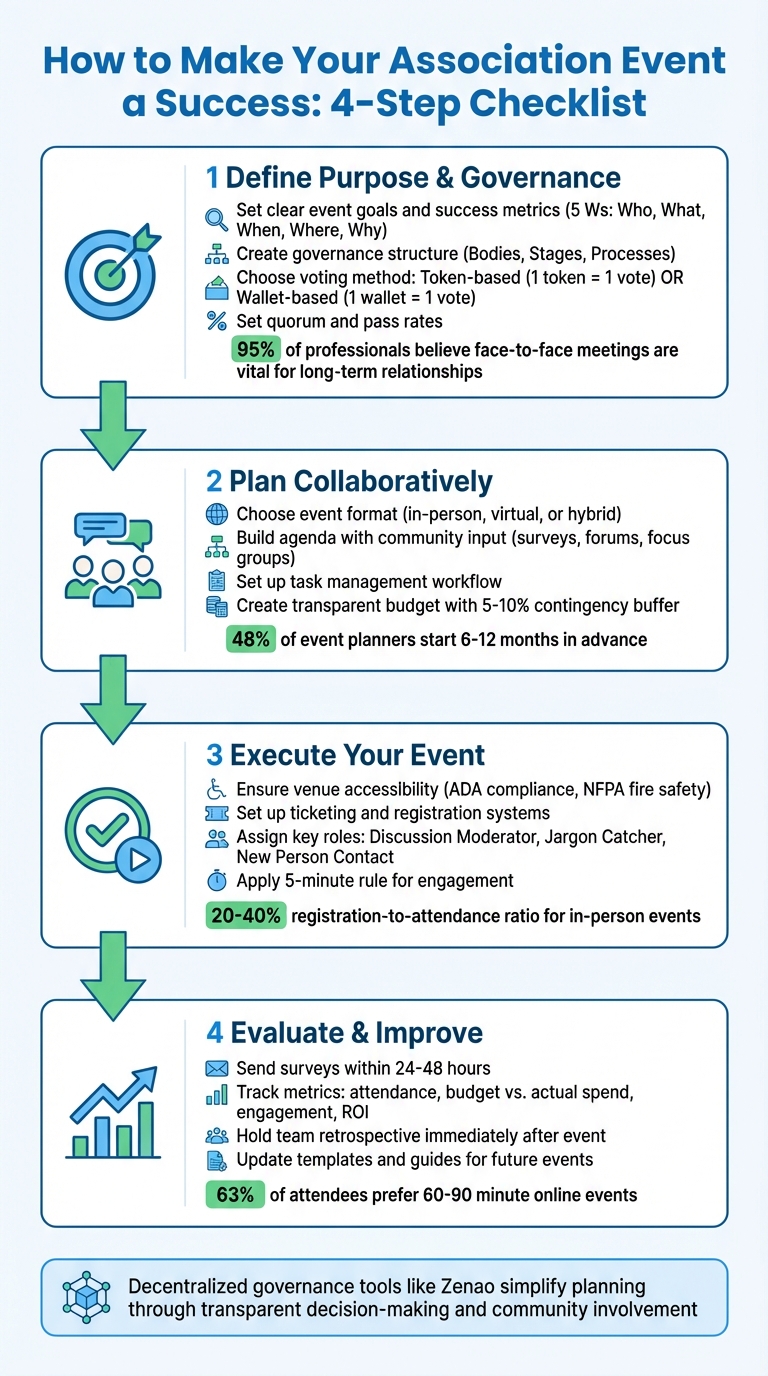
4-Step Association Event Planning Checklist
Step 1: Define Your Event's Purpose and Governance Framework
Before you start sending out invitations, it’s crucial to establish your event’s purpose and clarify decision-making authority. This foundational step prevents budget conflicts and last-minute changes, setting the stage for smooth, community-driven planning.
Set Clear Event Goals and Success Metrics
Begin by addressing the five Ws: Who is your audience, What content will you provide, When will it happen, Where will it take place, and Why does it matter. Clearly define the purpose of your event - what attendees will gain, whether it’s knowledge, networking opportunities, or a new skill. Then, select one to three measurable metrics for success, like attendance numbers, funds raised, or post-event engagement.
"The key metrics you use to measure your event's success should tie back directly to your event's purpose." – Eventbrite
For example, if your goal is community building, track metrics like post-event engagement or retention of new members. Considering that 95% of professionals believe face-to-face meetings are vital for building long-term relationships, these metrics can provide valuable insights.
To stay focused, write a concise audience profile that includes details like age range, job titles, and interests. From there, set specific benchmarks, such as “onboard 50 mission-aligned members in six months” or “achieve an 80% satisfaction rate in post-event surveys”.
Create Your Governance Structure and Decision-Making Process
A solid governance framework relies on defining three main elements: Bodies (who has voting rights), Stages (the approval process), and Processes (specific activities like budget approvals).
For voting, you can choose between token-based voting, where voting power depends on the number of tokens held (1 token = 1 vote), or wallet-based voting, where each wallet gets an equal vote (1 wallet = 1 vote). It’s also essential to set a quorum - the minimum level of participation required for a valid vote - and a pass rate, which is the percentage of “yes” votes needed to approve a proposal. For example, large decentralized groups might use a low quorum of 1% to avoid gridlock, while smaller teams might require 50% or more.
Decisions can be categorized by their importance. Routine matters, like catering choices, might only need a simple majority (50%+), while more critical decisions, like amending bylaws, could call for a super-majority (67%+).
Next, outline a clear proposal lifecycle. Start with informal idea-sharing in a chat, move to a formal proposal posted on a forum for feedback, and conclude with an official vote to make the decision binding. To ensure fairness, use a standardized template that includes fields like Title, Summary, Team, Financial Implications, and Success Metrics.
Choose Your Event Management Platform and Tools
The tools you use for event management can make or break your governance process. Platforms like Zenao combine event creation, ticketing, and governance into one system. If you’re just starting out, a simple multisig wallet - where a few members approve transactions - might be sufficient. As your organization grows, you can transition to more advanced token-based systems.
For gauging community interest before formal votes, use tools like Snapshot for free, non-binding sentiment polls. Create a digital forum, such as Discourse or Discord, to serve as your “town square” for proposal discussions. For financial transparency, platforms like Gnosis Safe allow multiple signers to approve fund releases, leaving a clear audit trail.
Set up access permissions early by defining who can create proposals, vote, and view financial records. Tools like Guild.xyz can help restrict access to specific token holders or verified members. To test your setup, run a low-stakes “trial vote” on something simple, like choosing a theme color, to ensure the system works smoothly before handling critical decisions involving funds.
With these governance structures and tools in place, you’ll be well-prepared to plan your event collaboratively and effectively.
Step 2: Plan Your Event Collaboratively
With your governance framework established, it’s time to involve your community in the planning process. This approach shifts event planning from a top-down directive to a shared effort where members feel a sense of ownership and responsibility. The next step is to define your event format and agenda in a way that actively engages your community.
Choose Your Event Format and Build the Agenda
First, decide whether your event will be in-person, virtual, or hybrid. This choice will influence everything from your budget to how accessible your event is to attendees. Virtual and hybrid formats, for instance, can help you reach a broader audience.
To bring your community into the fold, create a "Community Wishlist" on platforms like GitHub or a dedicated forum where members can suggest topics, speakers, or activities. Host focus groups or run surveys to learn about their preferences and needs - these insights can guide decisions on everything from workshop topics to catering options. For example, a quick digital survey can be an easy way to gather attendee input.
Consider hosting live discussions via Discord, Telegram, or Zoom to share your plans and collect real-time feedback. When crafting the agenda, focus on creating opportunities for interaction. Breakout sessions, networking blocks, and collaborative workshops can enhance engagement.
"Family engagement is everyone's job." – DYCD
While building the schedule, keep accessibility in mind. For remote participants, offer session recordings or schedule multiple time slots to accommodate different time zones. Empower community leaders by assigning them roles like "Discussion Moderator" or "Jargon Catcher" to ensure conversations remain inclusive.
Set Up Your Planning Workflow and Task Management
A smooth planning process relies on effective task management. Once you’ve gathered community input, establish a clear workflow to keep everything on track.
Use tools like Airtable for event templates, Jira for agile task tracking, or GitHub for managing public issues and proposals. Create a "run of show" or cue sheet as a central guide for your team. Break down the planning into specific workstreams - such as venue logistics, marketing, speaker coordination, registration, and day-of operations - and assign leads for each area with clear deadlines. Pre-built templates and early role definitions can help ensure everyone knows their responsibilities.
To keep the process transparent, set up a participatory roadmap in a public repository. This roadmap should outline key tasks, deadlines, and who’s responsible for each item. Starting early is crucial - 48% of event planners begin their work six to 12 months in advance. Build in extra time for community feedback and revisions to avoid last-minute stress.
Create Your Budget and Allocate Resources
Begin by drafting a DAO proposal that outlines your event concept, execution plan, and funding requirements. Tie your budget proposal to your governance process to ensure transparent, community-approved resource allocation.
Use a two-step governance process: post your budget draft on a community forum for discussion, then move to an on-chain voting platform for final approval. Think of the forum as a space for debate and the voting platform as the final decision-making tool.
"A DAO proposal is an idea that a community or DAO member wants the DAO to consider. It's typically a document describing an idea, how it will be implemented, and the funding requirements for executing the idea." – Aragon
Structure your budget with a clear breakdown of how funds will be used. Categories might include venue costs, catering, merchandise, speaker fees, staffing, technology, and marketing. Don’t forget hidden costs like local taxes or travel expenses for your core team. To cover unexpected expenses, include a contingency buffer of 5% to 10%.
Post your initial budget draft for community feedback, then update it based on their input. Link your budget allocations to measurable metrics - like cost per attendee - to justify spending. For major expenses, gather at least three quotes to ensure competitive pricing. Track your finances in three stages - Projected Costs (initial estimates), Actual Costs (confirmed vendor quotes), and Profit/Impact analysis - to maintain transparency. Use a shared approval log for vendor procurement and reimbursements to ensure accountability.
For example, in 2023, the ENS (Ethereum Name Service) DAO required all funding proposals to include a detailed timeline, a designated manager, and a comprehensive budget before members could vote. Similarly, BanklessDAO includes a "Financial Implications" section with specific KPIs and team background details, while Aave uses a multi-step Request for Comments (ARC) process to subject budget proposals to community review before moving them on-chain.
Step 3: Execute Your Event
Now it’s time to bring your event to life: prioritize safety, manage registration efficiently, and ensure smooth governance throughout.
Arrange Venue, Accessibility, and Safety Requirements
Visit your venue ahead of time to confirm it can handle your expected crowd. Check for potential bottlenecks, measure exit widths, and map out the attendee journey to identify any issues before they arise. Make sure the venue complies with ADA standards to ensure accessibility for everyone. For fire safety, adhere to National Fire Protection Association (NFPA) guidelines, ensuring exits are clearly marked, fire extinguishers are functional, and evacuation plans are in place.
"The larger your event, the more safety measures you need to put in place." – Jane Powell, Public Health Specialist, Eventbrite
Establish an Incident Command Structure (ICS) to define roles for operations, medical response, and security. Create a "show-stop" procedure that specifies who has the authority to pause the event and how to resume operations. Use barriers to manage crowd flow and designate "spotters" to monitor potential crush points in real time. Don’t forget to secure insurance - aim for at least $1 million in general liability coverage.
When working with vendors, ensure their values align with your association’s priorities, particularly in areas like diversity, equity, and inclusion (DEI). Keep the process transparent by using shared approval logs, which help maintain accountability among all stakeholders. These measures not only enhance safety but also build trust within your community.
Set Up Ticketing and Registration
Get your ticketing system ready well in advance. Platforms like Zenao offer digital ticketing and scanning features that integrate with governance systems, allowing you to restrict access based on registration or membership criteria. Decide which data fields you need - such as name, email, or dietary preferences - and set up CRM integrations early to keep things running smoothly.
If your association uses DAO governance, determine who is eligible to register: token holders (1 token = 1 vote) or authorized wallets (1 wallet = 1 vote). Tools like multisignature wallets (e.g., Gnosis Safe) can simplify fee management, while platforms like Aragon or Tally can automate certain processes. Conduct a test vote to ensure your governance and registration systems function as intended.
"Modern event programs rise or fall on the strength of their registration workflow. When registration works well, attendees move from sign-up to onsite check-in with confidence." – Jodi Whitehead, Marketing Coordinator, Bizzabo
Simplify registration forms by using conditional logic to hide unnecessary questions - this can reduce visible fields by 20% to 40%. Expect 5% to 15% of attendees to require manual assistance at check-in, so set up a dedicated lane for issues like reprinting tickets. For example, a 1,200-person B2B conference in October 2025 implemented a distributed check-in system with on-demand printers and QR-only entry. This reduced peak wait times from 18 minutes to 6 minutes and cut food and beverage overages from 14% to 6% by using real-time attendance data.
Keep in mind that 59% of event organizers see an increase in last-minute registrations, and in-person events generally have a 20% to 40% registration-to-attendance ratio. Plan your staffing and materials accordingly.
Once registration is sorted, shift your focus to executing your program and facilitating governance activities.
Run Your Program and Facilitate Governance Activities
With your preparation complete, focus on running your event agenda while encouraging active governance participation. Finalize your schedule and communicate it clearly to speakers, moderators, and attendees. Assign specific roles to ensure smooth operations:
- Discussion Moderator: Manages Q&A and proposal discussions.
- Jargon Catcher: Simplifies technical terms for broader understanding.
- New Person Contact: Welcomes and integrates newcomers into discussions.
To keep attendees engaged, follow the "5-minute rule": prompt participants to take an action or respond every five to seven minutes. Use tools like live polling, Q&A sessions, and breakout rooms to make the experience interactive. For smaller groups (10 people or fewer), start with introductions or icebreakers to build trust and encourage collaboration.
Document governance discussions as they unfold. Assign someone to record key quotes and summarize opinions - think of it as "live-tweeting" the event to create a transparent record. Distribute concise handouts summarizing the issues, your association’s positions, and instructions for future participation.
| Role | Responsibility |
|---|---|
| Discussion Moderator | Manages flow of proposal discussions |
| Jargon Catcher | Clarifies technical terms |
| New Person Contact | Welcomes newcomers |
Build extra time into your schedule to accommodate longer governance discussions. Assign a team member to monitor the event hashtag for real-time feedback. Allow for casual conversations before the official start and provide time after formal sessions for continued discussions.
Research shows that 63% of attendees prefer online events lasting 60 to 90 minutes, and 55% of Americans report feeling more connected after attending events. Keep sessions interactive and focused to maximize engagement and governance outcomes.
sbb-itb-8eb1bfa
Step 4: Evaluate Results and Improve Future Events
What happens after your event plays a huge role in shaping the success of your future gatherings. The days immediately following are your prime opportunity to analyze what went well, what didn’t, and how to make the next event even better.
Track Metrics and Measure Event Impact
Start by documenting the key numbers: total attendance, the gap between registrations and actual turnout, and how your spending lined up with your budget. If you’re working with a decentralized group, track the ratio of committee members to general attendees - this will help you see if you’re engaging your broader community or just your core team. Financial metrics like ticket sales, funds raised, and marketing ROI are also essential to measure.
Engagement metrics are equally important. Look at social media activity (think hashtags and mentions), press coverage, and new email signups. Involve your community in the evaluation process to maintain transparency. Don’t forget to check in with your staff and volunteers - understanding their level of satisfaction or burnout can reveal how well your event’s structure worked.
"Identifying a list of tangible and intangible goals for your event can give you a better sense of your event management needs. Your tangible goals may be to attract 500 attendees... Your intangible goals will help drive these tangible goals and may include raising awareness." – Dr. Yuanyuan Zhou, Co-Founder, Whova
Once you’ve gathered these metrics, dive deeper by collecting feedback.
Collect Feedback and Document What You Learned
Send out surveys to attendees within 24 to 48 hours while the experience is still fresh in their minds. Use a mix of numerical ratings (for things like speakers, venue, or food) and open-ended questions to capture detailed thoughts. For decentralized organizations, real-time engagement tools can be a game-changer - let participants upvote or downvote feedback topics to prioritize what matters most.
Schedule a retrospective with your core team, volunteers, and stakeholders as soon as possible - ideally the next day or shortly after. During this session, document key takeaways like how well your marketing channels performed, whether the event was accessible to all, and how efficiently your governance structure operated. Finally, keep everything organized: store contracts, receipts, registration data, and schedules in a shared digital folder or binder for easy access later.
"Although it might be tempting to say, 'It's all in my head! I'll be fine!' and not be concerned about writing it all down, beware: this kind of mentality will make it much more difficult for you to assign accountability! It'll also make it more difficult to remember what you did for the next event - so do your future self a favor and keep everything written down." – WildApricot
These insights will help you fine-tune your future events.
Build Templates and Guides for Future Events
Take what you’ve learned and update your event planning tools right away. Revise your master plan, checklists, and backup procedures to reflect your latest experiences. Create a reusable "day-of" supplies list with essentials like extra chargers, PR materials, and USB drives. If you’re working with a decentralized group, streamline your onboarding process by creating clear guides to help new members quickly find their roles, reducing drop-off rates. Update your budget template with actual expenses, and document which items were underwritten to maintain a clear audit trail. For groups using DAO governance, track new member retention after onboarding as a long-term indicator of community health. Store all updated templates and resources in a central location to make continuous improvement easier.
| Metric Category | Data Points to Document | Purpose for Future Events |
|---|---|---|
| Engagement | Voter participation, social media mentions, session attendance | Assess content relevance and community health |
| Logistics | Actual vs. budgeted spend, vendor performance, registration-to-check-in ratio | Refine budget accuracy and vendor selection |
| Sentiment | Net Promoter Score (NPS), attendee/sponsor satisfaction surveys | Improve attendee experience and secure future sponsorships |
Conclusion
Planning an association event doesn't have to be overwhelming. By sticking to a clear checklist - from setting up a governance framework to analyzing results - you can create events that truly reflect your community's values and keep members actively involved.
Decentralized governance tools, like Zenao, make this process more accessible. These tools allow your community to take part in decisions, from choosing speakers to allocating budgets, with every choice transparently recorded on the blockchain. A great example is the Samouraï Coop, which used Zenao in 2024 to organize the Hyper Hacktive Festival in Paris. Attendees were able to vote on key decisions, ensuring the event aligned with their collective vision.
To build on this kind of success, focus on setting clear goals and simplifying processes. Role-based permissions help you delegate tasks effectively, while automation takes care of repetitive work, freeing your team to focus on creating meaningful experiences. Over time, you'll develop templates and workflows that make organizing each event easier than the last. More importantly, your community will feel empowered, knowing their input shapes the outcomes. This not only strengthens engagement but ensures your events consistently align with your association's mission.
And here's the bottom line: people value tools that are both effective and easy to use. Zenao delivers on this by streamlining decentralized governance, whether you're handling digital ticketing, managing community votes, or tracking budgets. With the right approach and tools in place, your events will continue to evolve and serve your community better with every iteration.
FAQs
How can Zenao's decentralized governance tools streamline event planning for associations?
Zenao equips associations with a transparent, community-focused platform designed to streamline event planning. Through decentralized governance, members collaborate on key decisions like budgeting, venue selection, and scheduling, using token-based voting. This approach guarantees inclusivity and accountability, with clearly defined quorum and approval thresholds guiding every step.
Smart contracts power automated workflows, handling tasks such as releasing funds once a venue is booked or sending reminders when speakers are confirmed. These automations remove delays, speed up approvals, and maintain an auditable trail of decisions, promoting responsible use of resources. By blending transparency, automation, and community involvement, Zenao enables associations to plan events that reflect decentralized values while staying efficient and goal-oriented.
How can I effectively involve the community in planning an association event?
To get your community involved in planning an event, start by defining the event's purpose and explaining how their input will play a role in its success. By sharing these goals openly, you help everyone understand the vision and encourage them to actively engage.
Incorporate transparent decision-making tools, such as voting systems or idea boards, to give members a chance to suggest ideas, vote on decisions, and help allocate resources. This approach not only ensures everyone feels heard but also builds trust throughout the process.
Engage your audience early on with surveys, polls, or brainstorming sessions to gather their preferences on topics like event content, formats, or potential speakers. This makes the event more relevant to their interests and fosters a sense of ownership.
Keep communication flowing by sharing updates on decisions, budgets, and progress. After the event, collect feedback to improve future events and show how community collaboration made a difference.
What’s the best way to measure the success of an association event?
To gauge how successful your association event was, it’s crucial to start with clearly defined goals. These might include increasing member engagement, attracting new leads, highlighting sponsors, or driving revenue growth. Once your objectives are in place, track metrics that directly tie to these goals. Key indicators often include attendance rates, feedback from post-event surveys, social media interactions, revenue generated, and new memberships or renewals.
If your association operates with decentralized or DAO-style governance, you might also want to monitor metrics like community engagement levels (such as activity on forums or platforms), sponsor ROI based on tracked leads, and post-event involvement in governance activities, like voting on proposals. Leverage tools like event management software, surveys, and analytics platforms to collect data, compare it with previous events, and uncover patterns or areas for improvement.
By blending both numbers and feedback, you’ll gain a clearer picture of how well your event met its goals and provided value to members, sponsors, and the association overall.