

Community Management
How to build an engaged community in 6 steps
A practical 6-step guide to build a purpose-driven, governed community with clear rules, communication, rewards, events, and engagement metrics.

January 9th, 2026
•
17 min read
How to build an engaged community in 6 steps
Building an engaged community requires purpose, clear governance, effective communication, meaningful rewards, and active participation. Here’s a quick guide:
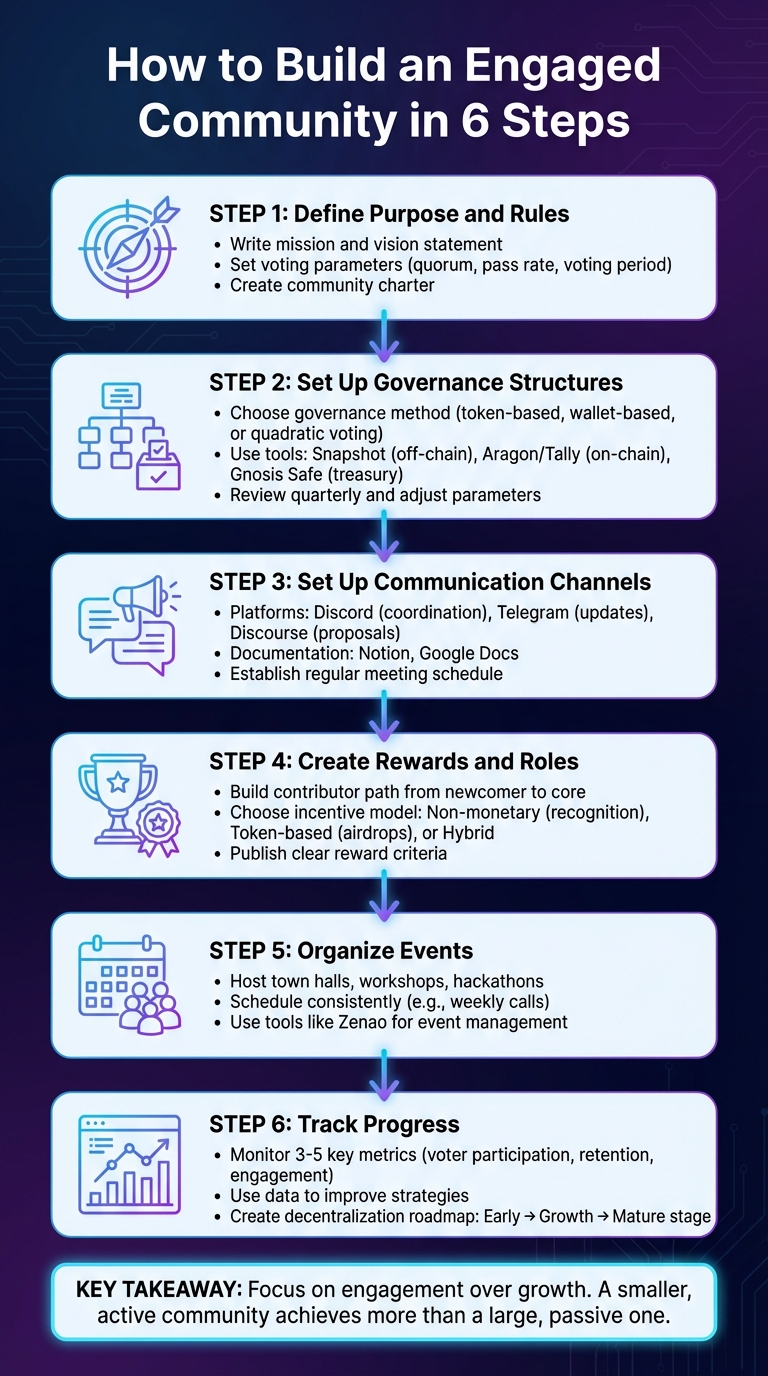
- Define Purpose and Rules: Start with a clear mission and vision. Create a community charter with rules for participation and decision-making.
- Governance Structures: Choose a decision-making framework (e.g., token-based or wallet-based voting) and use tools like Snapshot or Gnosis Safe for proposals and treasury management.
- Communication Channels: Use platforms like Discord, Telegram, or Notion for structured discussions, updates, and documentation.
- Rewards and Roles: Offer incentives like tokens, recognition, or hybrid models. Publish clear criteria for rewards and roles.
- Organize Events: Host regular events like town halls, workshops, and hackathons to boost participation and collaboration.
- Track Progress: Monitor engagement metrics (e.g., voter participation, retention) and adjust strategies as needed. Create a roadmap for decentralization.
Key takeaway: Focus on engagement over growth. A smaller, active community can achieve more than a large, passive one. Use tools like Zenao to streamline management and foster participation.
6 Steps to Build an Engaged Decentralized Community
E38: Throwback Episode - The Inside Story of Building a DAO with Jon Gregis
Step 1: Define Your Community's Purpose and Rules
Every decentralized community begins by addressing a fundamental question: Why do we exist? A clear mission serves as the foundation, uniting members around shared goals. As Flowscience, a Core Team Member for DAOPlanet, puts it:
Mission and values (MV) create guidelines for all future decisions and bring alignment to contributor actions.
Your vision paints the picture of the future you're working toward, while your mission lays out what you aim to accomplish, the obstacles you plan to tackle, and the principles that will guide your journey. Craft a purpose statement that's both inspiring and focused. To get there, consider interviewing project leaders to uncover your community's core values and target audience. This clarity will naturally attract members who resonate with your goals.
Once you've identified your purpose, break it down into actionable steps that empower your community to align and thrive.
Write Your Mission and Vision
Start by drafting a purpose statement that highlights your immediate goals and long-term aspirations. Think about the impact you want to make in the decentralized space. With your mission in place, align your community's values to draw in and retain dedicated members. Use tools like surveys, polls, and community calls to ensure your mission reflects the needs and priorities of your members, evolving as they do.
Set Rules for Participation and Decision-Making
Clear guidelines help members navigate their roles confidently. Define rules for behavior and decision-making, and document them for easy reference. Establish voting parameters, such as who is eligible to vote (e.g., token holders), required quorum, pass rates (e.g., 50% or 67%), and voting periods (commonly 3–7 days).
| Governance Parameter | Common Setting |
|---|---|
| Quorum | 1% to 50% of eligible voters |
| Pass Rate | 50% (simple majority) or 67% (super-majority) |
| Voting Period | 3 to 7 days |
Create a Community Charter
Develop a community charter - a living document that consolidates your mission, values, operating principles, and governance rules. Host it on a platform that's easy to access, such as Notion, GitHub, or GitBook. For codes of conduct, consider using open-source resources like the Contributor Covenant to promote inclusion and protect against harmful behavior. A charter is only effective if it’s actively applied in your community's daily operations.
Step 2: Set Up Clear Governance Structures
After defining your mission, the next step is to establish a decision-making framework that helps your community work together effectively. DAO governance determines who has the authority to make decisions and outlines the processes for reaching them. Clear and transparent structures not only enhance collaboration but also give members a sense of ownership. Striking the right balance between efficiency and security is key, as it ensures your treasury is safeguarded while enabling swift action. Choosing the right governance method is crucial to meeting your community's specific needs.
Pick Your Governance Methods
The governance approach you choose should reflect your community's size and level of development. For instance, token-based voting ties voting power to financial stakes, which works well for larger communities but can lead to dominance by large stakeholders. On the other hand, wallet-based voting gives each member equal say, making it a better fit for smaller, more tightly-knit groups. Quadratic voting offers another option, helping to reduce the influence of members with large token holdings.
Many DAOs start with off-chain signaling tools like Snapshot, which allow for gas-free voting to gauge sentiment. As they grow, they often transition to on-chain platforms such as Aragon or Tally, which can automatically execute smart contract actions based on voting outcomes. For example, Ethereum Name Service (ENS) requires proposal creators to hold at least 100,000 ENS tokens, while Curve Finance asks members to lock 2,500 CRV tokens for up to four years. While these requirements work for established DAOs, newer communities should start with simpler systems and gradually add complexity as they expand.
Use DAO Tools for Proposals and Voting
The right tools can make governance easier and more efficient. Snapshot is a popular choice for off-chain voting, while platforms like Discourse or Commonwealth facilitate structured discussions. For treasury management, Gnosis Safe provides a reliable multisig solution. Tools like Zenao simplify proposal creation by guiding users through key steps, such as setting vote timelines and defining automatic actions for approved proposals.
Aave demonstrates a robust multi-stage governance process. Proposals begin as "Aave Requests for Comments" (ARC) to gather community input, then move to preliminary votes, and finally evolve into "Aave Improvement Proposals" (AIP) that trigger automatic execution. To streamline your own processes, consider creating templates for proposals and storing them in a central hub like Notion or GitHub. Running test votes can help identify weaknesses before making high-stakes decisions. Adding a timelock - usually about seven days - after a vote passes also provides a critical security window to address any malicious proposals.
Review and Update Governance Regularly
Governance systems need to evolve alongside your community. Conduct quarterly reviews to assess quorum levels, pass rates, and voting periods, adjusting them based on member engagement and retention metrics. For example, large DAOs with widely distributed tokens might set quorums as low as 1% to avoid gridlock, while multisig setups may require over 50% participation to execute transactions. If proposals frequently fail to meet quorum, consider lowering the threshold. Conversely, if decisions feel rushed, extending the voting period beyond the typical 3–7 days might help.
Appointing a governance lead to update documentation and templates ensures your processes stay relevant. Researching how similar DAOs operate can also provide valuable insights. Regular updates not only build trust but also keep your community energized and engaged. Ultimately, the best governance system is one tailored to your community's unique dynamics and culture.
Step 3: Set Up Communication Channels
After solidifying your governance structures, the next step is to establish communication channels that keep your community informed and connected. These channels are the lifeline of your governance framework, ensuring that members can engage in transparent and ongoing discussions. Without effective communication, even the most well-designed governance systems may falter. It’s crucial to select tools that facilitate discussions, provide visibility into decisions, and accommodate members across different time zones.
"I think engagement is the best metric to track, not growth. Growth is definitely important, but would you rather be part of a huge community where barely anyone talks or a smaller group with dynamic conversations and infectious energy?"
- Emile Kormienko, Community Builder
Choose Your Communication Channels
The tools you use should match the specific needs of your community. Platforms like Discord work well as a central hub, offering features like structured coordination, custom bots, and permission-based channels. For quick updates and maintaining energy, Telegram is a strong choice. If your community needs space for more detailed discussions - especially around proposals and governance - Discourse provides threaded conversations that keep critical ideas organized and easy to revisit.
Organize your channels by topics or working groups to avoid overwhelming members. Smaller, focused groups (around five to six people) often collaborate more effectively. For documentation and knowledge sharing, tools like Notion or Google Docs can serve as the go-to repository for your community’s missions, values, and processes. Alona, founder of Ukraine DAO, emphasized the importance of simple collaboration tools: "If you cannot collaborate in a Google doc, no DAO tool is going to save you." For real-time communication, platforms like Zoom or Google Meet are ideal for meetings, while Zenao can help manage workshops, events, and other activities that bring members together.
Create a Regular Communication Schedule
Consistency is key to keeping members engaged. Establish predictable touchpoints, such as regular all-hands calls, monthly retrospectives, or quarterly roadmap reviews. For example, BanklessDAO has held its weekly community call every Friday at 11:00 AM Eastern since May 2024. Rotating meeting times can help accommodate members in different time zones. To avoid confusion, clearly label task priorities and set a default timezone (like UTC) for internal deadlines.
To keep everyone in the loop, use asynchronous updates like recorded walkthroughs or summaries. This is especially useful for global teams, as it allows members to stay informed on their own schedules. Research shows that 75% of businesses with diverse decision-makers outperform their financial targets, and remote work is expected to rival traditional office setups by 2025.
Keep Communication Clear and Accessible
Effective communication means making information easy to understand and accessible to everyone. Use inclusive, non-technical language for updates and proposals so that all members, regardless of expertise, can participate. Pin important posts to highlight required actions, and consider creating dedicated threads like "Introduce Yourself" to help the core team identify active contributors.
Centralizing documentation is equally important. Record meetings and upload them to platforms like YouTube so members can catch up on key discussions and decisions. Separate general chat from technical support channels to maintain a lively and engaging atmosphere. Prioritize meaningful interactions over sheer numbers, and establish clear moderation guidelines to handle issues - from misplaced posts to more serious concerns - with defined escalation paths.
With strong communication channels in place, the next step is to design systems that recognize and reward the contributions of your members.
sbb-itb-8eb1bfa
Step 4: Create Rewards and Roles for Contributors
Once you’ve set up effective communication channels, the next step is to design a system that acknowledges and rewards the people who keep your community thriving. The idea is to encourage members to evolve from casual participants into key contributors by offering meaningful roles and fair incentives. Focus on rewarding quality over sheer activity - systems that prioritize message counts or "grind-to-earn" strategies often attract bots or users who leave as soon as the rewards dry up.
"You want to think of monetary rewards as a means of acknowledging the value that a community member brings to the community as opposed to being the direct incentive to participate."
- Peter 'pet3rpan', 1kx
Build a Path for New Contributors
To grow a strong contributor base, you need to create a clear path that guides members from newcomers to core contributors. Start by lowering the barriers for entry. Offer simple, beginner-friendly tasks labeled as "good first issues" to help new members find their footing. Set up spaces like "Introduce Yourself" or "I Want to Contribute" channels where members can share their skills and interests. These spaces make it easier for community leaders to identify promising contributors.
As members gain experience, give them opportunities to take on more advanced roles. These could include leading working groups, moderating channels, or mentoring new members. Quick feedback also plays a huge role in retention. A Mozilla study found that contributors who received code reviews within 48 hours were much more likely to return and contribute again. Instead of handling every minor task yourself, use these as chances to mentor others and build up the community’s talent pool.
Choose Your Incentive Model
Picking the right incentive model is key to aligning your rewards with the community's goals. Here are a few options to consider:
- Non-monetary rewards: These include reputation roles, early access to features, public recognition, and peer acknowledgment. They foster loyalty and are easier to sustain long-term.
- Token-based rewards: Governance tokens, airdrops, and bounties can quickly attract talent and align financial interests with the community’s success. However, they come with risks, such as governance concentration or attracting short-term participants.
- Hybrid models: Combining financial rewards with non-monetary benefits like status or exclusive access strikes a balance between rapid growth and long-term retention. That said, managing such systems can be more complex.
| Incentive Model | Description | Benefits | Drawbacks |
|---|---|---|---|
| Non-monetary | Recognition, roles, early access, and public credit. | Builds loyalty and sustainability. | May not attract contributors as quickly. |
| Token-based | Governance tokens, airdrops, and bounties. | High initial attraction; aligns financial interests. | Can lead to governance centralization and short-term focus. |
| Hybrid | Mixes financial rewards with recognition and privileges. | Balances growth with retention. | Requires more complex management and tracking tools. |
While financial incentives like tokens can help bring in new contributors, they shouldn’t overshadow your community’s mission. Tools like Coordinape or Karma allow members to nominate and reward each other, helping to spotlight valuable contributors who may not always be the most vocal.
Publish Clear Reward Criteria
Transparency is the backbone of trust. Clearly document how payments are made, who can propose ideas, and the criteria for governance roles. This ensures that rewards go to those who genuinely contribute and avoids misunderstandings. Consider using POAPs (Proof of Attendance Protocol) to ensure that only active participants have governance privileges. Make this information easily accessible - whether through a community charter or a central Notion page - so everyone knows what’s expected of them and what they can earn in return.
Step 5: Organize Events to Build Community
Events are a powerful way to turn individual members into a connected and supportive network. As ethereum.org explains, "A community... is a network of interconnected people and organizations collaborating and supporting each other". Hosting gatherings like town halls, workshops, and hackathons encourages participation and a sense of ownership. These events promote transparency, build trust, and help members feel they’re contributing to something bigger.
Plan Events Around Governance
Focus on organizing events that directly involve members in your DAO’s decision-making. For instance, proposal walkthroughs allow contributors to present their ideas in real time, while workshops equip members with the skills they need to engage effectively. Hackathons, on the other hand, encourage hands-on collaboration and spark innovation. Take BanklessDAO as an example - they host a weekly community call every Friday at 11:00 AM Eastern to discuss key developments, creating a consistent rhythm that reinforces decentralized governance. Similarly, Friends With Benefits hosts in-person meetups during major crypto conferences, fostering stronger relationships through face-to-face interactions.
You can also add “show and tell” sessions where contributors share their work, showcasing their enthusiasm and inspiring others to get involved. Before rolling out major governance changes, consider holding low-stakes test votes to familiarize members with the process. And as mentioned earlier, recording events with clear timestamps ensures members in different time zones stay informed.
Use Zenao to Manage Events
Zenao is an all-in-one platform designed to simplify event management for governance activities. It handles everything from digital ticketing to attendee lists and even ticket scanning, eliminating the need for multiple tools. With its integrated governance features, Zenao allows you to incorporate voting and proposal discussions directly into your events, making it easier for members to influence upcoming activities. After events, Zenao’s social tools let you gather feedback through polls or messages, helping you identify what worked and what can be improved.
Schedule Events for Your Community
Consistency is crucial when it comes to scheduling events. Aim to hold events at 12:00 PM EST / 6:00 PM UTC, using the MM/DD/YYYY format and a 12-hour clock to align with U.S. standards while accommodating international members. Announce events at least a week in advance and send a final reminder 10 minutes before they begin. These well-organized, predictable events help build trust, encourage engagement, and set the stage for advancing decentralization in the next phase.
Step 6: Track Progress and Increase Decentralization
Building an active, thriving community requires constant monitoring and adaptation. As community builder Emile Kormienko aptly says, "I think engagement is the best metric to track, not growth. Growth is definitely important, but would you rather be part of a huge community where barely anyone talks or a smaller group with dynamic conversations and infectious energy?". Keeping a close eye on key data points helps you gradually shift from a founder-led structure to a decentralized community where members take the reins.
Monitor Engagement Metrics
Start by focusing on 3–5 key metrics that reflect your community's overall health. These could include:
- Governance metrics: Voter participation rates and quorum levels.
- Communication metrics: Activity on platforms like Discord and social media.
- Retention metrics: The percentage of members still active after 90 days and the ratio of active participants to lurkers.
- Leadership development: The number of members stepping into leadership roles, joining working groups, or earning vested token rewards.
Set clear benchmarks for voter participation and track the quality of interactions - look at metrics like comment depth, Net Promoter Score (NPS), and instances where members assist each other. Communities that treat onboarding as an ongoing effort can see retention rates improve by as much as 50%. By keeping tabs on these metrics, you can make informed decisions to enhance your community.
Use Data to Improve Your Community
Once you've started collecting data, use it to refine your strategies. For example, if voter participation is low, you might extend voting periods or adjust quorum thresholds to make it easier for members to engage. Experiment with different vote durations and thresholds to see what works best. Keep an eye on observable contributions, like completing bounties or participating in "I Want to Contribute" channels, to identify emerging leaders.
Feedback from surveys and community calls can also guide adjustments to your communication strategies and incentive models. For a well-rounded view, separate your data into on-chain (e.g., voter participation, treasury activity) and off-chain (e.g., Discord engagement, event attendance) categories. Tools like Statbot, Terminal, and Vantient can help automate this process. Using data to fine-tune governance, communication, and event planning strengthens the foundational practices of community building.
Create a Decentralization Roadmap
Use the insights from your data to outline a clear roadmap for transitioning from a founder-led structure to full decentralization. This process happens in stages, each building on the governance and engagement strategies discussed earlier.
- Early stage: The core team holds most of the control, using off-chain polls to gauge sentiment and conducting low-stakes test votes to establish baseline parameters.
- Growth stage: Introduce multisig execution for community votes, form working groups, and launch structured bounty programs to empower emerging leaders.
- Mature stage: Transition to fully on-chain token voting, create subDAOs for specialized tasks, and enable permissionless participation, shifting decision-making power to the broader community.
| Stage | Governance Structure | Primary Metrics | Leadership Structure |
|---|---|---|---|
| Early | Core team control; off-chain sentiment polls | Product usage, retention, event attendance | Founder-led; rapid iteration |
| Growth | Multisig execution of votes; working groups | Voter participation, 90-day retention, active-to-lurker ratio | Core team + emerging leaders |
| Mature | Fully on-chain voting; subDAOs; permissionless | Token distribution, proposal volume, leadership transitions | Community-owned; decentralized working groups |
As Peter "pet3rpan" from 1kx explains, "Ownership is not fostered through financial incentive design but rather through a long-term focus on community building". To ensure the community can operate independently, document everything - record meetings, upload them to YouTube, and maintain a central wiki.
Conclusion
Building a thriving decentralized community isn't about chasing rapid growth - it's about nurturing meaningful connections and fostering a sense of shared ownership. These steps can turn casual visitors into deeply committed contributors. A solid foundation, rooted in a clear purpose and well-defined governance, naturally attracts members who align with your mission. From there, strong communication and engaging events help sustain those connections, even during tough times.
"Ownership is not fostered through financial incentive design but rather through a long-term focus on community building." - Peter "pet3rpan", 1kx
This perspective highlights the importance of a deliberate, value-driven strategy. Your first 100 members are crucial - they set the tone and culture for everyone who joins later.
Tools like Zenao simplify event management and governance, while centralized documentation ensures transparency and empowers members to stay informed and involved. It's worth remembering: having 1,000 active, engaged participants is far more impactful than 10,000 who barely contribute.
As your community grows, the journey toward decentralization unfolds step by step. Start with simple structures like multisigs, transition to token-based governance as the group matures, and continuously refine your approach using feedback and engagement metrics. By focusing on transparency, open communication, and empowering your members at every stage, you'll create a community that doesn't just function - it flourishes on its own.
FAQs
What are the most important metrics to measure community engagement?
When evaluating community engagement, it’s crucial to zero in on metrics that showcase active involvement and sustained participation. While the article highlights strategies such as encouraging communication, offering incentives, and organizing events, it doesn’t outline specific metrics. That said, here are some commonly tracked engagement KPIs:
- Active member count: Tracks how many members consistently participate in discussions or activities.
- Message volume: Measures the total number of messages or interactions within a set period.
- Participation rate: Compares the percentage of active contributors to the overall membership.
- Retention rate: Monitors how many members stay engaged over time.
- Reward redemption: Measures the frequency of incentive or reward usage.
These metrics provide insights into the vitality and growth of your community. However, it’s essential to customize them according to your community’s specific goals and structure. Define what engagement looks like for your group, then choose the metrics that align with your vision.
What’s the best way to balance token-based rewards with non-monetary incentives?
Balancing token-based rewards with non-monetary incentives means crafting a system that taps into both financial rewards and intrinsic motivations. A good starting point is to offer a modest amount of tokens for milestones or early contributions - just enough to spark interest without making financial gain the main attraction. Pair these tokens with non-monetary rewards like badges, exclusive access, voting rights, or public recognition in community updates. These intangible perks often encourage deeper engagement and a stronger sense of belonging.
To put this into action, align specific activities with suitable rewards. For instance, a well-thought-out forum post could earn a badge and a small token bonus, while participating in governance votes might come with voting power and a token reward. By leaning on non-monetary incentives for routine interactions and reserving token rewards for key contributions, you can create a community that values meaningful recognition while still appreciating tangible benefits. This approach helps sustain long-term participation and builds stronger connections within the group.
How can I transition my community to a decentralized model?
Transitioning a community to a decentralized structure involves setting clear objectives, establishing a solid governance system, and using effective tools to boost participation and engagement.
Start by identifying the core purpose of your community and why decentralization is essential. This clarity helps guide decisions and ensures everyone remains on the same page. Develop a governance framework that specifies voting rights, proposal submission processes, and decision-making thresholds. Select tools that facilitate both on-chain voting and off-chain collaboration, prioritizing transparency and thorough documentation. To encourage active involvement, consider offering rewards like tokens or reputation points. As your community evolves, regularly review and refine these processes to adapt to new challenges and opportunities.
With these steps in place, you can create an environment where members feel empowered, transparency is prioritized, and collaboration thrives.