

Event Planning
How Interoperable Ticketing Works with DAOs
On-chain interoperable tickets let DAOs control events, enforce resale rules, enable cross-chain use, and protect privacy through token governance and SSI/ZK solutions.

February 9th, 2026
•
12 min read
How Interoperable Ticketing Works with DAOs
Interoperable ticketing uses blockchain to turn event tickets into digital assets that work across platforms and networks. These tickets go beyond access - they can offer perks like exclusive content, enforce resale rules through smart contracts, and maintain transparent records. For DAOs, this approach aligns with their decentralized values, eliminating centralized ticketing fees and giving communities control over events.
A platform like Zenao enables DAOs to manage events, tickets, and governance seamlessly. Tickets are issued as NFTs, verified on-chain, and can function across blockchains. DAOs can use token-based voting to set rules like price caps or scalping prevention, ensuring fair ticketing practices. Cross-chain protocols allow tickets to work across ecosystems, while tools like multisig vaults simplify fund management. Challenges like cross-chain compatibility and privacy are addressed with standards like ERC-7683 and zero-knowledge proofs.
This system redefines event management for DAOs, making ticketing smarter, more secure, and community-driven.
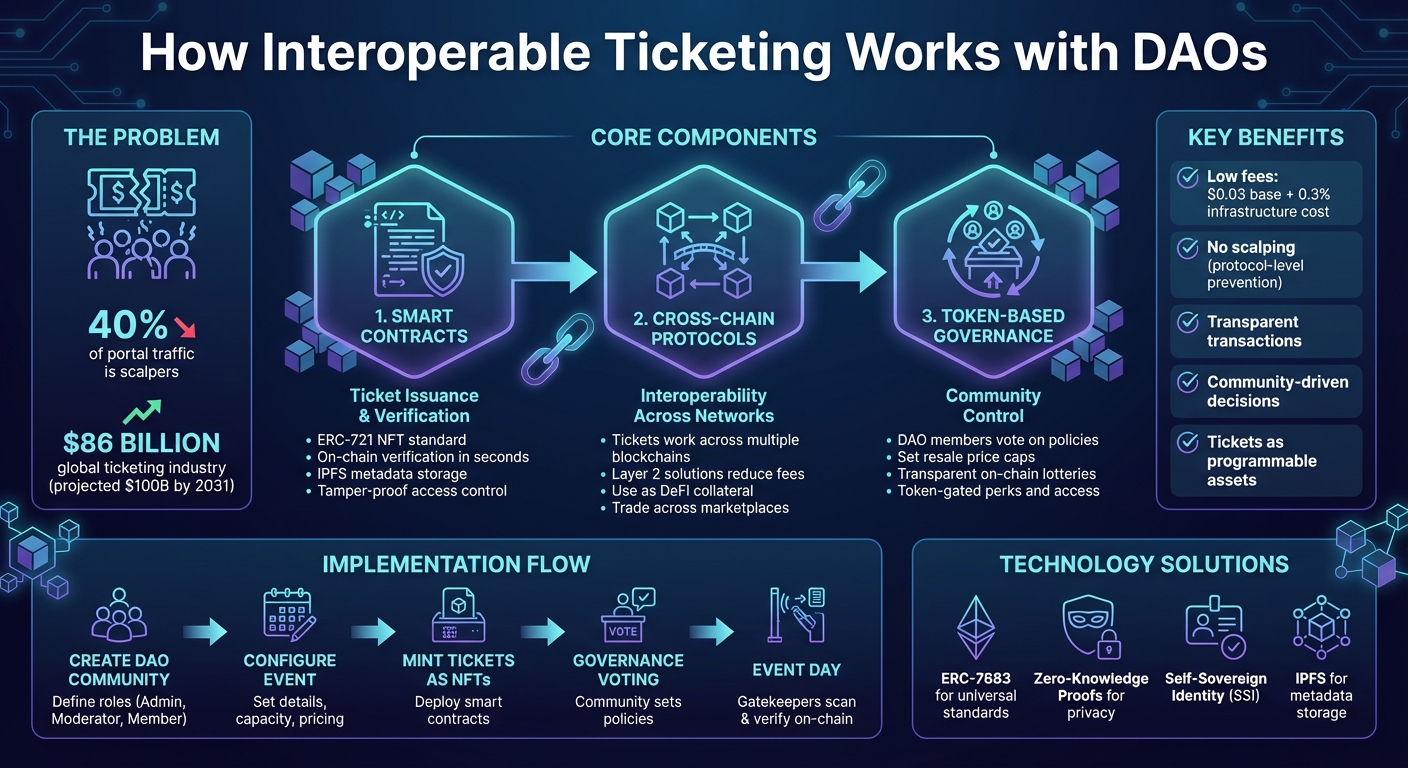
How Interoperable Ticketing Works in DAOs: Core Components and Workflow
Core Components of Interoperable Ticketing in DAOs
Smart Contracts for Ticket Issuance and Verification
Smart contracts play a central role in managing the entire lifecycle of tickets in a decentralized way. Using Event Factories, DAO members can deploy unique event contracts that handle everything - from minting tickets to marking them as used. Typically, tickets are issued using the ERC-721 standard for NFTs or semi-fungible formats, ensuring each ticket is a distinct, traceable digital asset.
The verification process happens entirely on-chain. When a ticket is scanned at an event, the smart contract quickly checks its status and marks it as invalid once used. This entire process is efficient, with verification completed in just a few seconds.
To address scalping - which accounts for about 40% of portal traffic - smart contracts tie tickets to verified identities and store metadata like event details and seat numbers on IPFS. This approach ensures tamper-proof access while minimizing reliance on centralized servers. Only the rightful owner, verified through digital signatures or identity checks, can use the ticket.
These mechanisms establish the foundation for interoperability, which is achieved through cross-chain protocols.
Cross-Chain Protocols for Interoperability
Cross-chain protocols enable tickets to function across different blockchain networks, effectively transforming them into assets that are not limited to a single ecosystem. A ticket minted on one network can be recognized and used on another, making them accessible to DAO members regardless of their preferred blockchain.
These protocols go beyond basic event entry. Tickets can be used as collateral in decentralized finance or traded across multiple marketplaces without being restricted to one platform. Layer 2 solutions and cross-chain bridges enhance this functionality by reducing transaction fees for actions like transfers or validation, all while maintaining security on the base blockchain layer.
As the OPEN Ecosystem highlights:
"What's incredibly exciting about onchain tickets is their ability to be real world assets, stored as an inventory onchain by organisers and artists. This allows for composability across the onchain space."
This level of interoperability allows tickets to offer more than just event access - they can provide ongoing utility within a DAO's ecosystem, unlocking a variety of digital experiences and platforms.
Governance Integration Through Token-Based Mechanisms
While smart contracts and cross-chain protocols handle the technical aspects of ticketing, governance integration ensures that the community has a say in ticketing policies.
Through token-based governance, DAO members can vote on ticketing rules and infrastructure. For example, in the OPEN Ticketing Revolution DAO, members stake ecosystem tokens like OPN to gain voting rights. The DAO oversees a treasury of approximately 2 billion OPN tokens, which funds builders creating new ticketing tools, with grants of up to 10,000 tokens available per project.
Smart contracts enforce these governance decisions automatically. For instance, DAOs can set resale price caps at the contract level to combat scalping or implement transparent on-chain lotteries for high-demand events, avoiding first-come, first-served systems that often favor bots. As noted by Sina Rafati Niya et al.:
"Ticket scalpers have no scope of action in DeTi and they are prohibited on protocol level. Thus no black market is possible."
This governance model also supports token-gated access, where ticket ownership unlocks perks like exclusive content, private community channels, or early access to future events. Additionally, DAOs can elect representatives - usually every six months - to manage smaller decisions, such as grant applications. This ensures ongoing community involvement without requiring full consensus for every action.
sbb-itb-8eb1bfa
How to Set Up Interoperable Ticketing on Zenao
Creating a DAO Community on Zenao
On Zenao, every user, event, and community operates as an upgradable DAO, meaning you're starting with a decentralized organization right from the beginning.
To get started, set up your DAO community page by defining your group's mission and assigning roles like Administrator, Moderator, and Member. These roles come with clear governance rules, making it easier to distribute decision-making responsibilities across the community.
Once your DAO community is established, you’re ready to set up ticketing for specific events.
Configuring Interoperable Digital Ticketing
Each event you create on Zenao becomes its own DAO with multiple members. Begin by entering your event details on the events page - this includes information like the date, location, and capacity.
Zenao simplifies digital ticketing by eliminating the need for users to create accounts, making it more accessible. When the event day arrives, you can assign staff members the gatekeeper role, which gives them the ability to scan and check in tickets using the Zenao app.
The platform is built on DAOKit, a blockchain-agnostic framework compatible with any Turing-complete virtual machine, such as EVM or WASM. This design allows your tickets to work seamlessly across different blockchain networks, avoiding limitations tied to a single system.
Integrating Governance Features for Ticketing Policies
Once your ticketing system is in place, you can use Zenao’s built-in tools like polls and discussion feeds to let your community vote on ticketing policies. These could include decisions about pricing, resale rules, or access restrictions. This interactive process helps you gather feedback before making formal on-chain decisions.
As your community grows, you can move toward a more decentralized structure. Start with a core team of organizers and gradually share roles and voting power with the broader group. Zenao is also rolling out features like multisig vaults for managing crypto funds and DAO templates to simplify organizational setups, making it easier to handle ticketing revenue transparently.
The Zenao Manifesto captures this vision:
"Zenao is a machine for creating DAOs in a zen spirit... designed to let you and your tribe decide together what the future of your community is."
This philosophy ensures that every aspect of ticketing - whether it’s entry requirements or revenue distribution - can be shaped and governed by your community.
Challenges and Solutions for Interoperable Ticketing in DAOs
Addressing Cross-Chain Compatibility Issues
Transferring tickets across different blockchain networks comes with its fair share of technical hurdles. One major issue is liquidity fragmentation - blockchains often function as isolated ecosystems, which can lead to failed or costly ticket transfers due to insufficient funds on the receiving chain. Additionally, intermediary networks, which facilitate these transfers, are usually tied to specific chains, slowing down the process even further.
Another challenge is transaction finality delays. When tickets are marked as "used", there’s a window where they could still be resold before the transaction is confirmed. This opens the door for front-running, where attackers exploit higher gas fees to manipulate the system. Since public blockchain transactions are visible before they’re finalized, this creates a potential for misuse.
One promising fix is the adoption of universal standards like ERC-7683. These standards aim to streamline cross-chain operations by consolidating intermediary networks and improving liquidity. To keep costs low while ensuring data integrity, storing detailed ticket metadata (like event details or images) off-chain via systems such as IPFS is a practical approach. Zenao, built on DAOKit, is already addressing these issues by being compatible with any blockchain virtual machine, showcasing how technical design can overcome these barriers. These advancements lay the groundwork for tackling regulatory challenges, which are just as critical.
Managing Regulatory and Privacy Concerns
DAOs face a tricky balancing act: ensuring compliance with regulations while safeguarding user privacy. Traditional ticketing systems rely on centralized databases to store personal information, which not only increases privacy risks but also complicates compliance with laws like GDPR [11, 17].
Zero-Knowledge Proofs (ZKPs) offer a way forward. They allow ticket holders to prove eligibility - such as age or membership - without exposing sensitive personal data on public blockchains [15, 18]. When paired with Self-Sovereign Identity (SSI) systems, users maintain control over their credentials through digital wallets, sharing only the necessary details for each event. Fabian Piper highlights the value of this approach:
"The combination of SSI and ZKPs for on-chain permissioning can resolve the tension between privacy and the need to make policy decision and enforcement decentralized and transparent."
This method aligns with GDPR’s "right to be forgotten", as sensitive data stays with the user rather than being stored immutably on a blockchain [11, 17]. It also extends to smart contracts, which can enforce secondary market rules, such as setting price caps or invalidating original tickets after resale to prevent scalping [10, 11].
Encouraging Adoption Among DAO Members
Even with robust technical and regulatory solutions, user adoption remains a key hurdle. For these systems to succeed, they must be easy to use and clearly better than traditional ticketing methods. Automated scalpers, for example, claim up to 60% of in-demand tickets today, creating frustration for buyers.
Simplifying onboarding is essential. Familiar methods like phone-based verification, password-lite logins, or biometric authentication can make the process smoother. Reducing the number of required interactions and using off-chain validations when on-chain fees are high can also lower barriers to entry.
Fairness mechanisms can further boost participation. Transparent lottery systems for distributing high-demand tickets and protocol-enforced price caps that deter scalping make the system more appealing to users. Encouraging the development of tools that enhance ticketing accessibility will also play a role. When users see a system that’s easy, fair, and effective, they’re more likely to embrace it - pushing decentralized event management closer to its full potential.
Best Practices for DAO Event Management
Balancing Token-Based and Reputation-Based Governance
When it comes to managing events, DAOs face an important decision: should governance rely on tokens or reputation? The best approach often blends both methods to address different needs effectively.
Token-based governance is ideal for major decisions like treasury allocations, protocol updates, or overarching policy changes. Here, voting power is tied to token ownership, aligning financial interests with the DAO’s success. However, this model has its drawbacks. Large token holders, or "whales", can dominate outcomes, and it tends to attract investors more than active community members.
On the other hand, reputation-based governance shifts focus to merit and trust. For example, in the OPEN Ticketing Ecosystem, representatives are elected every six months to manage tasks like grant approvals and initiating community votes. As OPEN describes:
"DAO Reps are able to enact small decisions that don't require wider DAO consensus, such as small grant applications and seed new votes to the community."
This structure speeds up day-to-day operations while fostering a sense of meritocracy, making it particularly effective for tasks like event lineup selection and operational management.
The ideal solution combines these models: reserve token-based voting for high-stakes decisions and delegate operational tasks to elected representatives with short terms. To address potential manipulation, integrating Self-Sovereign Identity (SSI) or using Identity Approvers can ensure voting power reflects verified individuals rather than anonymous wallets. This step also helps combat bots, which account for 40% of traffic on ticketing platforms, from exploiting the system.
| Governance Model | Impact on Ticketing Policies | Community Engagement Style | Best Use Case |
|---|---|---|---|
| Token-Based | Aligns financial incentives with token-weighted voting. | High engagement from investors; risk of "whale" dominance. | Protocol changes, treasury management, and major policies. |
| Reputation-Based | Elected experts handle specialized tasks efficiently. | Builds trust and encourages active participation. | Grant approvals, event lineup curation, and daily operations. |
With governance strategies in place, the focus shifts to ensuring scalable and efficient ticketing systems.
Optimizing Ticketing Processes for Scalability
Scalability is a must for DAOs hosting large-scale events. Without it, operational bottlenecks can derail even the best-planned gatherings.
Smart contracts simplify ticketing by automating rules like price caps and resale restrictions, reducing the need for manual intervention. As OPEN highlights:
"The blockchain is the perfect solution... by being able to programmatically enforce ticket sales rules at the contract level, whilst democratising access, ownership and financing opportunities for all."
For high-demand events, a lottery system can distribute tickets fairly, preventing issues like front-running. Storing event metadata on IPFS also helps cut down on on-chain costs.
Participation incentives can drive engagement. The OPEN Ticketing Ecosystem, for instance, has a reserve of 2 billion OPN tokens and offers grants of up to $10,000 to builders who contribute to its infrastructure. Tangible rewards like these encourage community involvement. Additionally, regular smart contract audits, real-time tracking via on-chain explorers, and automating budget allocations based on community votes can make ticketing smooth and transparent. These steps transform ticketing into a process that reflects the community's values and priorities.
How NFT Ticketing Will Onboard The Next Billion Users in Web3
Conclusion
Interoperable ticketing is reshaping how DAOs operate by removing centralized control from the equation. With tickets managed on-chain, they transform into programmable assets capable of enforcing rules like price caps or resale royalties automatically. This ensures complete transparency for every transaction. The potential here is enormous - consider the global ticketing industry, valued at $86 billion and projected to hit $100 billion annually by 2031. This technology is already opening doors to practical applications.
A great example of this is the role-based governance model showcased on Zenao. Take the Hyper Hacktive Festival in Paris: the Samouraï Coop team used this model to assign roles like "Gatekeeper" for ticket scanning and "Treasury Manager" for managing funds. Meanwhile, the community voted on which films and directors to support. This demonstrates how DAOs can handle complex event logistics without compromising their decentralized, community-driven nature.
From a financial perspective, the benefits are just as compelling. Base fees start as low as $0.03 per ticket, and infrastructure costs hover around 0.3% of the ticket’s face value. On-chain tickets also double as real-world assets (RWAs), which can be used as collateral for event financing or even as permanent access passes for digital experiences.
The OPEN Ecosystem captures this potential perfectly:
"The blockchain is the perfect solution to the inherent problems of ticketing monopolies, by being able to programmatically enforce ticket sales rules at the contract level, whilst democratising access, ownership and financing opportunities for all".
DAOs already have the tools to make this a reality. The next step is accelerating adoption.
With these examples and economic benefits in mind, the future of event management lies with DAOs that prioritize self-sovereign ownership, transparent governance, and programmable efficiency. Interoperable ticketing brings that vision within reach today.
FAQs
What makes an NFT ticket “interoperable” across blockchains?
An NFT ticket is considered “interoperable” when it adheres to standards like ERC-721. This means it can function across different blockchain platforms, making it compatible with various marketplaces and applications. By not being restricted to a single ecosystem, the ticket gains greater usability and adaptability.
How can a DAO enforce resale rules and stop scalping on-chain?
A DAO can use smart contracts to manage resale rules and combat scalping directly on the blockchain. These contracts can verify ticket authenticity, enforce resale under specific conditions, and block any transfers deemed unauthorized or fraudulent. This approach keeps ticketing secure and ensures that any resale activity aligns with the DAO's governance policies.
How do tickets prove eligibility without exposing personal data?
Tickets now leverage verifiable credentials and privacy-preserving identity solutions such as self-sovereign identity (SSI). These technologies empower users to prove their eligibility without exposing personal details, offering a balance of privacy and security.