

Governance
Best Practices for DAO Governance Security
DAO governance safeguards: timelocks, quorums, multisig treasuries, audits, real-time monitoring, ZK private voting, and modular governance.

January 18th, 2026
•
13 min read
Best Practices for DAO Governance Security
DAOs manage over $13 billion in assets, but their decentralized nature brings unique security risks. From flash loan attacks to governance takeovers, vulnerabilities in smart contracts and voting systems have resulted in billions in losses. Protecting DAO governance requires a mix of tools, strategies, and vigilance.
Key Security Practices:
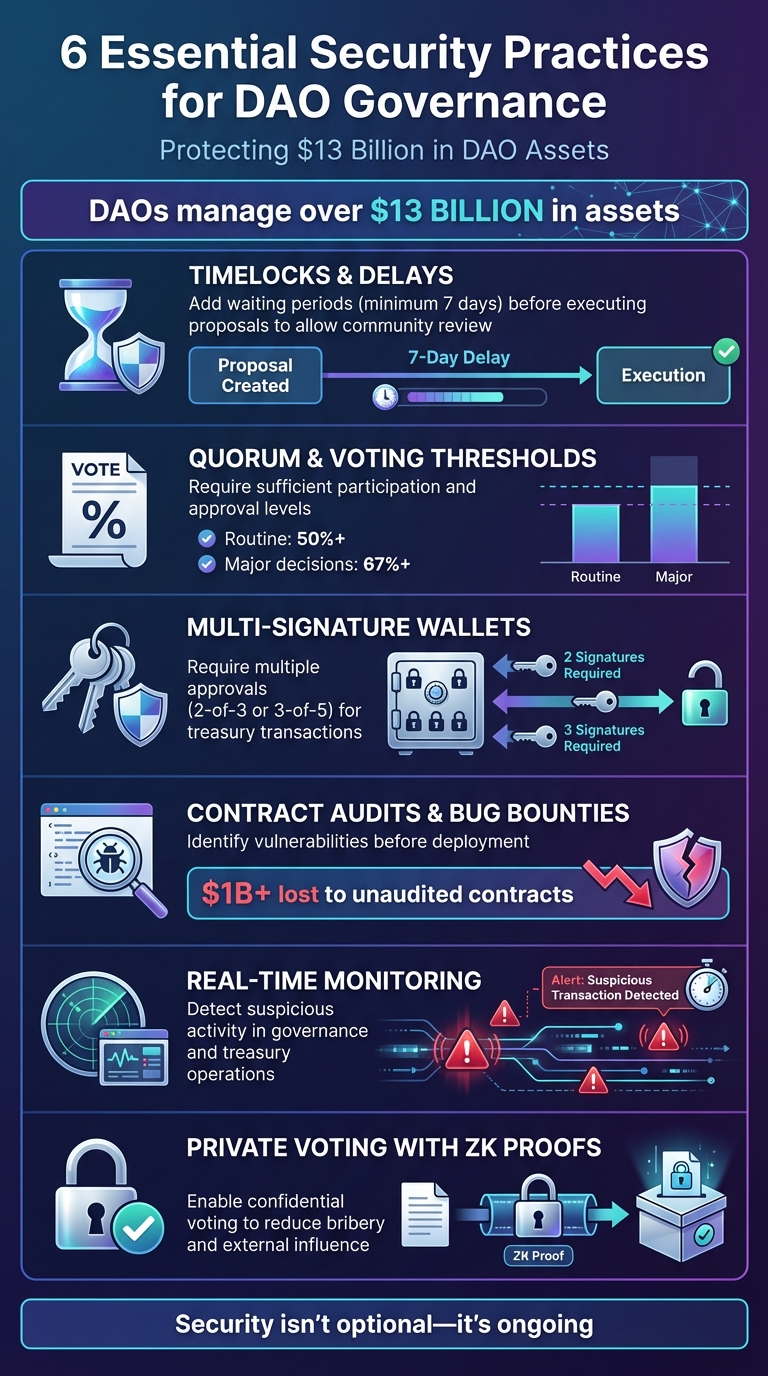
- Timelocks & Delays: Add waiting periods before executing proposals to allow community review.
- Quorum & Voting Thresholds: Ensure sufficient participation and approval levels to prevent low-vote manipulation.
- Multi-Signature Wallets: Require multiple approvals for treasury transactions to reduce single points of failure.
- Contract Audits & Bug Bounties: Identify vulnerabilities before deployment and incentivize ethical disclosures.
- Real-Time Monitoring: Use tools to detect suspicious activity or anomalies in governance and treasury operations.
- Private Voting with ZK Proofs: Enable confidential voting to reduce bribery and external influence.
DAOs can also scale governance effectively by using delegated voting and sub-DAOs that handle specific tasks while maintaining parent DAO oversight. Platforms like Zenao simplify event management and integrate security-focused tools such as DAO-vaults and private voting.
With billions at stake, securing DAO governance isn't optional - it's an ongoing effort combining technical safeguards, community vigilance, and scalable frameworks.
6 Essential Security Practices for DAO Governance
Securing the Vote - How to do secure voting in a DAO
Core Security Practices for DAO Governance
Securing a DAO involves implementing robust measures to protect against potential threats and ensure the safety of its assets. These strategies address vulnerabilities that have historically been exploited in DAO operations.
Use Timelocks and Execution Delays
Timelocks introduce a mandatory waiting period after a proposal is approved, giving the community time to review and, if necessary, take action before execution. This delay acts as a safeguard, allowing members to evaluate proposals and exit the DAO if they disagree with the direction.
A well-structured timelock system requires three distinct roles:
- Proposers: Queue operations for execution.
- Cancellers: Halt malicious or unauthorized actions during the delay period.
- Executors: Finalize and execute transactions.
As OpenZeppelin explains:
"The Timelock contract itself executes transactions, not the user. The Timelock should, therefore, hold associated funds, ownership, and access control roles."
To maximize security, set a minimum delay of at least seven days to give stakeholders enough time for review. Ensure the timelock contract directly manages the DAO's funds and ownership roles. Establish a Security Council with the authority to cancel malicious proposals and relinquish the DEFAULT_ADMIN_ROLE after setup to maintain decentralization.
Additionally, defining quorum and voting thresholds is essential for reinforcing decision-making processes.
Set Quorum Requirements and Voting Thresholds
Quorum refers to the minimum level of participation required for a vote to be valid, while voting thresholds determine the percentage of "yes" votes needed to approve a proposal. Without these mechanisms, DAOs are at risk of low-participation attacks. For example, AQUA DAO suffered a breach when attackers purchased tokens, staked them, and quickly took control due to weak safeguards.
Different types of decisions warrant varying levels of consensus. Routine matters might only need a simple majority (50%+), but major actions - like protocol upgrades or treasury withdrawals - should require super-majorities of 67% or higher. For instance, in March 2025, Lido DAO extended its voting phases to allow more time for review, increasing the main phase from 48 to 72 hours and the objection phase from 24 to 48 hours.
The size and structure of a DAO can influence quorum settings. Large DAOs with a widely distributed token base often set low quorums (around 1%) to prevent deadlocks, whereas wallet-based DAOs typically require 50% or more. New DAOs should analyze participation trends before locking in permanent quorum requirements.
Protect Treasury with Multi-Signature Wallets
Multi-signature (multisig) wallets are a critical tool for eliminating single points of failure in DAO treasury management. They require multiple approvals (using an M-of-N scheme) for any transaction, ensuring that no single compromised key can jeopardize funds.
The Security Alliance (SEAL) highlights this approach:
"The primary objective is to eliminate single points of failure and establish robust, distributed control over high-value assets and critical smart contract functions."
For effective implementation, consider these best practices:
- Use thresholds like 2-of-3 or 3-of-5 to balance security and operational efficiency. Avoid N-of-N setups, which can become problematic if a single key is lost.
- Store signer keys on separate hardware wallets and in different physical locations.
- Segregate "operational wallets" for daily transactions from "treasury wallets" meant for long-term reserves. Treasury wallets should require higher signer thresholds for added safety.
To further mitigate risks, verify transaction details before signing to prevent social engineering attacks. Conduct regular drills to practice emergency recovery scenarios and address compromised keys. Utilize monitoring tools like Safe Watcher, Forta, or Tenderly for real-time alerts on proposed transactions or changes in signer status. Combining multisig setups with timelocks adds an additional layer of security by introducing delays that allow the community to detect and respond to suspicious activities.
Advanced Security Tools for DAOs
As DAOs continue to evolve, advanced security tools play a critical role in staying ahead of threats. Smart contract vulnerabilities alone have cost protocols over $1 billion, while hacks reached $1.8 billion in 2023. These tools go beyond basic practices, tackling the complex and emerging risks DAOs face.
Run Smart Contract Audits and Bug Bounties
Smart contract audits are detailed reviews conducted by security experts to spot vulnerabilities before deployment. These inspections ensure governance contracts are thoroughly vetted. To get the most out of an audit, schedule it once your code is mature, well-documented, and has at least 90% test coverage.
Take the example of ZKsync Association. During an audit by OpenZeppelin, a critical flaw in the ProtocolUpgradeHandler contract was uncovered and resolved before the mainnet launch.
Bug bounty programs add another layer of protection by encouraging ethical hackers to find and report flaws instead of exploiting them. In February 2022, a whitehat hacker reported an "infinite money bug" in the Optimism Layer 2 protocol. This vulnerability could have allowed unlimited ETH creation, but the hacker responsibly disclosed it and earned a $2 million reward - one of the largest payouts in bug bounty history. As Ethereum.org advises:
"A useful strategy is to set the payout of a bug bounty program in proportion to the amount of funds at stake".
To support these efforts, create a transparent vulnerability disclosure policy in your project’s documentation. Additionally, ensure your contracts use the Checks-Effects-Interactions pattern to guard against reentrancy attacks, a common exploit in DAOs.
Use Real-Time Monitoring Tools
While audits and bug bounties are proactive measures, real-time monitoring tools provide immediate threat detection. For instance, OpenZeppelin Defender monitors transactions in real time throughout the proposal lifecycle. These tools can alert teams to suspicious activity, such as unusual token transfers, irregular proposal execution times, or sudden spikes in voting.
Monitoring governance token markets is equally important. Hostile actors can exploit low participation periods to amass voting power, as seen in the $AQUA DAO attack. In that case, attackers bought tokens on a decentralized exchange and quickly staked them to seize control.
To counter such threats, some DAOs have implemented emergency mechanisms. In March 2025, Lido DAO introduced GateSeal, a feature that can pause critical smart contracts - like WithdrawalQueue and ValidatorExitBus - for up to 11 days during a security incident. Lido explains:
"GateSeal acts as an emergency brake on specific smart contracts, allowing for rapid action in response to critical vulnerabilities without waiting for the standard on-chain voting procedure".
To enhance monitoring, program smart contracts to emit events for key actions, enabling off-chain tools to detect anomalies quickly. Combining this with timelocks - typically 48 to 72 hours - gives the community time to veto or stop malicious proposals flagged by monitoring systems.
Apply Zero-Knowledge Proofs for Private Voting
For an extra layer of security, advanced cryptography like zero-knowledge proofs (ZKPs) can safeguard voting confidentiality. ZKPs allow members to vote privately, shielding their choices from external pressure or bribery. While individual votes stay private, ZKPs still ensure the final tally is accurate and that only eligible members participate.
Platforms like COTI offer privacy-focused infrastructure to enhance DAO governance. As Chris Hendzel from Syncra highlights:
"COTI's enterprise-grade privacy infrastructure can transform your DAO governance with confidential voting, encrypted treasury management, and regulatory compliance across 71+ blockchain networks".
What’s more, no-code platforms now make it easier for DAOs to adopt private voting and secure governance without needing custom smart contracts. Beyond voting, ZKP technology can also protect treasury operations, ensuring financial transactions remain confidential while adhering to regulatory requirements.
sbb-itb-8eb1bfa
Scaling DAOs While Maintaining Decentralization
As DAOs grow from small communities into large-scale organizations, one of the biggest challenges is scaling without compromising decentralization. Take the Lido DAO, for instance. Despite a broader token distribution, active voting power dropped from 88,364,207 LDO in Q4 2023 to 63,520,217 LDO in Q4 2024. This decline highlights a paradox: as DAOs expand, participation can dwindle unless governance structures evolve.
The answer lies in modular governance frameworks that distribute decision-making while preserving the community's shared values. By building on strong security principles, DAOs can adopt strategies like delegated voting and sub-DAOs to scale governance effectively without centralizing power.
Set Up Delegated Voting Systems
Low participation rates are a recurring issue for DAOs, with fewer than 10% of eligible token holders casting votes. Delegated voting, or liquid democracy, offers a solution by allowing token holders to assign or revoke their voting power to trusted representatives. This reduces the burden on individual participants while keeping governance active.
Simona Pop, Advisor at Optimism Foundation, emphasizes the importance of alignment between delegates and token holders:
"It's essential to make sure the delegate's values and long-term vision align with yours. They should share a common perspective on the broader objectives of the DAO".
To safeguard against manipulation, DAOs can use snapshotting, which measures voting power at a specific past block. This method prevents flash-loan attacks, where bad actors temporarily borrow tokens to sway votes. The ERC20Votes standard is particularly effective here, offering built-in tools for both delegation and snapshotting.
However, delegation isn't a "fire-and-forget" system. Bob-Rossi, a delegate for Arbitrum, cautions:
"Set-it-and-forget-it delegating is very dangerous to a DAO. It can create a centralizing effect as it limits the ability for new delegates to gain traction".
Token holders need to periodically review their delegates' actions and revoke power if necessary. Some DAOs go a step further by implementing reputation-based governance, where influence is tied to historical contributions rather than just token holdings. This creates a more balanced and equitable power structure.
Use Sub-DAOs for Modular Governance
Sub-DAOs provide another way to scale governance by delegating specialized tasks to smaller, focused groups while keeping the parent DAO in control. For large communities managing diverse responsibilities, sub-DAOs can handle areas like marketing, treasury management, or node operations. This setup allows for quicker decision-making on routine matters, reducing voter fatigue, while leaving major strategic decisions to the parent DAO.
Lido DAO is a prime example of this approach. It uses committees to oversee key functions like node operations and rewards distribution. To ensure alignment, any committee managing over $50,000 must grant an unlimited allowance to the Lido Aragon Agent, allowing the parent DAO to recover funds if needed. As DAO DAO documentation explains:
"SubDAOs are full DAOs that are 100% under the control of their parent DAO. In other words, at any time the parent DAO may execute a proposal on behalf of the SubDAO, but not vice versa".
This parental override mechanism is critical. While sub-DAOs operate autonomously, the parent DAO retains ultimate authority, ensuring that no sub-unit acts independently of the broader community's interests.
A more advanced model, optimistic dual governance, takes this a step further. Here, sub-DAOs or committees can propose and execute decisions quickly, but token holders retain veto power. For instance, in 2024, Taiko DAO introduced an 8-member Security Council. Standard proposals require approval from 3 out of 8 members and are subject to a community veto period, while emergency proposals need a 6 out of 8 supermajority. If no veto is issued during the review period, the proposal is automatically executed after a 7-day timelock.
To maintain balance, DAOs should define granular permissions for sub-DAOs. This includes setting limits on fund withdrawals, restricting parameter adjustments, and requiring quorums for key decisions. Starting with simpler multisig-based sub-DAOs for less critical tasks can help DAOs build confidence before transitioning to more complex token-based governance structures as they grow.
Using Zenao for Secure Community Governance
When it comes to DAOs managing events and community activities, security isn't just a buzzword - it’s a necessity. It spans everything from controlling venue access and handling ticket sales to coordinating participants effectively. That’s where Zenao (https://zenao.io) steps in. This platform simplifies event and community management by offering modular tools that allow organizers to adopt best practices without the need for additional infrastructure.
Zenao's Distributed Governance Features
Zenao's design is built on a modular framework, enabling shared decision-making. For example, event organizers can handle ticketing, while the broader DAO oversees treasury management. This setup reduces the risks tied to centralized decision-making, where a single misstep could have sweeping consequences.
The platform also introduces DAO-vaults to strengthen security. These vaults use selector-based access control and timelocks to separate routine operations from critical administrative or emergency actions. A governor contract oversees the vaults, supported by two timelock controllers - one for high-level tasks like role assignments and another for day-to-day operations. For communities that prioritize privacy, Zenao offers private events with zero-knowledge proofs, letting participants confirm their eligibility without revealing personal information.
Managing Events with Zenao's Governance Tools
Zenao’s governance tools provide event organizers with a streamlined way to handle digital ticketing, community decision-making, and treasury management - all within one platform. Imagine hosting a conference or workshop: participants can vote on agenda items, approve budgets for vendors, or set ticket prices, all through a secure governance framework.
The platform’s selector-based access control ensures permissions are highly specific. For instance, volunteers scanning tickets won’t have access to treasury funds, and marketing teams can’t bypass emergency protocols. This level of precision, often recommended for sub-DAOs, helps event-focused communities grow while maintaining the level of security expected from well-established DAOs. Plus, these tools align seamlessly with broader DAO security practices, ensuring both financial and operational safeguards are firmly in place.
Conclusion
Securing DAO governance requires systems that can withstand both technical vulnerabilities and human-driven manipulation. At the heart of this effort lies the integrity of smart contracts, which must rely on well-tested, professionally audited frameworks. The Beanstalk attack serves as a stark reminder: even contracts that are technically sound can fall victim to exploitation through legitimate voting mechanisms, resulting in staggering losses like the $182 million taken in a single block.
To protect DAO governance, tools such as timelocks, quorum thresholds, and multisig wallets play a vital role. As highlighted by OpenZeppelin:
"The Security Council serves as the final line of defense against exploits, governance attacks and systemic failures".
This human oversight is crucial because, as research indicates, open token markets often fail to differentiate between genuine contributors and malicious actors.
These principles are put into action by platforms like Zenao, which provide practical solutions for DAOs managing events and community activities. Zenao’s modular setup, DAO-vault integration, and optional zero-knowledge proofs for private events empower organizers with robust governance tools - eliminating the need to build complex systems from scratch.
Given the high financial stakes in DAO ecosystems, these multi-layered defenses are more important than ever. Over $2 billion has been lost to smart contract projects that skipped formal audits, and DAO treasuries now manage billions in shared assets. To succeed, DAOs must adopt thoughtful mechanism designs, conduct regular security drills, and establish clear emergency protocols. Security isn’t a one-time effort - it’s an ongoing responsibility that grows alongside the community it protects.
FAQs
What are the biggest security risks in DAO governance?
DAO governance systems encounter several serious security challenges that can compromise their integrity and disrupt fair decision-making.
One major issue is flash-loan attacks. In these cases, attackers borrow a large number of tokens for a short period, use them to manipulate voting outcomes, and then quickly repay the loan. This tactic lets them push harmful proposals without needing to own the tokens long-term. Another concern is off-chain vote manipulation, where voting data managed outside the blockchain can be tampered with, censored, or exploited to unfairly influence results. Furthermore, vote-buying and coercion pose risks, as token-based voting power can leave holders open to bribery or pressure to cast their votes in a particular way.
When you add these vulnerabilities to traditional threats like smart contract bugs or compromised wallets, it becomes clear that DAOs need secure, on-chain governance systems backed by cryptographic protections to ensure their safety and reliability.
What role do timelocks and execution delays play in securing DAO governance?
Timelocks introduce a required waiting period before any proposed action can be carried out. This pause gives the community a chance to review, discuss, or challenge decisions, acting as a safeguard against hasty or harmful changes to the DAO’s governance.
By enforcing delays, transactions can only be completed after the designated period has passed. This creates an extra barrier against immediate, unchecked alterations. These measures work together to promote transparency and give token holders the opportunity to intervene when necessary, bolstering the security of the DAO.
What are sub-DAOs, and how do they help scale DAO governance?
Sub-DAOs function as smaller, semi-autonomous governance units within a larger DAO. Their purpose is to handle specific tasks or oversee particular areas, enabling the main DAO to delegate responsibilities and simplify decision-making processes.
This decentralized approach helps the main DAO work more efficiently by cutting down on bottlenecks and concentrating on overarching strategic objectives. At the same time, sub-DAOs empower specialized teams to make quicker, domain-specific decisions, enhancing the system's ability to grow and adjust as needed.