

Community Management
Decentralization: 10 benefits for organizers, members, and participants
Decentralized event platforms give organizers, members, and attendees control of data, governance, and funds while lowering costs and boosting security.

January 9th, 2026
•
14 min read
Decentralization: 10 benefits for organizers, members, and participants
Decentralization empowers communities by redistributing control from central authorities to individuals. This approach ensures transparency, reduces costs, and enhances security while giving users full ownership of their data and decisions. Platforms like Zenao.io leverage blockchain technology to enable decentralized event organization and community management, offering features like secure data handling, censorship resistance, and transparent governance.
Key Benefits:
- Control Over Data: Users manage their data without relying on third-party platforms.
- Censorship Resistance: Events and communities cannot be arbitrarily shut down.
- Open Governance: Decisions are transparent and involve all stakeholders.
- Lower Costs: Eliminates middlemen, reducing fees and operational expenses.
- Global Access: Events remain accessible across regions, bypassing restrictions.
- User Ownership: Individuals retain control over their digital identity and assets.
- Community-Driven Discovery: Highlights events based on genuine interest, not paid promotions.
- Private Ticketing: Zero-knowledge proofs verify tickets without exposing personal data.
- Scalable Growth: Modular tools allow for easy adjustments as needs evolve.
- Secure Funding: DAO vaults ensure transparent and collaborative financial management.
Decentralization is reshaping event and community management by prioritizing user control, transparency, and efficiency. Platforms like Zenao.io are leading this shift, enabling communities to thrive without reliance on centralized systems.
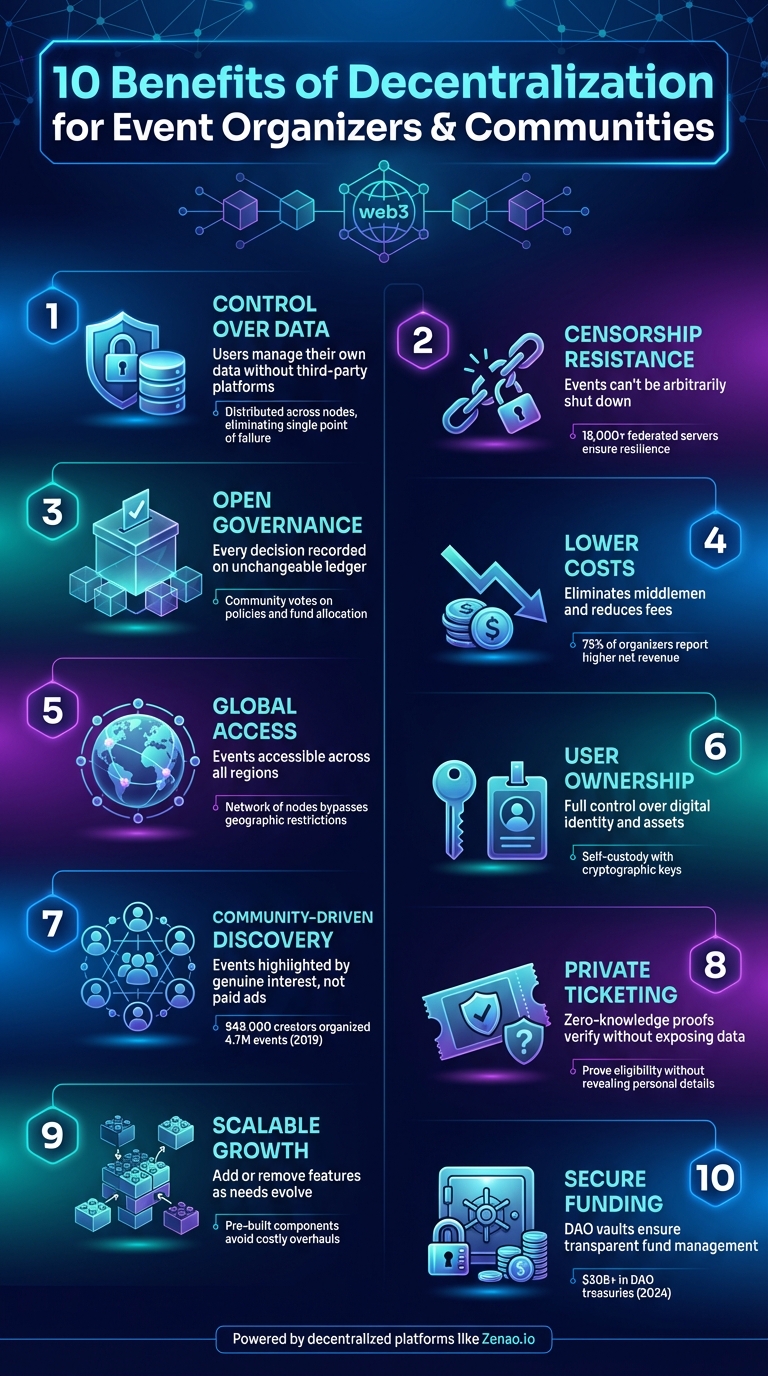
10 Key Benefits of Decentralization for Event Organizers and Communities
DAO - Decentralized Autonomous Organization Explained | What is a DAO | Intellipaat
sbb-itb-8eb1bfa
1. Control Over Your Data
Traditional platforms store your personal data on centralized corporate servers, meaning you have to trust their privacy policies and practices. Decentralized platforms, on the other hand, give you direct control over your data.
In these systems, data is distributed across multiple nodes, which removes the single point of failure that has led to breaches like the infamous 2015 Yahoo hack. This decentralized approach makes attacks far more challenging for bad actors.
"In a well designed decentralized network, you should be able to reduce or eliminate the trust that you're required to put into third parties." - Doug Petkanics, Founder, Livepeer
For event organizers, this setup is a game changer. Blockchain technology adds an extra layer of security with its cryptographic foundation. While transaction histories remain transparent and easy to verify, personal data is securely hashed. This means you can prove your participation in an event without revealing sensitive information.
Using Zenao.io, event organizers gain full control over their community and event data. You maintain authority over your event records and user information, ensuring your events are secure, accessible, and protected from sudden policy changes imposed by third parties.
2. Protection from Censorship
Centralized platforms give a single authority the power to shut down events or change community rules at will. Decentralized systems, on the other hand, spread control across thousands of independent servers. This structure makes it nearly impossible for any single entity to censor content or block access unilaterally.
We’ve seen these advantages play out in real-world examples. In July 2019, when Gab attempted to join Mastodon, independent server administrators blocked its integration through a process called "defederation." Similarly, in June 2024, more than 800 administrators defederated from Meta's Threads via a "Fedipact", effectively protecting their communities from centralized influence.
"A decentralized network is also more resilient to censorship... some servers will be blocked, some will comply, but not all. And creating new servers is easy."
- Eugen Rochko, Founder, Mastodon
For event organizers, this means your community can’t be arbitrarily taken down. If a server’s policies don’t align with your needs, you can easily transfer your account, followers, and connections to another server without losing your network. Today’s decentralized networks include over 18,000 federated servers, with Mastodon alone hosting about 9,000 independent servers.
Platforms like Zenao.io put control back in your hands. You dictate the rules for your events and communities, free from worries about sudden policy changes or account suspensions. Your audience stays yours - no third party can take away your platform or limit access for your participants.
3. Clear and Open Governance
Traditional event platforms often operate behind closed doors, leaving members in the dark about why policies change or how new fees are decided. Decentralized governance flips this approach on its head, ensuring every decision is out in the open for all members to see.
With open governance, every proposal, vote, and decision is recorded on an unchangeable ledger. This transparency creates a clear "feedback loop", where both the process and outcomes of decisions are communicated to everyone involved. For events, this kind of openness fosters trust among organizers and participants, as everyone knows exactly how decisions are made and why.
"Decentralized decision making without a feedback loop is really unaccountable autonomy. When people make decisions or undertake actions without communication of the process and results, it keeps everyone in the dark."
- LeaderLab
This approach highlights how decentralization can empower communities, making decision-making in event management more inclusive and participatory.
For event organizers using Zenao.io, this means the community has the power to vote on everything - from event policies to how funds are allocated. No single entity can impose changes unilaterally. Instead, decisions are shaped collectively, ensuring those most affected by the outcomes have a direct voice in the process.
4. Lower Operating Costs
Decentralization isn’t just about transparency and community empowerment - it’s also a game-changer for cutting operational expenses. By simplifying processes and removing unnecessary middlemen, it helps organizations save money while staying efficient.
Traditional platforms often charge fees for things like ticketing, payments, marketing, and administration. Decentralized systems eliminate many of these fees by automating backend tasks and removing intermediaries. Think of it like how direct-to-consumer retail models have slashed prices by skipping the middleman. Similarly, event organizers can adopt a direct-to-participant strategy, keeping more of their revenue instead of handing over large commissions.
Smart contracts are a key part of this shift. They handle tasks like validation, deployment, and transaction processing automatically, reducing the need for expensive administrative oversight. This mirrors the broader trend of flattening organizational structures to boost efficiency.
But the cost savings don’t stop at administration. Decentralization also trims design and marketing expenses. For example, at the FIL Hong Kong event, organizers used modular toolkits like Fil-city.io to create branded materials quickly, skipping the need to hire outside designers. They also partnered with local media through simple barter deals - offering logo placements in exchange for content publishing - which helped them attract 40% new participants without spending heavily on marketing.
The impact of these tools is clear. Around 75% of organizers who use advanced digital tools report higher net revenue, thanks to direct control over participant data and the elimination of third-party analytics costs.
5. Access from Anywhere
Decentralized platforms break down geographic barriers, enabling broader participation in events and communities. Unlike centralized systems that rely on servers located in one place - making them vulnerable to regional blocks, shutdowns, or restrictions - decentralized networks distribute data across a network of nodes. This ensures that your event or organization remains accessible even if servers in a specific region face disruptions. This global accessibility paves the way for seamless operations across borders.
A great example of this is e&, which operates in 32 countries with a workforce representing 90 nationalities. Their subsidiary, Careem, leverages decentralized principles to serve 50 million customers in 74 cities. This demonstrates how decentralization eliminates geographic limitations, allowing organizations to expand their reach effortlessly.
"By decentralizing certain functions or decision-making processes, companies can empower local teams to respond more effectively to regional needs and market conditions." - Saeed Al Zarooni, Group Chief Procurement Officer, e&
Decentralized systems thrive on peer-to-peer networks and smart contracts, removing the need for traditional intermediaries. This opens the door for anyone with internet access to participate. For instance, the Filecoin Orbit community held roadshows in three regions across China in early 2024, culminating in the FIL Hong Kong event. This event attracted 650 attendees, partnered with 20 Mandarin and Cantonese media outlets, and saw that 40% of attendees were completely new to the Filecoin ecosystem. Such events highlight how decentralized strategies can engage diverse audiences, creating opportunities for growth and collaboration.
The financial impact of decentralization is equally impressive. The DeFi sector, for example, saw Ethereum-based digital assets skyrocket from approximately $600 million in 2020 to over $150 billion by early 2022, fueled by global participation. By removing geographic restrictions, decentralized platforms tap into a vast global pool of talent, resources, and participants - something centralized systems simply can't replicate.
6. Full User Control
Decentralized systems not only provide access from virtually anywhere but also put users in the driver’s seat when it comes to managing their digital identity. With these systems, you alone hold the cryptographic keys, granting you complete ownership and control. This self-custody approach makes it nearly impossible for anyone else to freeze or seize your assets. Essentially, you are in charge of your identity, content, and online interactions.
One of the standout features of decentralized networks is their ability to avoid platform lock-in. Thanks to shared smart contract protocols, independent frontends can operate seamlessly, ensuring continued access even if a primary interface goes offline. Take Liquity Protocol, for example - it incentivizes independent frontend hosts with tokens, ensuring the protocol remains accessible even if its main website is no longer active.
"Users retain control of their data, purchases, and content across web3 products and services." - Miles Jennings, General Counsel, a16z crypto
Another key benefit is the way data is distributed across nodes. This setup eliminates the risk of a single entity gaining control over or shutting down your information. You’re no longer at the mercy of arbitrary terms of service changes or sudden restrictions. Plus, you can move your data freely between services without losing your history, purchases, or connections with your community.
Decentralization fundamentally changes how the internet operates. It shifts from the Web 2.0 model - where a handful of corporations dictate how you interact online and control your data - to a transparent, open, and secure environment where your identity and interactions are entirely in your hands.
7. Community-Led Event Discovery
Decentralization doesn’t just bring transparency to decision-making; it also transforms how communities discover and promote events. Traditional platforms often prioritize corporate interests, paid promotions, and events with broad appeal. In contrast, decentralized systems hand decision-making power to community members who are more attuned to local needs. This shift allows them to highlight events that truly reflect their values and priorities. As Maggie Wooll explains: "The key idea behind a decentralized approach is giving authority and responsibility to those who know best - since they're closer to stakeholders and have relevant information available to them". When people with shared interests and values take the lead, they naturally bring attention to events that align with their community’s core goals. This creates a stronger foundation for impactful event planning.
Take 2019, for example: Eventbrite enabled 949,000 independent event creators to organize and promote 4.7 million events worldwide. That’s the kind of scale and empowerment decentralization can achieve.
Decentralized discovery also levels the playing field for smaller or niche communities that centralized algorithms tend to overlook. A great example is the Lambeth Portuguese Community in London. This network of over 40 local groups curates initiatives like a Breakfast/Homework Club and culturally specific health resources to address the unique needs of their members.
Transparency plays a crucial role here, too. With tools like voting and smart contracts, the decision-making process becomes more open and accountable. Events gain visibility based on genuine community interest, not hidden agendas or paid promotions. This approach builds trust while ensuring that the events spotlighted truly matter to the people they’re meant to serve.
8. Private Ticketing with Zero-Knowledge Proofs
Zero-knowledge proof (ZKP) technology offers a way to verify event tickets without requiring attendees to share personal details like their ID, wallet address, or transaction history. Instead, it generates a cryptographic proof that confirms ticket ownership while keeping all other data private. As Aragon puts it:
"A zero knowledge proof is the ability of a person to prove information (the prover) to someone else (the verifier) that they possess information without actually revealing the information to the verifier".
This system operates on three core principles: completeness (a valid ticket will always pass verification), knowledge soundness (forgery is mathematically impossible), and zero-knowledge (the organizer only learns that the ticket is valid, nothing more). Any fake credentials are automatically rejected.
For event organizers, this means there's no need to collect personally identifiable information, significantly reducing the risk of data breaches. At the same time, attendees can confirm eligibility - like proving they are over 18 or verifying membership status - without exposing additional personal details. This approach isn't just theoretical: Bhutan has already implemented zero-knowledge proofs in its national digital ID system, built on the Ethereum blockchain. Citizens can confirm statements like "I am a citizen" or "I am over 18" without revealing sensitive information from their physical IDs.
Although zero-knowledge proofs were first introduced in 1985, they became practical with the advent of ZK-SNARKs in the early 2010s. These modern proofs are compact - just a few bytes - and can be verified quickly on standard devices, eliminating the need for back-and-forth communication. By combining privacy, security, and efficiency, this technology is transforming decentralized event operations.
9. Flexible Growth Options
Modular decentralization takes the benefits of transparent governance and reduced costs to the next level by offering adaptable growth options. Platforms built with modular architecture allow organizers to add or remove features as their needs change, avoiding the expense and hassle of overhauling an entire system.
Think of it like building with LEGO blocks instead of pouring concrete. With traditional, monolithic systems, even a small change can require a complete system overhaul, potentially costing millions each year on custom development and security audits. Modular frameworks, on the other hand, rely on pre-built, audited components - such as token voting, multisig approvals, or optimistic governance. These components are ready to plug in whenever needed, allowing you to install only the features you require, exactly when you need them.
This concept also applies to decentralized event communities. Permissions-based systems enable specific governance rules to be assigned, such as letting a finance team manage the treasury while a technical council oversees upgrades. This eliminates the need for centralized control. As the community grows, responsibilities can be delegated to specialized subgroups, or SubDAOs, which independently handle specific tasks. This approach prevents bottlenecks in decision-making. A real-world example is Johnson & Johnson, which operates in over 60 countries with more than 130,000 employees. Former CEO William Weldon explained:
"The men and women who run our businesses around the world usually are people who grew up in those markets, understand those markets, and develop themselves in those markets".
This modular strategy supports scalable, community-driven management.
"A modular framework enables organizations to more safely and affordably adapt over time, evolving their governance structures as their needs change - resolving the problem of DAOs becoming entrenched in their existing tools".
Whether you're organizing a small workshop or a multi-city festival, modular decentralization grows alongside your community.
10. Secure Funding Through DAO Vaults
DAO vaults offer a decentralized way to manage community funds, removing the need for a single bank account. These vaults use multi-signature wallets, which require multiple approvals before any transaction can take place. For example, in a 3-of-5 multi-signature setup, at least three out of five designated signers must approve a transaction, reducing the risk of unauthorized spending. As of 2024, Safe (formerly Gnosis Safe) secures over $22 billion in assets managed by DAOs using this method.
By decentralizing financial management, DAO vaults make every fund movement fully transparent. Transactions are permanently recorded on a public blockchain, and smart contracts enforce spending rules, blocking any transaction that doesn’t meet the required votes or approvals. Many DAOs also implement timelocks, typically 24–48 hours, to allow for a final review before executing transactions, adding an extra layer of security.
"A DAO's treasury is most often managed through smart contracts and decentralized governance protocols... ensuring transparency and security over the organization's finances." - Colony
In 2024, DAO treasuries collectively surpassed $30 billion, with leading DAOs holding an average of 35% of their reserves in stablecoins. For treasuries under $10 million, experts suggest using at least a 3-of-5 signature configuration, while larger reserves may benefit from a 4-of-7 setup or higher. Additionally, it's recommended to maintain 12–18 months of operating expenses in liquid stablecoins to protect against market volatility.
DAO vaults transform financial management into a transparent, rules-based process, strengthening trust and ensuring community control. Whether you're funding a local project or a large-scale event, DAO vaults guarantee that every dollar is tracked and every decision reflects the collective voice of the community.
Conclusion
Decentralization is reshaping the way we handle event and community management. By distributing control, it ensures transparency, reduces costs, and gives users genuine ownership of their data and decisions. Instead of relying on intermediaries, this model depends on code and consensus, creating a system where every transaction and governance choice is visible and verifiable. It’s a game-changing approach that combines these benefits into a new standard for managing events.
One of the standout advantages of decentralization is the elimination of middlemen, which simplifies cost structures and financial management. DAO vaults, for instance, allow communities to manage funds transparently using multi-signature wallets and smart contracts. With blockchain technology projected to drive $3.1 trillion in new business value by 2030, this shift to decentralized systems presents a major economic opportunity for communities across the globe. These financial benefits highlight why platforms like Zenao.io are setting a new standard in event management.
"Decentralization has, not only an administrative value but also a civic dimension since it increases the opportunities for citizens to take interest in public affairs; it makes them get accustomed to using freedom." - Alexis de Tocqueville
Zenao.io embodies these principles with features like seamless ticketing, role-based governance, and secure tools for managing funds and data. Instead of treating users as mere consumers under corporate control, Zenao empowers them as active members and owners of their own decentralized organizations.
Through decentralization, event organizers and participants alike gain the tools to create transparent, resilient, and community-driven experiences. As this model continues to redefine engagement, platforms like Zenao.io are leading the way in enabling everyone to take part in this transformation.
FAQs
How does decentralization improve security and protect data privacy for event organizers?
Decentralization improves security by spreading control and data across a network of independent nodes. This setup removes the risk of a single point of failure, making it much more difficult for bad actors to breach the entire system.
On top of that, decentralization fosters a trust-minimized environment. Here, participants collectively verify information, removing the need to depend on a central authority. This not only bolsters security but also provides stronger safeguards for sensitive data, offering event organizers greater confidence in their system's integrity.
How do DAO vaults ensure secure and transparent management of community funds?
DAO vaults function as secure, code-driven treasuries designed to protect community funds. Access to these funds is tightly controlled, requiring member-approved proposals or votes, which ensures transparency and encourages collective decision-making.
By eliminating the possibility of unilateral access, DAO vaults safeguard assets from potential misuse or mismanagement. This approach ensures that every financial decision aligns with the goals established by the community.
How does decentralization make events more accessible and inclusive for a global audience?
Decentralization allows event organizers and participants to connect directly, cutting out the middleman. This means local teams can handle tasks like setting prices, scheduling sessions, and approving registrations instantly. The result? A more dynamic and seamless experience for everyone involved. International attendees, for instance, can join events without delays or red tape, no matter where they are.
What’s more, decentralized systems cater to local preferences while operating within a global framework. Think about it: U.S. participants see familiar formats like $ for currency or MM/DD/YYYY for dates, which makes the process feel natural and intuitive. At the same time, these systems can adapt to other languages, currencies, and customs, creating a truly borderless environment where anyone can join, contribute, and participate with ease.
By giving local organizers the tools to address attendee needs quickly and tailor experiences, decentralization builds trust and invites more people from around the world to get involved. It transforms events into open, flexible platforms that anyone can access and help shape.