

Event Planning
How DAOs Manage Event Budgets Effectively
DAOs manage event budgets using multisig treasuries, smart contracts, milestone payments, stablecoins and token voting for transparent, accountable spending.

February 10th, 2026
•
11 min read
How DAOs Manage Event Budgets Effectively
DAOs (Decentralized Autonomous Organizations) are reshaping how event budgets are managed. By using blockchain technology, they ensure transparency, automate fund distribution, and allow community-driven decisions through token-based voting. Here's how DAOs tackle event budgeting:
- Transparent Financial Tracking: Every transaction is recorded on-chain, offering real-time visibility.
- Automated Fund Allocation: Smart contracts distribute funds based on predefined conditions, eliminating delays and errors.
- Community Governance: Members propose and vote on budgets, ensuring decisions are inclusive and accountable.
- Stablecoin Reserves: Treasuries often hold stable assets like USDC or DAI to avoid crypto volatility.
- Milestone-Based Payments: Funds are released incrementally as goals are achieved, reducing risks.
DAOs like Metafest DAO and EventsDAO have successfully used these methods to organize events. Tools like Safe multisig wallets and platforms such as Zenao simplify this process further, offering features for planning, tracking, and governance. This approach minimizes manual intervention, enhances accountability, and empowers communities to take charge of event planning.
Setting Up a DAO Treasury for Event Budgets
Creating a DAO Treasury on Blockchain
To set up a DAO treasury, you'll first need to choose a blockchain platform. Options like Ethereum, Polygon, or Arbitrum are common choices. Ethereum is the go-to platform for many due to its established ecosystem, but Polygon and Arbitrum are attractive alternatives because of their lower transaction costs - an important factor when handling frequent event-related payments.
Smart contracts, on-chain governance systems, and analytics tools are key components for securing and managing treasury funds. Most DAOs rely on multi-signature wallets - such as Safe (formerly Gnosis Safe) - to ensure that transactions require multiple approvals. These wallets use an M-of-N system, meaning a predefined number of signers must approve any transfer before funds can be moved.
When funding your treasury, aim to hold 18–36 months' worth of operating expenses in stable, liquid assets. Specifically for event budgets, maintain reserves in stablecoins like USDC, USDT, or DAI. These assets help shield your treasury from the volatility of cryptocurrency markets. As highlighted in Aragon's treasury guide:
The first principle of DAO treasury management - as with any asset management - is not to lose money.
With the technical setup in place, the next step is establishing clear rules to govern how funds are used.
Establishing Governance Rules for Funds
Once your treasury is operational, governance rules are critical to ensure spending is transparent and accountable. These rules dictate who can propose expenditures, how voting is conducted, and what criteria must be met before funds are released.
Take the Arbitrum DAO as an example. In October 2024, they allocated $1.5 million for their 2025 event budget by setting aside 4 million ARB tokens to convert into stablecoins. Their governance framework required event proposals to pass a Snapshot vote with at least 3% of the votable token supply. Funds were then managed using a multi-signature wallet, and service providers were required to submit post-event reports detailing costs and outcomes. This approach ensured both accessibility and accountability.
Key governance parameters to consider include:
- Quorum: The minimum percentage of votes needed for a proposal to pass.
- Threshold: The number of tokens required to submit a proposal.
- Voting period: A timeframe that accommodates members across various time zones.
- Timelock: A delay after voting to allow for review before executing fund transfers.
Additionally, some DAOs use milestone-based disbursements, releasing funds incrementally as event organizers meet specific goals. This method reduces risk by avoiding the upfront release of the entire budget.
sbb-itb-8eb1bfa
Community-Driven Budget Planning
Proposal Submission and Voting
In DAOs, proposals often start as discussions within community spaces like Discord or Discourse. These conversations allow members to provide feedback and refine ideas before moving to formal on-chain submission.
When a proposal is ready, it’s submitted officially. Some DAOs have requirements for this step - like Api3, which mandates at least 0.1% of the staking pool to create a proposal. A strong proposal typically includes detailed event costs, funding needs, and measurable KPIs to ensure clarity and accountability.
Voting usually operates on a token-based system, where voting power is tied to the number of tokens held. Proposals are often divided into categories such as "Primary", which requires an absolute majority, or "Secondary", which might need a lower threshold like 15% support. Once a vote is approved, there’s often a grace period - typically around seven days - giving dissenting members the chance to exit before funds are released.
This structured approach fosters transparency and encourages active participation in budget decisions.
Engaging the Community for Transparent Decisions
After proposals are submitted and voted on, maintaining transparency and accountability becomes essential. Community engagement plays a central role in ensuring every transaction is clear and traceable.
Real-time discussions and deliberations happen on platforms like Discord, Telegram, and Discourse. Members can verify financial transactions using blockchain explorers like Etherscan, ensuring funds are allocated and used as promised.
To keep everyone informed, DAOs often rely on centralized documentation tools like Notion or GitHub. These serve as a single source of truth, ensuring members who can’t attend live discussions stay updated. For example, in January 2025, Gitcoin DAO submitted a budget proposal for $808,098, led by contributor "deltajuliet", to fund operations through December 2025. The breakdown included $301,575 for the core team, $160,800 for consultants (handling marketing, design, and regional coordination), and $30,000 for travel and events. The proposal also committed to quarterly updates on budget use and progress toward goals.
Community engagement extends beyond voting. Many DAOs hold weekly calls or icebreaker sessions to strengthen member connections. Incentives like tokens, bounties, and POAPs, combined with career development opportunities, help sustain long-term involvement.
Transparency is a key pillar that cultivates trust and collaboration within a DAO. By openly sharing decision-making processes and outcomes, a DAO can bridge the gap between its members.
Additionally, platforms like Zenao simplify decentralized event management by offering tools to organize events, track expenses, and facilitate governance. This makes it easier for DAOs to maintain clear and efficient budget planning.
Using Smart Contracts for Budget Allocation
Automating Fund Distribution with Smart Contracts
Smart contracts simplify the process of distributing funds by automating releases once specific conditions are met. For DAOs managing event budgets, this means that after a community vote is approved, the smart contract instantly allocates funds to designated categories - no manual input required.
"A smart contract acts like a digital escrow or digital legal clause: when all parties' obligations encoded in the program are fulfilled, the contract self-enforces the outcome, providing transparency and trust in a tamper-proof way." - Fedotov, 2024
This isn't just theory; there are real-world examples of how this works. Back in September 2017, AXA launched the "Fizzy" platform on Ethereum to automate insurance payouts. The smart contract was tied to global air traffic databases. If a flight was delayed by more than two hours, the contract automatically triggered a payout to the policyholder - no need for a manual claim.
For DAO event planning, funds can be released in stages based on milestones. For instance, a venue vendor might receive an initial payment upon signing a contract (verified on-chain), another payment after confirming the venue setup (possibly verified through photos uploaded to IPFS), and the final payment once the event concludes successfully. The smart contract ensures funds are held securely in escrow and released only when milestones are verified, often using oracles to connect real-world data to the blockchain. This automation not only keeps payments timely but also ensures transparency and accountability in handling budgets.
Tracking Expenses in Real-Time
Smart contracts don't just automate payments - they also allow DAOs to keep an eye on expenses as they happen. On-chain dashboards provide real-time visibility, logging every transaction on the blockchain for DAO members to review.
Platforms like Sablier and LlamaPay have made strides in this area by introducing streaming payments. Instead of lump sums, funds flow continuously over time. For example, Optimism DAO used Sablier to manage the distribution of 10 million OP tokens during their RetroPGF Round 4 in 2024/2025. The tokens were released gradually through time-locked escrow. Similarly, Gitcoin used LlamaPay to automate grant payments throughout project lifecycles, cutting down on manual treasury management.
Even smaller teams are leveraging these tools. Silhouette, a shielded trading platform with eight core contributors, uses Sablier integrated with a Safe multisig wallet to pay team members in real time. Contributors can withdraw their earned funds whenever they want, while the DAO maintains full oversight of its treasury.
"I think it's very important web3 teams use web3 tools. You guys are definitely one of the standard economic tools of the future." - Chandler De Kock, CEO, Silhouette
Platforms like Zenao add another layer by offering decentralized event management tools that integrate seamlessly with blockchain-based payment systems. These tools allow DAOs to handle ticketing, governance, and event logistics transparently while keeping expenses in check.
As of early 2026, DAO treasuries collectively hold around $24.5 billion, with $17.8 billion in liquid assets. Much of this is managed through automated systems powered by smart contracts, demonstrating their growing role in efficient and transparent fund management.
DAO Treasury Management: How DAOs Manage Their Funds Explained
Best Practices for Managing DAO Event Budgets
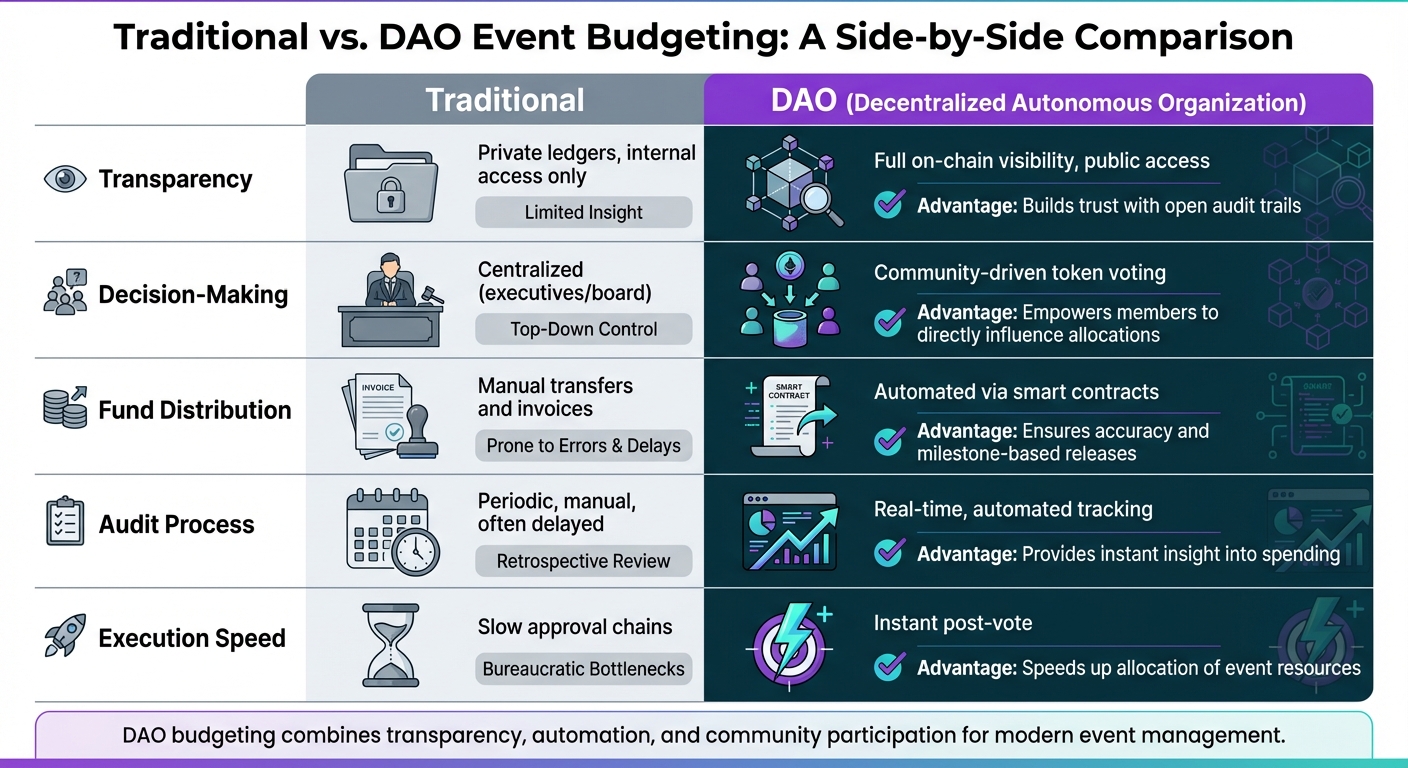
Traditional vs DAO Event Budget Management Comparison
Conducting On-Chain Audits
After automating fund distribution, it's essential to maintain strong auditing practices to safeguard DAO event budgets. A multi-signature wallet, like Gnosis Safe with a 3-of-5 approval configuration, adds an extra layer of security by requiring multiple sign-offs for transactions. Tools such as Dune Analytics and Llama can provide real-time visibility into treasury balances and wallet activity. However, blockchain data alone can feel incomplete - adding brief documentation for each expense (e.g., "$5,000 venue deposit for a workshop on March 15") provides valuable context.
"Managing financial reporting for DAOs requires a shift in mindset - from private ledgers and silent audits to public dashboards and community-facing updates." - Block3 Finance
To align on-chain activity with the approved budget, consider publishing monthly or quarterly financial summaries on community platforms like Discourse or Snapshot. These updates give the community a clear picture of how funds are being used. For an extra layer of security, you might also bring in audit firms like CertiK to review the smart contracts managing your budget. This step can help catch vulnerabilities before they become expensive problems.
Encouraging Fair Representation in Budget Decisions
Making budget decisions fair starts with accessibility. Begin with a Request for Comments (RFC) phase before formal voting, giving community members time to discuss and refine event proposals. Platforms like Discourse act as open forums for these debates, ensuring that ideas are transparent and easy to follow.
Using standardized proposal templates can also simplify the process for new members. These templates should cover key areas like mission alignment, team background, financial details, and measurable KPIs. Additionally, setting quorum requirements ensures that budget decisions reflect the larger community's interests.
"DAOs that are cliquey, geographically limited, or culturally homogeneous will always be more vulnerable to attack than diverse DAOs simply because they don't have access to as much information and have stronger biases." - Aragon
Building a diverse, global membership - spanning different time zones and perspectives - reduces groupthink and strengthens decision-making. To address low participation in voting, offering token-based rewards can motivate members to engage in reviewing and approving budget proposals.
Traditional vs. DAO Budgeting Comparison
DAO budgeting introduces a fresh approach that contrasts with traditional methods in several key areas:
| Aspect | Conventional Method | DAO Method | Advantages |
|---|---|---|---|
| Transparency | Private ledgers; internal access only | Full on-chain visibility; public access | Builds trust with open audit trails |
| Decision-Making | Centralized (executives/board) | Community-driven token voting | Empowers members to directly influence allocations |
| Fund Distribution | Manual transfers and invoices | Automated via smart contracts | Ensures accuracy and milestone-based releases |
| Audit Process | Periodic, manual, often delayed | Real-time, automated tracking | Provides instant insight into spending |
| Execution Speed | Slow approval chains | Instant post-vote | Speeds up the allocation of event resources |
The switch from traditional to DAO budgeting isn’t just about adopting new technology - it’s about creating systems where transparency and community involvement are at the heart of every financial decision. For example, platforms like Zenao offer decentralized tools that combine blockchain-based payments with event management. From digital ticketing and governance to detailed budget tracking, Zenao helps DAOs manage every aspect of their events while maintaining full financial transparency.
Conclusion
Managing event budgets through DAOs marks a shift from traditional top-down planning to a more open and community-driven approach. By leveraging blockchain, smart contracts, and decentralized governance, DAOs replace the secrecy of private ledgers with real-time, public tracking of every dollar spent. This transparency fosters trust and invites community members to actively participate in decisions - whether it's allocating budgets or choosing vendors.
The benefits are hard to ignore: automated fund distribution and multisig security streamline operations and reduce risks, while on-chain audits ensure instant accountability. Organizations using DAO budgeting can achieve quicker execution, lower administrative costs, and stronger community involvement. These advantages signal a new way forward. As the Zenao Manifesto puts it:
In case of emergency, stay zen and organize.
For those ready to explore this approach, Zenao offers tools tailored for practical use. With features like role-based governance, digital ticketing, and upcoming multisig vaults for co-managing crypto funds, Zenao simplifies DAO technology without losing the core benefits of transparency and community participation. By treating every community and event as a DAO, Zenao makes decentralized budgeting accessible to users who value simplicity and efficiency over technical complexity.
Blending transparency, streamlined processes, and community-driven decisions creates a resilient framework for event management that aligns with shared values. Whether you're planning a small workshop or a large-scale festival, DAO tools provide the structure to handle budgets openly and effectively. The technology is here, the platforms are ready, and the results speak for themselves. The time to embrace DAO budgeting is now.
FAQs
How do DAOs prevent event funds from being misused?
DAOs help ensure event funds are used properly through transparent, on-chain governance. They achieve this by employing tools like multi-signature wallets, which require multiple approvals for transactions, and role-based permissions, which limit access based on specific responsibilities. Additionally, token-weighted voting allows community members to have a say in decisions proportionate to their stake. These mechanisms work together to ensure funds are distributed according to approved proposals and predefined rules, fostering accountability and trust.
What should an event budget proposal include to get approved?
An event budget proposal needs to clearly communicate several key elements: the purpose of the event, a detailed breakdown of costs, the amount of funding required, and a plan for how the funds will be allocated. Laying out this information in a straightforward way not only ensures clarity but also boosts the chances of getting the proposal approved.
How do milestone-based payments work for vendors and organizers?
Milestone-based payments involve releasing funds in phases as distinct project milestones are achieved and confirmed. This approach usually adheres to a set protocol, ensuring clear accountability and transparency for both the vendor and the organizer.