

Governance
Ultimate Guide to On-Chain Financial Reporting for DAOs
Guide to DAO treasury reporting: balance sheets, cash flow, multisig security, automation, and tax/compliance practices for real-time transparency.

February 2nd, 2026
•
13 min read
Ultimate Guide to On-Chain Financial Reporting for DAOs
On-chain financial reporting is a game-changer for DAOs. It transforms blockchain data into real-time financial insights, fostering transparency and accountability. Unlike traditional organizations, DAOs rely on public, immutable blockchain records to create financial statements like balance sheets and income statements. This ensures all members can access up-to-date financial data, enabling better decision-making and trust.
Key takeaways:
- Real-time tracking: Blockchain APIs and smart contracts automate data collection, reducing errors.
- Transparency: All transactions are publicly visible, creating a permanent audit trail.
- Unique DAO needs: Financial reporting includes managing DeFi activities, token-based compensation, and treasury diversification.
- Tools to use: Platforms like Gnosis Safe, Aragon, and Request Finance simplify treasury management and reporting.
Asset Management & Financial Reporting for DAOs with Jack Gale from kpk (formerly karpatkey)
sbb-itb-8eb1bfa
Core Components of DAO Financial Reporting
DAOs integrate traditional financial reporting practices with blockchain technology, creating a unique approach to tracking and managing financial data. Here's a closer look at the essential elements that form the backbone of DAO financial reporting.
Balance Sheets and Asset Classification
A DAO's balance sheet is quite different from that of a traditional company. Instead of cash and inventory, DAOs classify assets into categories like digital holdings (operational vs. treasury), locked DeFi positions (e.g., staked tokens or liquidity provider positions), and non-fungible tokens (NFTs). These assets often include native governance tokens, stablecoins like $USDC and $DAI, and Layer 1 assets such as $ETH. Additionally, staked positions across various protocols must also be accounted for.
For example, MakerDAO and MicroStrategy use segmented wallet classifications to track their holdings more effectively.
Valuing these assets can be tricky. Under IFRS, cryptocurrencies are treated as intangible assets (IAS 38), while US GAAP traditionally required historical cost valuation with impairment-only adjustments (ASC 350). However, newer accounting standards now allow certain crypto assets to be measured at fair value, with gains recognized only when sold.
"A well-designed crypto chart of accounts is the pillar of transparent, compliant Web3 financial transactions." - KoinX
Liabilities in DAOs also require careful tracking. These include token-based compensation (distinguishing between vested and unvested grants) and DeFi borrowing positions, such as collateralized loans on platforms like Aave or Compound. A detailed chart of accounts (COA) is essential, with specific codes for items like gas fees (Account 5010), unvested token grants (Account 2010), and unrealized crypto gains or losses (Account 6010). By clearly categorizing assets and liabilities, DAOs can streamline their financial processes and improve revenue tracking.
Income Statements and Revenue Streams
DAO income statements reflect revenue sources unique to the Web3 ecosystem. These include protocol fees, supply-side fees paid to liquidity providers, token incentives for user acquisition, and earnings from yield farming. Unlike traditional businesses that report earnings monthly or quarterly, blockchain technology allows DAOs to access revenue data almost in real time.
"The unique property of blockchains is that business data is made accessible in near real-time." - Token Terminal
How DAOs handle protocol fees can vary. Some retain revenue in yield-bearing stablecoins, while others do not keep protocol fees in their treasuries at all. This highlights the importance of separating operating revenue from treasury investment gains when assessing a DAO's financial health.
Expense tracking also presents unique challenges. DAOs must account for costs like blockchain transaction (gas) fees, smart contract audits, and contributor payments made through streaming protocols. For example, on Ethereum, transaction fees need to be separated from the principal transfer value to ensure accurate profit-and-loss tracking. If a contributor receives $10,000 with a $50 gas fee, the payment should be recorded as $10,000 in compensation expense and $50 in transaction costs. Beyond revenue, tracking cash flows and governance budgets in detail is essential for maintaining financial stability.
Cash Flow Tracking and Governance Budgets
DAOs rely on cash flow monitoring to manage burn rates, track governance spending, and assess treasury health in real time. Tools like Dune Analytics and custom dashboards connected to blockchain APIs provide live insights into wallet activity. Streaming payment systems like Superfluid and Sablier further enhance transparency, allowing DAOs to monitor contributor compensation and burn rates continuously, rather than waiting for periodic reports.
Lido Finance, for instance, uses an AccountingOracle contract to update validator balances and protocol vaults in real time, ensuring consistent daily treasury reporting.
Maintaining a liquid reserve is a priority for many DAOs, with targets often set at 18–36 months of operating expenses. However, as of June 2021, many DeFi DAOs held nearly all their treasury assets in native governance tokens, exposing them to significant risk during market downturns. This has led to diversification strategies, such as allocating funds to stablecoins or real-world assets like U.S. Treasuries. MakerDAO, for example, has strategically invested in U.S. Treasuries and corporate bonds through regulated entities to reduce risk and generate additional yield.
CFOs in DAOs also play a key role in publishing reports that compare approved budgets to actual spending, explaining any variances to the community. This practice ensures accountability and helps token holders see whether governance decisions are being implemented as planned. Combining automated data pipelines with milestone-based funding - where treasury disbursements are tied to specific outcomes - further strengthens accountability and cash flow management. Together, these practices ensure transparent, on-chain financial reporting and foster trust in DAO operations.
Tools for On-Chain Financial Reporting
Transparent, real-time financial reporting is essential for DAOs, and several tools help streamline treasury management. DAOs need software that provides real-time asset tracking, secure multi-signature approvals, and automated workflows. Three standout platforms for these needs are Gnosis Safe, Aragon, and Request Finance.
Gnosis Safe for Treasury Security
Gnosis Safe (often referred to simply as Safe) ensures treasury security with its multi-signature approval system. This feature requires multiple parties to authorize transactions, creating an on-chain record that verifies each step of the process.
Safe also allows DAOs to assign specific permissions to wallets. For instance, one wallet may be authorized to "create new payments", while another focuses on managing smart contract interactions. This level of control helps DAOs maintain accountability and detailed audit trails.
A unique feature of Safe is its transaction simulation tool, which tests operations before they go live. This prevents issues like incorrect gas estimates, parameter errors, or ABI mismatches. Since its launch in 2017, Safe has integrated with Aragon OSx infrastructure to secure billions in total value locked, with no reported security breaches.
Aragon for Financial Dashboards
Aragon offers a Finance App that provides real-time token balances and transaction histories, complete with filtering options and CSV export capabilities for easier accounting.
What sets Aragon apart is its governance integration. DAOs can use Aragon to propose financial actions - like moving or purchasing assets - and once the proposal is approved through voting, the transaction executes automatically. With a track record of managing over $35 billion in assets across more than 10,000 projects, Aragon’s combination of financial dashboards and governance tools simplifies the link between financial reporting and decision-making.
Request Finance for Invoicing and Payments
While Aragon shines in asset tracking and governance, Request Finance specializes in automating invoicing and payments. It centralizes crypto and fiat transactions, automating accounts payable (AP) and accounts receivable (AR) tasks. The platform manages payroll, invoices, and expense claims, categorizing payments for easy integration with bookkeeping tools like Xero.
Since January 2021, around 60% of the $770 million in crypto payroll, expenses, and invoices processed through Request Finance have been in USD-stablecoins. This focus on stablecoins helps DAOs maintain accurate records without the hassle of adjusting for crypto volatility.
For example, The Sandbox replaced manual wallet transfers with Request Finance, significantly reducing administrative work. Similarly, Robin Lehmann, co-founder and CEO of DataUnion, highlighted the inefficiency of using "a combination of MetaMask and a spreadsheet" for financial tracking. By automating these processes, Request Finance reduces errors and eases the administrative burden of managing crypto transactions.
Setting Up On-Chain Reporting Workflows
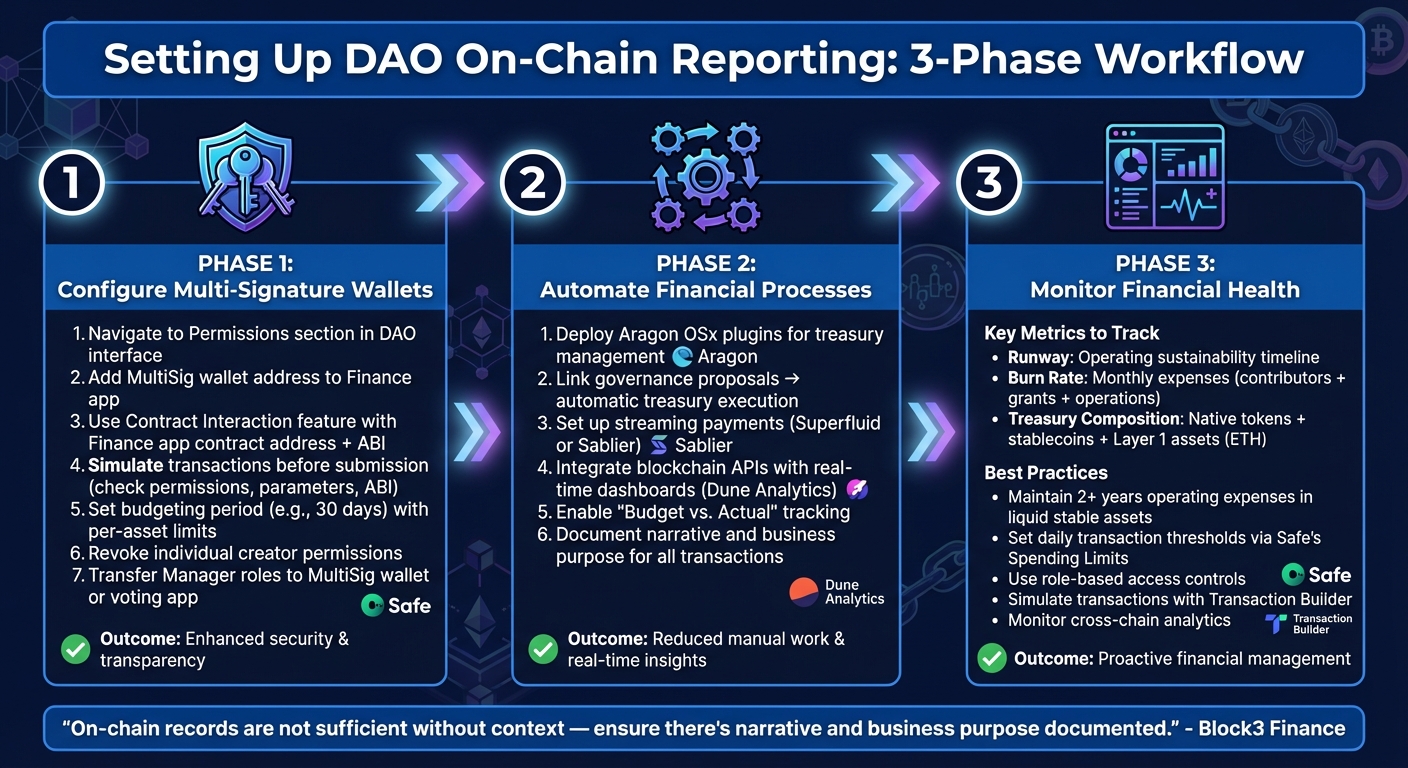
DAO On-Chain Financial Reporting Setup Workflow
Configuring Multi-Signature Wallets
Multi-signature wallets, such as Safe, play a crucial role in managing your DAO's treasury operations. These wallets act as entities within your DAO's Access Control List (ACL), enabling secure and streamlined financial management. To set this up, head to the Permissions section in your DAO's interface, select the Finance app, and add the MultiSig wallet address. When it's time to execute payments, use the Contract Interaction feature. Here, you'll need the DAO's Finance app contract address and its ABI (Application Binary Interface).
Before submitting any transactions, use the Simulate feature to double-check permissions, method parameters, and the ABI. This step minimizes potential errors and avoids unnecessary transaction fees. For added control, configure a budgeting period (e.g., 30 days) to establish per-asset limits, capping transfer volumes within that timeframe. Once everything is set, revoke permissions from individual creator addresses and transfer Manager roles to the MultiSig wallet or a voting app. This ensures decentralized control and reduces reliance on individual actors.
By implementing these steps, your DAO's financial activity feeds directly into live dashboards, enhancing both operational security and transparency.
Automating Financial Processes
Once your MultiSig controls are in place, take the next step by automating repetitive treasury tasks. Modular frameworks like Aragon OSx simplify this process by using plugins - specialized smart contracts designed to handle specific tasks like treasury management or bundled actions. For example, you can link governance proposals directly to treasury actions, so transactions execute automatically once a vote passes, eliminating the need for manual intervention.
Instead of processing monthly payments manually, consider protocols like Superfluid or Sablier to enable automated streaming payments. These systems ensure a continuous flow of value to contributors without the hassle of recurring transfers. Additionally, integrate blockchain APIs or subgraphs with real-time dashboards, such as Dune Analytics, to automate reporting. This setup supports "Budget vs. Actual" tracking, making it easier to spot discrepancies as they happen.
"On-chain records are not sufficient without context - ensure there's narrative and business purpose documented." - Block3 Finance
Monitoring DAO Financial Health
With automation in place, your focus can shift to monitoring the financial health of your DAO. Use cross-chain analytics tools to track data from your MultiSig wallets and aggregate insights across multiple networks. Pay close attention to these key metrics:
- Runway: How long your DAO can sustain operations based on current spending rates.
- Burn Rate: Monthly expenses, including contributor payments, grants, and operational costs.
- Treasury Composition: The mix of assets in your treasury, such as native tokens, stablecoins, and Layer 1 assets like ETH.
A common best practice is to maintain at least two years' worth of operating expenses in liquid, stable assets. To further protect your treasury, utilize Safe's Spending Limits & Roles feature. This allows you to set daily transaction thresholds and assign role-based access, reducing the risk of unauthorized transfers. For more complex treasury operations, tools like Safe's Transaction Builder can help you simulate outcomes and identify potential risks before executing.
"I use a multisig (safe) for >90% of my personal funds. M-of-N, some keys held by you... the rest held by other people you trust." - Vitalik Buterin, Co-founder, Ethereum
Advanced DAO Financial Management Strategies
Taking automated monitoring a step further, these strategies aim to strengthen and streamline the financial management of DAO treasuries.
Diversifying Smart Contract Wallets
Relying on a single wallet for all DAO assets can create vulnerabilities. Instead, spread funds across multiple wallets to enhance security and operational flexibility. By setting up sub-treasuries, each managed by smaller committees, DAOs can handle day-to-day expenses more efficiently while reserving major decisions for the broader community. This reduces governance overload and ensures smoother operations.
Another common issue is over-concentration in a single token - many DAOs hold more than 90% of their treasury in one asset, which increases exposure to market swings. A good practice is to maintain at least two years' worth of operating expenses in stable, liquid assets like USDC or DAI. Tools like Weezi and Multis can simplify the process by allowing DAOs to monitor funds across multiple wallets and blockchains from a single dashboard.
For added security, use M-of-N multisig wallets with role-based spending limits and rotate signers regularly. Conducting test runs for treasury operations can further reduce the risk of errors. Additionally, consider using Ethereum staking as a baseline investment for stable returns, often viewed as a "risk-free rate" in DAO treasury management.
Scenario Modeling and Runway Projections
To ensure financial stability, model your DAO’s finances and calculate its runway. This involves tracking your burn rate and ensuring you have enough liquidity to cover 18–36 months of operating expenses, allowing you to weather market fluctuations.
Sensitivity analysis can refine these forecasts. For instance, if your native token's value drops by 50%, calculate how much stablecoin reserve is needed to sustain operations based on your budget. Tools like Chainlink's SmartData (NAVLink and SmartAUM) offer real-time, on-chain modeling for tracking Net Asset Value and Assets Under Management.
"A sustained bear market might force DAOs to sell native tokens at 'fire-sale' prices to finance their normal operations." - Yuan Han Li, Blockchain Capital
Dashboards that compare approved budgets to actual on-chain spending can quickly flag discrepancies. Some AI-powered treasury protocols are now capable of autonomously rebalancing assets when predefined financial thresholds are met, reducing the need for frequent governance votes. Forming a dedicated treasury committee can also improve operational efficiency by handling routine tasks while leaving major decisions to the community.
While building robust financial models is key, ensure your treasury management strategies also comply with relevant regulations.
Tax and Legal Considerations for DAOs
Proper tax and regulatory compliance is essential to safeguard DAO assets. Under IRS Notice 2014-21, stablecoins and governance tokens are classified as property, not currency. This means every transfer, spend, or swap triggers a taxable event. Additionally, staking rewards, liquidity provider fees, and airdrops are considered ordinary income, taxed at their fair market value upon receipt.
Starting January 1, 2025, Rev. Proc. 2024-28 will require individual cost basis tracking for each wallet address, replacing the universal pooling method. By 2026, Form 1099-DA will mandate reporting of gross proceeds and full cost-basis details, with thresholds set at $600 for centralized brokers and $10,000 in aggregate for non-custodial wallets.
"Every stablecoin disposition, regardless of $0.0001 deviation, triggers a reportable capital gain or loss under IRS Notice 2014‑21." - Stablecoin Tax Guide 2025
To navigate these challenges, many DAOs establish legal entity wrappers, such as Wyoming LLCs, Unincorporated Non-profit Associations (UNAs), or offshore foundations. These structures provide regulatory clarity and limit liability for members. For example, MakerDAO allocated parts of its treasury to U.S. Treasuries and corporate bonds through regulated entities, balancing yield generation with compliance.
Maintaining thorough documentation is equally important. A "Crypto Audit Binder" that includes signed accounting policies, transaction ledgers, and reconciliations to Form 1099-DA can help satisfy auditors. On-chain records alone won't suffice - you must also document the purpose behind each transaction to meet regulatory requirements.
Conclusion
On-chain reporting plays a crucial role in the success of DAOs, serving as the backbone of trust, accountability, and long-term growth. With the global web3 market expected to surpass $33 billion by 2030, having transparent treasury management practices is what sets resilient DAOs apart from those at risk. The strategies and tools discussed here - ranging from multi-signature wallets and automated accounting platforms to diversification plans and compliance measures - enable DAOs to operate with the precision of traditional organizations while staying true to decentralized principles.
"Managing financial reporting for DAOs requires a shift in mindset - from private ledgers and silent audits to public dashboards and community-facing updates." - Block3 Finance
Start by creating a strong foundation. Deploy a multi-signature wallet, set up real-time dashboards, and secure operating funds in stablecoins. These steps shield your DAO from the financial strain of forced asset sales during market downturns - a hard lesson learned from previous crypto market crashes.
Once the basics are in place, focus on efficiency. Transition from error-prone manual spreadsheets to platforms that sync crypto transactions with traditional accounting systems. These tools can track budgets against spending and generate detailed financial reports, streamlining treasury operations and reducing mistakes through automation.
Strong treasury management doesn’t just protect assets - it also strengthens governance. DAOs that combine transparency with secure, automated processes are better equipped to scale, adapt, and maintain the trust of contributors, token holders, and regulators. Whether you're starting a new DAO or improving an existing one, the practices outlined in this guide offer a clear path to building financial systems that inspire confidence and support sustainable growth.
FAQs
How can DAOs use on-chain reporting to ensure financial transparency and accountability?
DAOs can promote financial transparency and accountability by using on-chain reporting to make financial details - like earnings, expenses, and fund allocations - accessible on the blockchain. This openness helps build trust among stakeholders and offers a clear view of the DAO's financial standing.
Additionally, on-chain reporting ensures data accuracy and integrity by using blockchain technology to validate transactions and records. This approach removes the risk of tampering, giving stakeholders greater confidence in the DAO's operations.
What challenges do DAOs face when valuing digital assets in their financial reports?
Valuing digital assets in DAO financial reports comes with its own set of hurdles. One major problem is the absence of standardized accounting frameworks for these assets. Without a clear standard, ensuring consistency in reporting becomes tricky.
On top of that, market volatility and illiquidity make determining a fair value a tough task. Prices can swing wildly, and some assets may not have enough buyers or sellers to establish a reliable market value.
Another significant challenge lies in the reconciliation of on-chain data with traditional accounting standards. On-chain transactions often need specialized tools and expertise to convert them into formats that fit conventional financial reporting. These challenges underscore the demand for solutions designed specifically for the unique structure and operations of DAOs.
What tools can DAOs use to automate financial processes and stay compliant?
To simplify financial workflows and stay compliant, DAOs can make use of several essential tools. Treasury management platforms offer features like multi-signature approvals, real-time reporting, and transparent activity tracking. These platforms help manage assets across various tokens, handle payments, and produce detailed financial reports, making it easier to maintain both accountability and efficiency.
On the automation side, smart contract tools can take care of repetitive tasks such as scheduled payments and executing workflows, minimizing the risk of manual mistakes. Additionally, libraries of secure, reusable smart contracts can be implemented to ensure compliance and bolster security measures. Using these solutions, DAOs can improve transparency, streamline their operations, and meet regulatory standards with greater ease.