

Governance
Task Assignment vs Role Assignment in DAOs
Compare task-based and role-based work in DAOs: benefits, drawbacks, hybrid models, and practical tips for events and governance.

January 17th, 2026
•
17 min read
Task Assignment vs Role Assignment in DAOs
Managing work in DAOs boils down to two main approaches: task assignment and role assignment. Each method offers a unique way to organize contributions in decentralized systems, and understanding their differences is key to building an effective DAO. Here's a quick overview:
- Task Assignment: Breaks work into specific, one-off tasks like voting, completing bounties, or designing materials. It’s flexible and open, allowing anyone to contribute based on skills or interest.
- Role Assignment: Assigns ongoing responsibilities like "Community Manager" or "Tech Lead" with defined duties and authority. It’s focused on consistency and accountability, ideal for long-term projects.
Key Takeaways:
- Task Assignment Strengths: Flexible, encourages participation, rewards results. Best for short-term needs like bounties or specific proposals.
- Task Assignment Weaknesses: Can lead to disorganization, unreliable contributions, and fragmented work.
- Role Assignment Strengths: Reliable, promotes expertise, streamlines decision-making. Best for complex, ongoing responsibilities.
- Role Assignment Weaknesses: Can create rigidity, risk favoritism, or require frequent reviews to stay effective.
Blending both systems often works best. For example, task-based contributions can identify skilled members who later take on formal roles. DAOs like MakerDAO and MetaGame use this hybrid approach to manage both short-term actions and long-term goals effectively.
Quick Comparison:
| Feature | Task Assignment | Role Assignment |
|---|---|---|
| Work Type | One-off tasks (e.g., bounties, voting) | Ongoing responsibilities (e.g., manager roles) |
| Flexibility | High | Lower |
| Accountability | Peer-reviewed, decentralized | Formalized with clear authority |
| Best For | Short-term, specific needs | Long-term, complex initiatives |
To build a functional DAO, choose the approach - or mix of both - that aligns with your goals and contributors' availability.
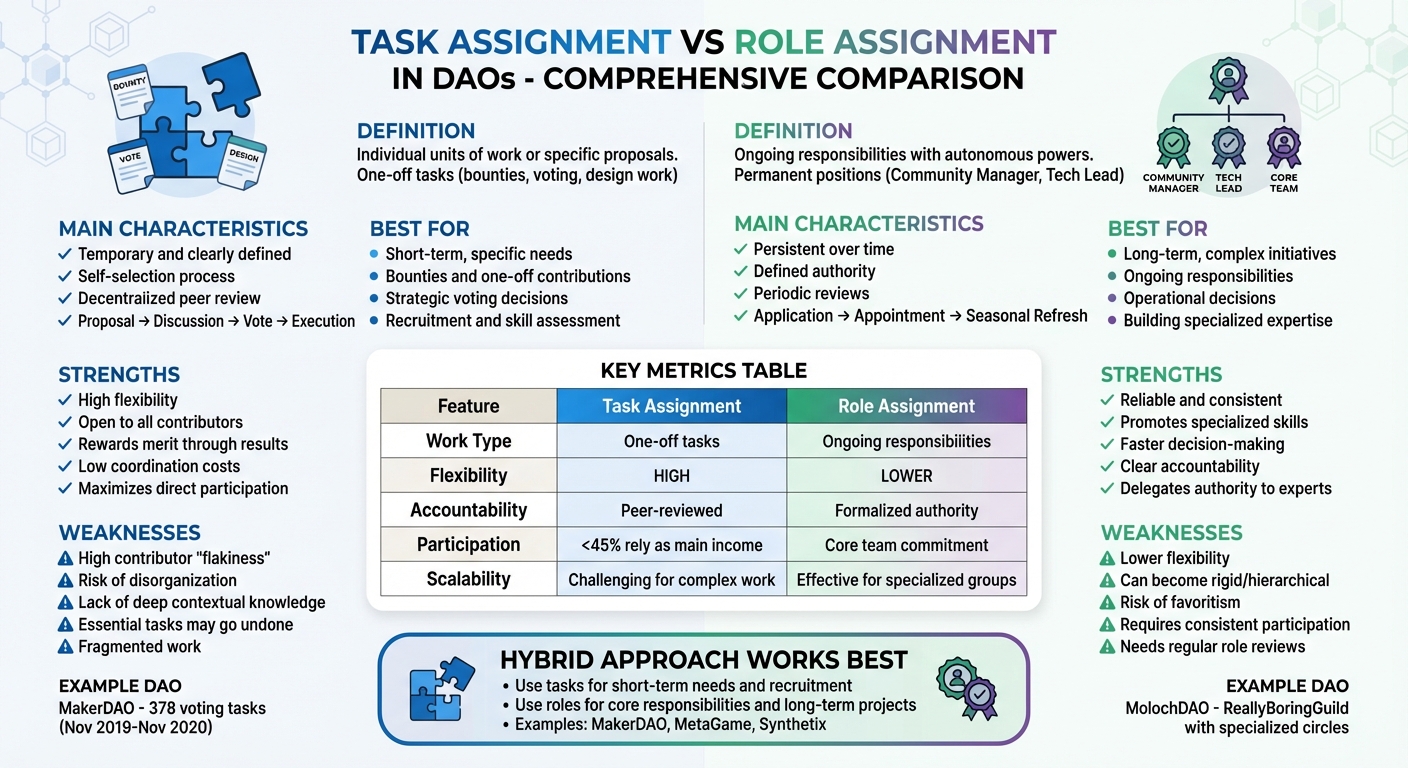
Task Assignment vs Role Assignment in DAOs: Complete Comparison Guide
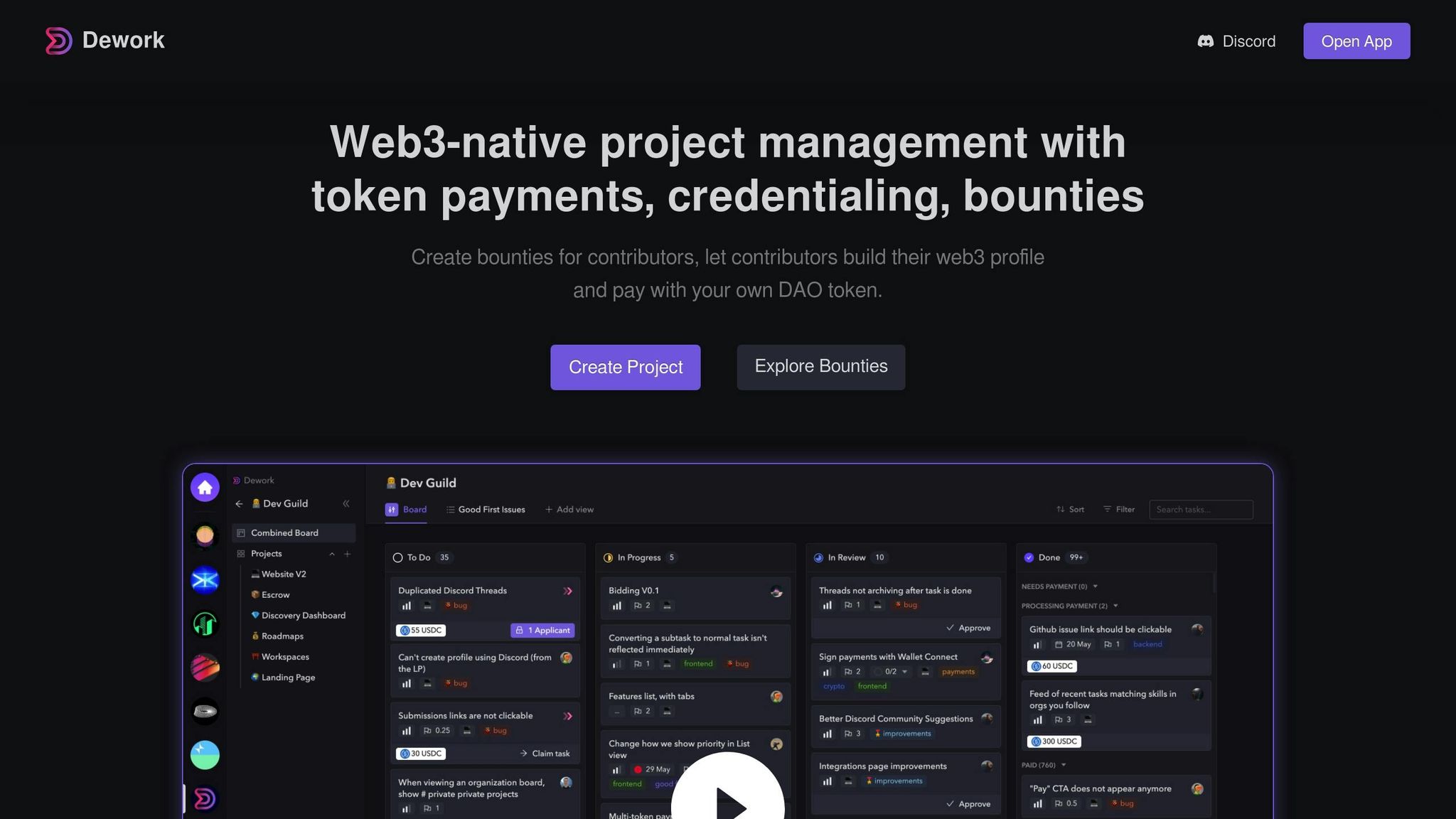
🆘|DEMO|Dework.xyz - Bounty Board / Task Management solution for DAOs|08Feb2022
What is Task Assignment?
In a decentralized environment, task assignment allows members to contribute without the need for centralized control. Instead of relying on permanent roles - like a "Marketing Director" - this system breaks work into individual, self-contained tasks. These tasks could range from voting on proposals to completing design bounties, with each one standing on its own. Members then choose which tasks to take on based on their skills, interests, or even token holdings.
This approach tackles four key challenges in organizing work: breaking down goals into actionable steps, assigning those steps to participants, creating incentives, and sharing the necessary information to complete the tasks. What sets task assignment apart from traditional organizational models is the absence of managerial oversight. Members of decentralized autonomous organizations (DAOs) decide for themselves which tasks to pursue.
"A voting proposal can be regarded as a task that DAO members should complete compared with using agents in traditional companies."
- Xi Zhao, School of Management, Xi'an Jiaotong University
Tasks within this system generally fall into two categories: strategic (long-term goals like launching new features) and operational (day-to-day actions like adjusting protocol settings). Once a task is completed - whether by voting or submitting work - smart contracts often handle the next steps automatically, such as transferring funds, updating settings, or awarding rewards. Every action is recorded on the blockchain, ensuring transparency and accountability.
Main Characteristics of Task Assignment
This system has some defining features. Tasks are temporary and clearly defined, with a specific scope and completion point. This is a sharp contrast to traditional roles, which are often ongoing and open-ended.
Task assignment also uses a self-selection process. For example, if you hold governance tokens and want to vote on adding a new collateral type, you can simply participate in the vote. Similarly, if a DAO posts a bounty for creating promotional materials for an event, you can claim it if it aligns with your expertise.
Quality is ensured through decentralized verification. Instead of a single supervisor reviewing the work, multiple community members evaluate completed tasks. This peer-review process ensures transparency and accountability, eliminating the need for traditional managerial oversight.
Task Assignment Examples in DAOs
Between November 23, 2019, and November 30, 2020, MakerDAO processed 378 individual voting tasks to manage its DAI stablecoin. These tasks ranged from operational decisions, like adjusting the stability fee, to strategic moves, such as adding new collateral types. While strategic tasks generally enhanced platform performance, an overload of operational tasks sometimes led to voter fatigue, reducing overall effectiveness.
Another example is ConstitutionDAO, which formed in November 2021 with a single, ambitious goal: to purchase a copy of the U.S. Constitution at a Sotheby's auction. The group raised over $40 million from thousands of contributors, showcasing how task assignment can rally large-scale coordination around a specific, time-sensitive objective.
DAOs also use platforms like Dework to post bounties - short-term tasks that serve as both work opportunities and recruitment tools. Contributors can showcase their skills by completing real tasks, allowing DAOs to assess their capabilities based on actual results. These examples highlight how breaking work into discrete tasks enables DAOs to operate effectively without relying on permanent roles.
What is Role Assignment?
Role assignment involves giving individuals ongoing responsibilities rather than one-off tasks. Instead of focusing on single contributions, these roles, such as "Community Manager", represent permanent positions with defined duties.
This approach, often referred to as "Roleocracy", eliminates the need for constant voting by allowing specialists to act independently within their areas of expertise. It creates a stable framework where roles are clearly defined, ensuring that the right people consistently handle the right responsibilities.
Another key benefit of role assignment is its ability to address informal power dynamics. Without explicit roles, certain individuals may take on leadership positions without proper transparency or accountability. By formalizing roles, everyone knows who holds authority and the reasons behind it.
"You succeed by having reliable people playing the right roles consistently"
- peth, Founder, MetaGame
In many DAOs, communities are divided into two main groups: the core team, often referred to as "The Mission", and the broader community, known as "The Village." This division helps maintain focus on critical tasks while ensuring that operational decisions don’t require input from every member.
Main Characteristics of Role Assignment
Roles in this system are not tied to single tasks - they persist over time and come with defined authority. This allows role holders to make decisions without requiring repeated votes from the community. However, roles are periodically reviewed to ensure they align with changing needs.
For instance, a Tech Beacon might have the authority to reject subpar code contributions, while a Community Manager could enforce rules by sanctioning members who violate guidelines. These clearly defined powers streamline decision-making and reduce the need for community-wide votes on every detail.
Accountability is another crucial aspect of role assignment. Some DAOs use "Role Auditors" to ensure responsibilities are fulfilled, while others rely on on-chain tools like Hats Protocol. Hats Protocol assigns non-transferable NFTs to represent roles, and these tokens can be revoked if the holder fails to meet their obligations.
Role Assignment Examples in DAOs
The practical application of role assignment can be seen in several DAOs.
In October 2023, MetaGame transitioned to a role-based structure, introducing positions like "Vision Beacon" and "Tech Beacon" to simplify decision-making processes.
MolochDAO’s "ReallyBoringGuild" employs a structured role system divided into specialized circles. As of May 2023, these circles include roles such as Grant Strategists, who focus on tokenomics; Community Strategists, who coordinate grant pipelines; and Marketeers, who handle social media and events.
Synthetix, on the other hand, uses a representative structure called "The Spartan Council." This seven-member elected group oversees protocol improvement proposals. To gauge broader community sentiment, Synthetix also employs off-chain snapshot voting.
Task Assignment vs Role Assignment: Main Differences
Task assignment and role assignment represent two distinct approaches to organizing work, each with its own focus and implications. Task assignment breaks work into individual, one-off actions - think of it as addressing specific needs like bounties or individual voting proposals. On the other hand, role assignment creates ongoing positions with defined responsibilities and authority, designed to persist over time.
When it comes to execution, tasks follow a straightforward cycle: proposal, discussion, vote, and execution. This process is often facilitated by platforms like Dework, which streamline task-based workflows. In contrast, roles involve a more structured process that includes application, appointment, and periodic reviews (often referred to as seasonal refreshes). Tools like Hats Protocol help automate role mapping and permissions, ensuring clarity and accountability.
These differences in operation lead to contrasting outcomes in how organizations scale and govern themselves. Task assignment is ideal for addressing immediate, short-term needs but can become chaotic when tackling more complex projects. Roles, however, provide stability and accountability, making them better suited for long-term, intricate initiatives. That said, roles demand consistent participation and specialized expertise from contributors.
Governance is another area where these systems diverge. Task-based systems emphasize direct participation, allowing anyone to contribute to specific decisions. However, research on MakerDAO’s 378 votes revealed some challenges: while strategic voting tasks improved performance, operational voting tasks often caused issues due to their complexity and the workload involved. Role-based systems, by contrast, delegate authority to specialists, reducing voter fatigue. This approach, however, requires robust accountability measures to ensure transparency and trust.
Comparison Table: Tasks vs Roles
| Category | Task Assignment | Role Assignment |
|---|---|---|
| Definition | Individual units of work or specific proposals | Ongoing responsibilities with autonomous powers |
| Assignment Process | Proposal → Discussion → Vote → Execution | Application → Appointment → Seasonal Refresh |
| Flexibility | High; members can contribute on demand | Lower; requires consistent, specialized expertise |
| Scalability | Challenging for complex work; risks disorganization | Effective for dividing work into specialized groups or sub-DAOs |
| Governance Integration | Maximizes direct participation | Delegates authority based on expertise |
| DAO Example | MakerDAO (voting on stability fees, parameters) | MolochDAO (roles like Grant Strategists, Marketeers) |
Next, we’ll delve into the strengths and weaknesses of each system, comparing them side by side to better understand their practical applications.
Pros and Cons of Each System
Task assignment brings adaptability and openness, while role assignment offers dependability and expertise. Weighing the strengths and challenges of each approach can help organizations decide whether to use one, the other, or a mix of both to meet their goals.
Task assignment stands out for its flexibility and openness. It allows anyone to step in and contribute without needing prior approval or a long-term commitment. This approach rewards merit through results and can even serve as a powerful recruitment strategy. It also promotes transparency and minimizes coordination overhead by enabling open participation.
But this freedom has its drawbacks. Task-based systems often face high levels of "flakiness", where contributors abandon projects midway, making them unreliable for time-sensitive work. As peth, founder of MetaGame, pointed out:
"DAOs are a haven for people with commitment issues and armchair governors"
Another challenge is the risk of breaking labor into tiny, impersonal tasks, which can lead to neglect of essential but unglamorous work. A 2021 survey of 422 DAO participants found that fewer than 45% relied on DAOs as their main source of income, underlining the transient nature of task-based contributions.
On the other hand, role assignment focuses on consistency, offering a different set of benefits and challenges.
Role assignment provides reliability and specialization. Clearly defined roles establish accountability, streamline decision-making through autonomous authority, and enhance onboarding by outlining responsibilities. This approach fosters strategic alignment and allows individuals to build in-depth contextual knowledge.
However, roles can sometimes lead to rigidity or even hierarchy, creating potential "us vs. them" tensions between core teams and the wider community. There’s also the risk of roles being assigned based on popularity rather than merit, and inactive role holders can hinder progress if responsibilities aren’t regularly reviewed.
Comparison Table: Pros and Cons
The table below highlights the key advantages and disadvantages of each system:
| System | Advantages | Disadvantages |
|---|---|---|
| Task Assignment | Flexible and open; rewards merit; low coordination costs; effective for recruitment; open to all contributors | High risk of contributor "flakiness"; lack of deep contextual knowledge; labor can feel fragmented; essential tasks may go undone |
| Role Assignment | Reliable and consistent; encourages specialized skills; faster decision-making; clear accountability; smoother onboarding; promotes strategic focus | Can become rigid or hierarchical; may favor popularity over merit; risks interference from inactive or uninvolved members; requires ongoing role reviews |
sbb-itb-8eb1bfa
How These Systems Work in Decentralized Event DAOs
Decentralized events like festivals, workshops, and multi-day conferences come with their own set of challenges when it comes to coordination. The choice between task assignment and role assignment can significantly impact how smoothly an event runs and how engaged the community feels.
The main distinction between these systems lies in time sensitivity and continuity. Some responsibilities, like ticket scanning at the entrance, require precise timing and reliability. Others, such as promoting the event on social media, allow for more flexibility and open participation. Picking the right approach can mean the difference between seamless execution and unnecessary bottlenecks. Let’s explore how each system fits into managing decentralized events.
Managing Events with Task Assignment in Decentralized Event DAOs
Task assignment shines when it comes to one-off activities that don’t need strict timing or deep organizational context. Think of tasks like designing promotional materials, creating content, or running social media campaigns - these are ideal for bounty-based contributions.
For instance, an event DAO might offer bounties for specific deliverables like designing event posters, writing blog posts, or managing social media outreach in the weeks leading up to the event. These tasks allow members to contribute without requiring critical system access or immediate deadlines. As Zero Mass from BanklessDAO explains:
"DAOs accomplish work through individual tasks and projects rather than through jobs. This makes it much less likely for someone who's not good at a particular task to continue doing it for long".
By posting bounties for promotional tasks, DAOs not only move event planning forward but also identify skilled contributors who might take on more permanent roles. However, task assignment has its limits - especially for duties that demand real-time decision-making or consistent, on-site presence. For those, a different approach is necessary.
Managing Events with Role Assignment
Role assignment is critical when reliability and accountability are non-negotiable. Tasks like treasury management, security coordination, ticket scanning, and technical support need dedicated individuals who can commit to being present and responsive throughout the event.
A great example is the Hyper Hacktive Festival in Paris, which used Zenao's role-based system to organize its short film festival. Specific roles were assigned to ensure smooth operations: "Organizers" from the Samouraï crew oversaw administrative and treasury functions, "Gatekeepers" managed ticket scanning at the entrance, and "Jury Members" from the community took charge of film selection for future events.
Research on MakerDAO’s task management supports this approach, showing that operational efficiency improves when time-sensitive functions are handled by designated roles rather than relying on community-wide input.
As pΞTH, founder of MetaGame, puts it:
"You succeed by having reliable people playing the right roles consistently... MMO-RPG players have learned the lesson a long time ago: You can't just have people jump between roles".
For multi-day events, this consistency is vital. It ensures that key operations run smoothly and avoids the kind of coordination breakdowns that could derail an otherwise well-planned experience. Aligning the system - task or role-based - with the specific demands of the event is crucial for success.
How Zenao Handles Tasks and Roles
Zenao approaches each user, event, or community as a decentralized autonomous organization (DAO). Using Daokit - a blockchain-agnostic framework - Zenao equips these entities with clear governance rules. The platform operates on a role-based permission system, where community-defined rules determine how tasks and roles are assigned. This setup works seamlessly for both short-term event logistics and ongoing governance needs.
Zenao's system is designed to be user-friendly for non-technical individuals while remaining powerful enough to handle complex governance scenarios. As the Zenao Manifesto states:
"Zenao is a machine for creating DAOs in a zen spirit... designed to let you and your tribe decide together what the future of your community is." (Zenao Manifesto)
The platform’s modular design lets communities start with centralized management and gradually transition toward full autonomy as they grow. This adaptability forms the backbone of Zenao’s approach to managing tasks and roles, offering a flexible framework for various operational needs.
Task Management in Zenao
Zenao’s framework is particularly effective for assigning temporary tasks, especially during events. Through the Event DAO structure, operational responsibilities - like ticket scanning, security, or technical setups - are assigned to specific individuals or teams. The platform simplifies these logistics with features like digital ticketing and in-app scanning, ensuring tasks are handled efficiently.
For example, at the Hyper Hacktive Festival in Paris, the Samouraï Coop team used the Zenao app to assign "Gatekeeper" roles for ticket scanning. This allowed staff to focus on operational duties without requiring long-term commitments to the organization. By keeping event-specific tasks separate from governance roles, Zenao ensures contributors can support events without taking on broader responsibilities.
Role Management in Zenao
In addition to temporary tasks, Zenao emphasizes the importance of long-term roles for governance and continuity. Through the Community DAO structure, Zenao facilitates permanent role assignments such as Super-admin, Treasury Manager, and Community Moderator. These roles help shape the community’s direction and manage resources over time. Tools like DAO-vaults enable treasury managers to co-manage crypto funds with features like multisig transactions and DAO voting, ensuring financial transparency and accountability.
At the Hyper Hacktive Festival, organizers used Zenao to clearly separate governance roles from operational tasks. The Samouraï crew took on Super-admin responsibilities, while other members were assigned roles like Treasury Manager or Community Moderator. Additionally, participants were given "Jury Member" roles to vote on film selections and grant allocations - tasks tied to governance rather than event operations. This distinction allows strategic decision-making to remain separate from the day-to-day execution of tasks, ensuring clarity and efficiency.
How to Choose Between Task and Role Assignment
What to Consider When Choosing
When deciding between task-based and role-based systems, the choice often depends on your DAO's stage of development and the nature of the work at hand. In their early days, DAOs typically rely on versatile roles - often referred to as "Beacon" roles - that handle both vision and technical direction. As the organization matures, these broad roles naturally evolve into specialized teams to manage the growing complexity.
For strategic decisions, task-based voting often proves effective. Research on MakerDAO's 378 votes shows that community input on strategic issues - like expanding into new markets or adding features - can boost operational performance. However, using broad voting for day-to-day operational decisions tends to slow things down and create bottlenecks.
The type of assignment should align with the nature of the decision. As pΞTH, founder of MetaGame, aptly notes:
"Being fully democratic doesn't mean being fully functional".
If your DAO needs to act quickly on operational matters, assigning clear roles with specific authority is the way to go. On the other hand, for shaping long-term goals or making major strategic decisions, opening up the process to community participation through task-based systems can yield better results.
Contributor commitment is another key factor. Roles are ideal for core team members who can consistently deliver, while tasks and bounties are better suited for contributors with limited availability or those still building their reputation. With fewer than 10% of token holders actively participating in decision-making, role-based structures help prevent burnout and ensure smooth operations. Striking this balance is crucial for integrating both approaches effectively.
Using Both Systems Together
Understanding these dynamics allows DAOs to blend task and role systems effectively. Many successful DAOs adopt a hybrid model that capitalizes on the strengths of both approaches. MetaGame, for example, separates the "Mission" - the core team responsible for time-sensitive, complex work - from the "Village", the broader community contributing to tasks, bounties, and strategic voting.
Task-based bounties can also double as a recruitment tool. Contributors who excel at completing tasks showcase their skills and reliability, making them strong candidates for formal roles with more responsibilities. To ensure accountability, a "Champion and Deputy" system can be implemented, where each role has a primary lead and a backup. This setup ensures continuity if someone becomes unavailable. Regularly refreshing these role assignments - say, every few months - allows team members to reaffirm their commitment or makes space for new contributors who’ve proven themselves through task-based efforts.
The key is tailoring the balance to your DAO's specific needs. For instance, organizing a one-time event might lean heavily on task-based assignments for operational duties, while governance roles remain with a small core team. Conversely, building long-term infrastructure benefits from clearly defined roles for ongoing responsibilities, complemented by task-based contributions from the broader community. This thoughtful balance ensures stability while maintaining the flexibility needed for effective DAO governance.
Conclusion
Task and role assignment offer two distinct ways to structure work in DAOs, each with its own advantages. Task-based systems encourage participation and community involvement by allowing flexible contributions. On the other hand, role-based systems ensure stability and efficiency by assigning clear responsibilities and maintaining accountability.
The most successful DAOs combine these approaches thoughtfully. Roles are ideal for establishing core responsibilities that simplify decision-making processes. At the same time, task-based bounties are perfect for attracting new contributors, engaging the community, and handling non-sensitive tasks. This combination equips DAOs to address both short-term needs and long-term goals effectively.
Zenao's modular DAO architecture is designed to integrate both task and role management seamlessly. It organizes users, events, and communities as individual DAOs with role-based permissions while also supporting task-oriented activities like digital ticketing, community polls, and event planning. This dual approach ensures flexibility and structure, meeting the diverse needs of modern DAOs.
FAQs
How can DAOs effectively balance task-based and role-based systems?
To successfully merge task-based and role-based systems, DAOs should start by defining clear roles that specify each member’s responsibilities and decision-making authority. Having well-defined roles provides structure, minimizes confusion, and ensures contributors understand their long-term areas of focus. This framework supports both autonomy and accountability across the organization.
With roles established, DAOs can implement task-based systems to handle short-term objectives. Tasks can be distributed using methods like proposal voting, token-weighted bidding, or smart-contract-based rewards. By aligning tasks with relevant roles and automating incentives, DAOs can stay adaptable while ensuring tasks are completed effectively. This blended approach offers the stability needed for long-term goals while maintaining the flexibility required for day-to-day operations.
Tools like Zenao make this process easier by offering a unified platform for creating role-based permissions and managing task assignments. By connecting tasks to roles and automating rewards, Zenao helps DAOs improve coordination while maintaining transparency and fairness.
What challenges come with assigning tasks in DAOs?
Task-based coordination in DAOs often encounters several hurdles that can hinder both efficiency and collaboration. One major issue is the reliance on on-chain voting or ad-hoc proposals, which often slows down decision-making and suffers from low participation rates. This is especially true when members either lack the necessary expertise or aren’t actively involved, creating delays and bottlenecks.
Another challenge stems from misaligned incentives. Without well-defined reward systems, contributors may prioritize immediate gains over the organization’s broader, long-term goals. On top of that, many DAOs lack effective tools for tracking progress or managing responsibilities. This makes it harder to adjust to changes or redistribute tasks when needed.
Lastly, accountability gaps and information asymmetry are frequent issues in decentralized environments. Without clear reporting structures, tasks can fall through the cracks, deadlines may be missed, and efforts are sometimes duplicated. Evaluating contributions also becomes a challenge, further complicating the workflow. These obstacles underscore the importance of establishing better task management strategies within decentralized organizations.
Why is assigning roles essential for long-term success in DAOs?
Assigning roles is a key factor in ensuring the long-term success of decentralized autonomous organizations (DAOs). When responsibilities are clearly defined, individuals know their areas of focus and are empowered to make decisions confidently. This clarity not only keeps operations running smoothly but also helps prevent bottlenecks, ensuring tasks are completed on time.
Having structured roles also makes it easier for new members to understand how they can contribute, which reduces confusion and encourages active participation. Without this structure, DAOs can quickly become chaotic, leading to delays, member burnout, and governance issues. By striking a balance between individual autonomy and accountability, role assignments create the foundation for DAOs to grow and succeed over time.