

Governance
Quadratic Voting in Blockchain Governance
How quadratic voting can rebalance DAOs and blockchain governance—explaining mechanics, benefits, risks (Sybil, whale influence) and practical mitigation strategies.

January 14th, 2026
•
13 min read
Quadratic Voting in Blockchain Governance
Quadratic voting (QV) is reshaping blockchain governance by addressing a key issue: traditional voting often favors large stakeholders, sidelining smaller voices. QV allows participants not only to express their preferences but also the strength of those preferences. Here's how it works:
- The cost of votes increases quadratically (e.g., 1 vote = 1 credit, 2 votes = 4 credits, 3 votes = 9 credits).
- This structure discourages vote hoarding and encourages thoughtful allocation of voting power.
Key Benefits:
- Balances influence between large and small stakeholders.
- Gives minorities with strong preferences a fair chance to impact decisions.
- Improves decision-making in decentralized systems like DAOs.
Challenges:
- Susceptible to Sybil attacks (using fake accounts to manipulate votes).
- Wealth disparities can still influence outcomes.
- High costs may deter knowledgeable voters from fully expressing their views.
Real-World Use Cases:
- Gitcoin Grants: Over $60M distributed to 3,000+ projects using QV.
- DAOs like Compound and Uniswap are experimenting with QV to improve governance.
Solutions to Challenges:
- Identity verification tools (e.g., proof-of-personhood) to prevent manipulation.
- Vote-escrowed tokens to deter short-term exploitation.
- Probabilistic QV models to reduce vulnerabilities.
While QV is promising for blockchain governance, it requires safeguards to address vulnerabilities and ensure fair participation.
Balancing Power in Decentralized Governance: Quadratic Voting under Imperfect Information
Research Findings on Quadratic Voting in Decentralized Systems
Researchers have been delving into how quadratic voting (QV) operates within blockchain ecosystems, focusing on its potential benefits and challenges. A key question is whether QV can make governance more balanced while maintaining decentralization. Recent studies have categorized different QV models and explored their implications for decentralized governance.
Types of Quadratic Voting Models
Quadratic voting models vary in how they distribute voting power, and researchers have identified three main types:
| QV Model Type | Description | Governance Implication |
|---|---|---|
| Type 1 | Square root applied to total stake | The standard approach; limits the influence of large stakeholders but still depends on stake size |
| Type 2 | Square root applied to preferences after splitting stake | Allows nuanced preferences but is prone to Sybil attacks due to account splitting |
| Type 3 | Consolidated stake allocation | Focuses voting power on a single issue but sacrifices cost-averaging benefits across multiple decisions |
The Type 1 model is the most widely used. By applying the square root to the total stake, it reduces the disproportionate influence of wealthy stakeholders while maintaining a balance across all governance decisions. Type 2, on the other hand, lets users divide their stake among different preferences before applying the square root. While this enables voters to express more detailed preferences, it introduces a vulnerability - users can exploit the system by creating multiple accounts since splitting stakes lowers the overall cost of votes (e.g., 1² + 1² is less than 2²). Lastly, Type 3 requires voters to concentrate their stake on fewer issues, maximizing their impact on specific decisions but losing the broader cost-averaging benefits.
These distinctions have significant implications for governance. As Nicola Dimitri from the University of Siena points out:
A main concern related to governance appears to be the possible emergence of dominant positions, that is of subjects who could keep under their control a large number of votes... this may discourage users with small number of votes from participating.
Decentralization Metrics and QV
To evaluate whether QV supports decentralization, researchers use metrics like the Gini coefficient, which measures inequality in voting power, and the Nakamoto coefficient, which calculates the minimum number of entities needed to control 51% of voting power. Studies suggest that QV typically sacrifices less than 10% of potential social welfare across various group sizes. However, its effectiveness diminishes in societies with extreme wealth disparities.
In a real-world example from April 2019, the Colorado House Democratic caucus implemented QV, allocating 100 tokens to each member. This system allowed the Equal Pay for Equal Work Act to secure 60 votes without any single member monopolizing tokens.
Still, blockchain-based governance reveals challenges. An analysis of 370 proposals in Compound and Uniswap DAOs found that decisions were often swayed by just 3–5 voters, highlighting the concentration of power even in decentralized systems.
Advantages and Limitations of Quadratic Voting
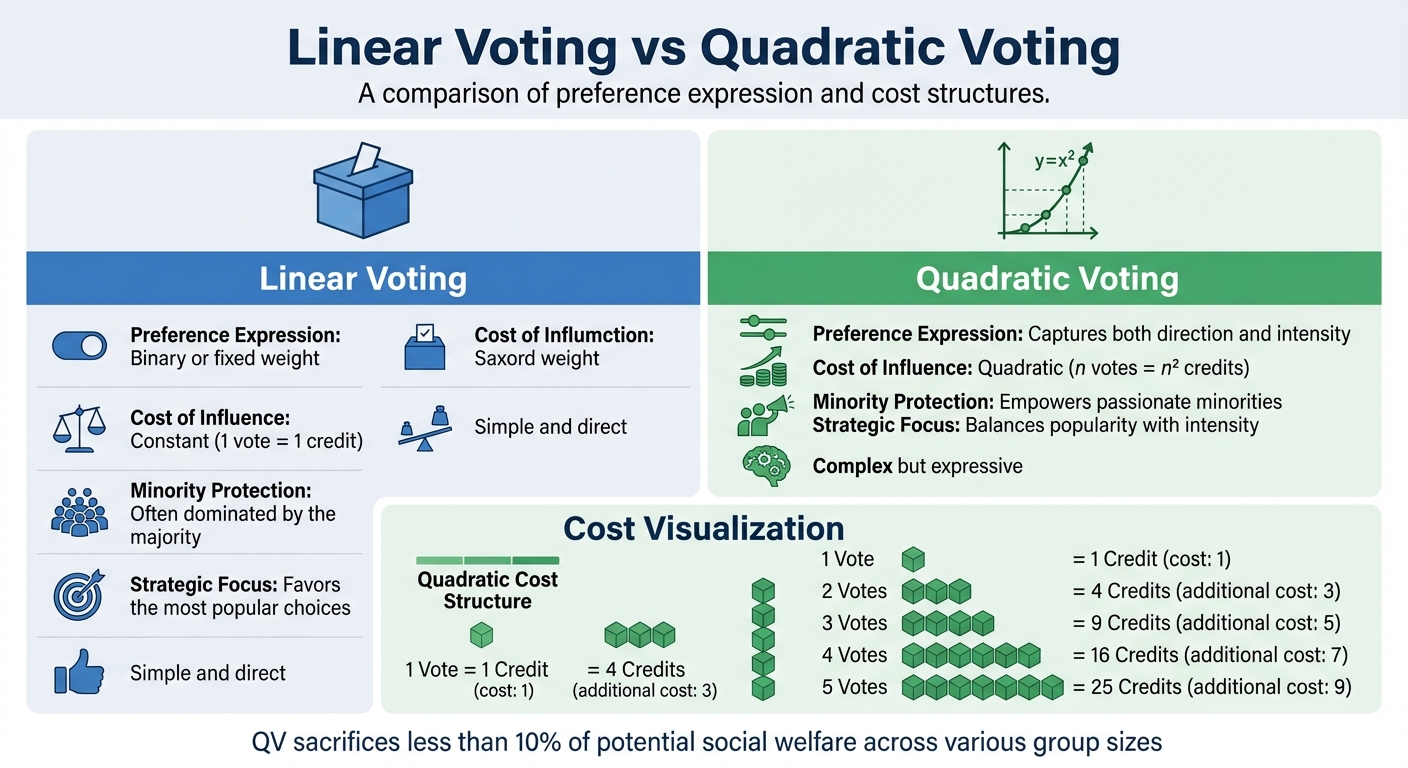
Quadratic vs Linear Voting: Cost Structure and Benefits Comparison
Quadratic voting offers a unique twist on traditional voting systems by allowing participants to express not just their stance on an issue but also how strongly they feel about it. While it excels at revealing the intensity of preferences, it faces challenges in scenarios where the "right" collective decision is uncertain.
Preference Aggregation vs. Linear Voting
One of the standout features of quadratic voting is its ability to account for the strength of voter preferences. In a linear voting system, every vote carries the same weight - voters simply cast a "yes" or "no" with equal influence. Quadratic voting, on the other hand, introduces a cost structure where the price of additional votes grows quadratically. For example, casting 1 vote costs 1 credit, 2 votes cost 4 credits, and 3 votes cost 9 credits. The cost per additional vote increases: the first vote costs 1 credit, the second requires 3 more, and the third adds 5 more credits.
This rising cost discourages voters from focusing too heavily on a single issue, ensuring a more balanced distribution of influence. It also gives minorities with strong feelings about a particular issue a chance to make their voices heard. Nicola Dimitri from the University of Siena explains:
QV ensures that the most desirable social outcome will receive the highest number of votes; alternatively, that the number of votes assigned by a user to an item is proportional to the utility/value of the item.
Here’s a quick comparison of linear voting and quadratic voting:
| Feature | Linear Voting (Yes/No or fixed weight) | Quadratic Voting (QV) |
|---|---|---|
| Preference Expression | Binary or fixed weight | Captures both direction and intensity |
| Cost of Influence | Constant (1 vote = 1 credit) | Quadratic (n votes = n² credits) |
| Minority Protection | Often dominated by the majority | Empowers passionate minorities |
| Strategic Focus | Favors the most popular choices | Balances popularity with intensity |
When complete information is available, quadratic voting demonstrates strong performance, rarely sacrificing more than 10% of potential social welfare across various population sizes. However, its strengths are less evident in uncertain situations.
Challenges in Common-Value Settings
Quadratic voting falters in common-value scenarios - situations where there is one objectively correct decision for the group, but voters are unsure of what that decision is. In these cases, the system’s cost structure can deter knowledgeable voters from fully expressing their insights. Researchers Alon Benhaim, Brett Hemenway Falk, and Gerry Tsoukalas emphasize this limitation:
uncertainty not only breaks QV optimality but can also cause it to underperform LV. Intuitively, this is because cost convexity can disincentivize better-informed voters from adequately conveying their private information.
Imagine a voter with critical knowledge about which technical upgrade would benefit a blockchain network. In a quadratic voting system, casting 5 votes to signal their preference would cost 25 credits, compared to just 5 credits in a linear system. This steep cost might discourage them from fully expressing their position. As a result, while QV excels at capturing subjective intensity, linear voting may outperform it when aggregating technical or factual insights.
sbb-itb-8eb1bfa
Mitigating Collusion and Whale Influence in QV Systems
Quadratic voting (QV) reduces the dominance of large token holders, but it also introduces risks like manipulation and coordinated attacks. Addressing these vulnerabilities is crucial to maintaining fair and secure governance.
Collusion and Bribery in Quadratic Voting
While QV limits the influence of wealthy participants by increasing the cost of additional votes, it can also open the door to collusion. Wealthy actors may find it more cost-effective to bribe smaller token holders rather than purchase votes themselves. As researchers Shunya Tamai and Shoji Kasahara from the Nara Institute of Science and Technology highlight:
"In comparison to Linear Voting, Quadratic Voting lacks resistance to collusion."
A stark example of governance manipulation occurred during the Beanstalk DAO incident in April 2022. A malicious actor used a flash loan to acquire a large number of tokens, passed a proposal, and drained $182 million from the protocol. This underscores the need for stronger safeguards against both concentrated power and collusion.
One effective countermeasure is the use of vote-escrowed tokens (veTokens). These tokens are locked for a specific period, delaying liquidity and making short-term manipulation more costly. Tamai and Kasahara explain:
"The short-term, profit-driven voting actions of whales can lead to a decrease in token prices, and delaying token liquidity is proposed as an approach to mitigate these effects."
Another innovative approach is Probabilistic Quadratic Voting (PQV), developed by the D3LAB-DAO team in their "Governor C" system. This method, which incorporates Chainlink-VRF for randomness, makes Sybil attacks economically unviable. According to lead developer Luke Park (Sanghyeon Park):
"In PQV, splitting voting power makes the expected value of voting power lower than executing 1 voting power."
These strategies highlight the importance of addressing vulnerabilities in QV systems to ensure fair and secure governance.
Whale Mitigation Strategies
To address the dual challenges of collusion and concentrated control, additional measures are necessary. While the quadratic cost structure compresses token power (√tokens), it has its limits. For instance, a whale could divide 100 tokens into 100 separate accounts, gaining 100 votes instead of just 10. This exploit stems from the square root function's concave nature, which reduces the cost of dominating votes through account splitting. However, the quadratic model does make it increasingly expensive to dominate multiple issues from a single account, as each additional vote requires exponentially more tokens.
To counter these vulnerabilities, complementary solutions can be implemented. Robust identity verification systems - such as decentralized identity (DID) tools or proof-of-personhood mechanisms - can effectively prevent account splitting. Additionally, distributing non-transferable voice credits equally among verified participants can separate voting power from token wealth, ensuring decisions reflect a broader range of perspectives, especially in highly unequal societies.
The table below summarizes key threats and their corresponding mitigation strategies:
| Threat | Mitigation Strategy | How It Works |
|---|---|---|
| Collusion & Bribery | Vote-Escrowed Tokens | Locking tokens increases the cost of short-term manipulation |
| Sybil Attacks | Probabilistic QV (PQV) | Randomization discourages account splitting by lowering expected returns |
| Whale Dominance | Quadratic Cost Structure | Compresses influence by applying a square root to token power |
| Strategic Manipulation | Simultaneous Revelation | Revealing all votes at once eliminates last-mover advantage |
| Wealth Inequality | Non-Transferable Voice Credits | Decouples voting power from token holdings, promoting fairness |
Applications of Quadratic Voting in Blockchain and DAOs
Generalized QV Models for Blockchain
Blockchain platforms are evolving beyond basic vote-counting by adopting more advanced quadratic voting (QV) frameworks. In Proof-of-Stake systems, for instance, a user's stake often funds their QV participation. To ensure both privacy and transparency, modern implementations employ Zero-Knowledge Argument of Knowledge (ZKAoK) protocols. These allow for ballot secrecy while enabling decentralized, self-tallying systems. Researchers like Zibo Zhou and team have shown that such systems can process votes in just a few milliseconds and complete tallying in under 255 milliseconds.
Some platforms are also experimenting with generalized power voting models, where the exponent in the quadratic function can be adjusted. This flexibility helps fine-tune the balance between safeguarding minority interests and respecting majority preferences. These advancements are paving the way for broader integration of QV into decentralized autonomous organizations (DAOs) and other community governance systems.
Applications in DAOs and Community Governance
DAOs are increasingly leveraging QV for tasks like resource allocation and funding decisions. Platforms such as Gitcoin, Cardano, and MakerDAO have adopted these mechanisms to support projects that enjoy widespread community support.
In December 2025, researchers from Input Output Global (IOG) and Zhejiang University, including Lyudmila Kovalchuk and Bingsheng Zhang, tested an on-chain QV protocol tailored for liquid democracy. This prototype involved 64 voters, 128 delegates, and 128 projects. The results showed that the protocol was well-suited for modern blockchain governance, with network traffic averaging around 2.7 MB per project.
Liquid democracy, a key feature of some DAOs, allows participants to delegate their QV power while maintaining flexibility in how their votes are allocated. Nicola Dimitri from the University of Siena highlights the unique value of QV in such settings:
"QV allows participants to express both the direction as well as the intensity of one's preferences as it takes place, for example, with oral acclamation."
Case Study: Decentralized Platforms and Event Management
QV's adaptability is also evident in event management. Platforms organizing festivals, workshops, or conferences use QV to empower communities in decisions like venue selection, speaker lineups, and budget distribution. This system enables participants to express not just their preferences but also the strength of their convictions.
For instance, Zenao integrates decentralized governance into event planning, allowing communities to collaborate on decisions. Instead of relying on monetary stakes, Zenao uses non-transferable voice credits or reputation-based tokens. This ensures that decision-making power is earned through active participation rather than financial resources.
QV proves especially effective in protecting minority interests during event planning. Small groups with strong preferences for specific topics or locations can allocate their voting budgets strategically. This prevents majority dominance and ensures that a variety of community voices are represented.
Conclusion and Key Takeaways
Quadratic voting brings a fresh approach to blockchain governance by allowing voters to express how strongly they feel about an issue - something traditional linear voting doesn’t accommodate. By making the cost of additional votes rise quadratically, this system curbs the influence of large stakeholders while giving smaller participants a chance to impact decisions they care about most. For instance, as of 2022, Gitcoin Grants has successfully distributed over $60 million to more than 3,000 projects using quadratic methods, proving its practicality.
Here’s how it works: with 100 tokens, a voter gets 10 votes instead of the 100 they would under a linear system. This creates a "threshold effect", giving mid-sized stakeholders a meaningful voice.
That said, quadratic voting isn’t without its hurdles. It’s susceptible to Sybil attacks and can sometimes discourage well-informed voters, as seen in past incidents.
The future of quadratic voting depends on solving these challenges. Strong identity verification and privacy-preserving technologies are key. For example, advancements like QV-net, which can tally votes in just 255 milliseconds while keeping ballots private, show the potential for scaling this approach in modern blockchain systems.
To move forward, platforms need to tailor the system to their specific needs. Tools like artificial voice credits and vote escrow mechanisms can help reduce wealth-based distortions and fend off malicious activities. While quadratic voting excels in capturing voter preferences for resource allocation and community-driven decisions, it might need to be paired with other methods for governance tasks that require technical expertise or detailed information.
FAQs
How does quadratic voting help prevent large stakeholders from dominating blockchain governance?
Quadratic voting works by curbing the dominance of large stakeholders. In this system, the cost of each additional vote rises exponentially - specifically, it’s equal to the square of the total votes purchased. This means that as someone buys more votes, the expense grows significantly, making it far more costly for larger stakeholders to amass excessive voting power. The result? Smaller stakeholders gain a more equitable say in the decision-making process, while the ability of larger stakeholders to overpower outcomes is effectively restrained.
What challenges arise when using quadratic voting in decentralized governance?
Quadratic voting (QV) in decentralized systems comes with its fair share of challenges. One of the biggest hurdles is the threat of Sybil attacks - when bad actors create fake identities to cheaply accumulate voting credits and skew results. To address this, systems need strong identity verification processes or staking mechanisms to ensure fairness.
Another issue is the potential influence of large token holders. These individuals or entities can buy up excessive voting credits, effectively overpowering the system and defeating QV’s purpose of distributing influence more equitably.
Allocating voting power across multiple proposals also presents difficulties. The square-root calculations required by QV can be computationally demanding and might even raise privacy concerns in the process. On top of that, information uncertainty can discourage voters who are well-informed but hesitant to participate fully, especially when voter turnout is low.
Overcoming these challenges demands robust identity protections, scalable solutions, and strategies to incentivize thoughtful, informed participation. Without these safeguards, the potential of QV in decentralized systems could be compromised.
How do identity verification tools prevent Sybil attacks in quadratic voting systems?
Identity verification tools play a crucial role in safeguarding quadratic voting systems by ensuring that every vote originates from a single, verified individual. These tools link voting credentials to actual identities using methods such as KYC (Know Your Customer) checks, decentralized attestations, or social proofs. This linkage makes it significantly more difficult for malicious actors to create multiple fake accounts and distort the system.
Without proper verification, attackers could exploit the system by spreading their resources across numerous fake identities. This would allow them to bypass the quadratic cost structure of voting and exert an outsized influence. By implementing identity verification, the effort and expense required to create fake accounts rise sharply, helping to maintain the fairness and balance that quadratic voting aims to deliver.