

Governance
Quadratic Funding: How It Allocates Resources
Quadratic funding boosts small donors by using a square-root matching formula to favor projects with broad community support over a few large donations.

January 15th, 2026
•
10 min read
Quadratic Funding: How It Allocates Resources
Quadratic funding is a system that prioritizes community-driven decisions over the size of individual donations. Unlike traditional funding models, it amplifies the impact of smaller contributions by focusing on the number of unique donors backing a project. This approach ensures that projects with widespread support receive more funding, even if the total amount donated is the same.
Key Highlights:
- Introduced in 2018 by Vitalik Buterin, Zoe Hitzig, and E. Glen Weyl.
- Gitcoin, the largest quadratic funding platform, has distributed $67M+ to 5,000+ projects by 2025.
- Mathematical Formula: Matches funds based on the square root of each donation, favoring projects with more contributors.
- Example: A project with 20 contributors donating $50 each unlocks significantly more matching funds than one with 2 contributors donating $500 each.
- 3-Step Process: Matching pool creation → Community contributions → Fund allocation using the quadratic formula.
This method is widely used in blockchain ecosystems, DAOs, and digital public goods, addressing challenges like the free-rider problem and reducing the influence of wealthy donors. It emphasizes community consensus, ensuring that funding decisions reflect the collective voice.
How Can $1 Turn Into $27? QUADRATIC FUNDING Explained
sbb-itb-8eb1bfa
How Quadratic Funding Works
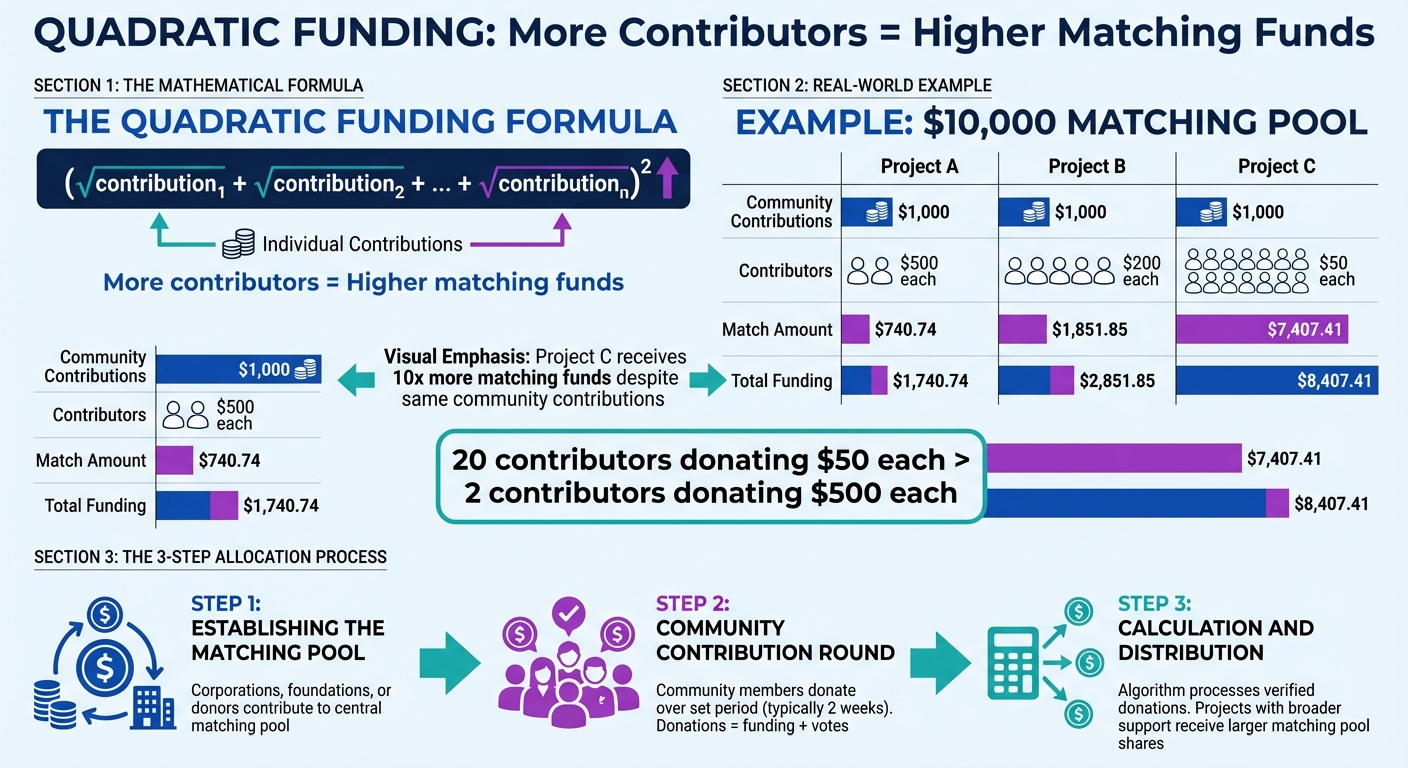
How Quadratic Funding Works: 3-Step Process and Mathematical Formula
Quadratic funding is built on a straightforward yet impactful principle: the number of people backing a project is more important than the amount of money they contribute. Instead of letting a few wealthy donors dominate the funding process, this method amplifies the power of smaller, grassroots contributions.
Here’s how it works: the model applies a mathematical formula that takes the square root of each donation, adds those values together, and then squares the total. The result? A project supported by 20 people donating $50 each will unlock far more matching funds than a single $1,000 donation from one person - even though both scenarios raise the same amount of money. This approach reduces the influence of large donations while rewarding projects with widespread community support.
The Mathematical Formula
At the heart of quadratic funding is a formula that calculates matching funds by summing the square roots of all individual contributions and then squaring that total. This ensures that projects backed by more contributors receive larger matches, even if the total donations are the same.
For instance, imagine a $10,000 matching pool:
| Project | Community Contributions | Number of Contributors | Match Amount | Total Funding |
|---|---|---|---|---|
| Project A | $1,000 | 2 ($500 each) | $740.74 | $1,740.74 |
| Project B | $1,000 | 5 ($200 each) | $1,851.85 | $2,851.85 |
| Project C | $1,000 | 20 ($50 each) | $7,407.41 | $8,407.41 |
Take a close look at Project C. Even though it raises the same $1,000 as Project A, the broader base of contributors earns it over ten times the matching funds. This formula ensures that even a $1 donation can make a huge impact - potentially triggering a match of $27 or more when enough people support the project.
This mathematical approach forms the backbone of how funds are distributed.
The 3-Step Allocation Process
Quadratic funding unfolds in three key phases:
-
Step 1: Establishing the Matching Pool
Corporations, foundations, or individual donors contribute to a central pool of funds. This pool is dedicated to matching community contributions, ensuring these funds amplify smaller donations. -
Step 2: Community Contribution Round
Over a set period (often two weeks), community members donate to the projects they care about. These contributions act as both direct funding and as votes, signaling which projects deserve additional support. -
Step 3: Calculation and Distribution
Once the round ends, the quadratic funding algorithm processes all verified donations. Projects with broader support receive larger shares of the matching pool, reinforcing the idea that community consensus drives funding.
This structured process ensures fairness and prioritizes projects that resonate with a larger audience.
Understanding the Matching Pool
The matching pool is the engine that powers quadratic funding, amplifying each dollar based on the number of unique donors. It’s typically funded by organizations looking to support public goods without needing to evaluate every individual project. This setup allows for a democratic and scalable distribution of funds.
Kyle Weiss, Executive Director of Gitcoin, sums it up perfectly:
"The match is more aligned to the sentiment of the community as opposed to the sheer dollar value amount raised by any grantee."
Where Quadratic Funding Is Used
Quadratic funding is changing the way resources are shared in decentralized communities. It has proven to be an effective way to fund projects, especially in areas like blockchain ecosystems and digital public goods, where traditional funding methods often fall short. By applying its mathematical principles, quadratic funding creates a tangible impact in these spaces.
Quadratic Funding in DAOs
Decentralized Autonomous Organizations (DAOs) have adopted quadratic funding to level the playing field in fundraising. Instead of letting large donors dominate, this method emphasizes the number of unique contributors, ensuring that funding decisions reflect the collective voice of the community rather than the preferences of a few wealthy individuals.
Take Gitcoin, for instance. By May 2025, the platform had distributed over $67 million to more than 5,000 projects. Early beneficiaries of these grants include well-known names like Uniswap, Optimism, and 1inch.
Vitalik Buterin, the founder of Ethereum, highlighted its importance:
"Gitcoin Grants is establishing itself as a significant pillar of the Ethereum ecosystem that more and more projects are relying on for some or all of their support."
To ensure fairness, DAOs use tools like Gitcoin Passport to verify contributors' identities, reinforcing the idea of "one person, one voice." This prevents manipulation of the funding process and keeps the system democratic.
Community Projects and Public Goods
Quadratic funding also plays a key role in supporting community-driven projects, particularly those that create open-source software or other digital public goods. These resources benefit everyone but are often difficult to fund through traditional methods because of the free rider problem. By amplifying smaller contributions, the matching pool ensures that projects with widespread support get the funding they need.
One example is Polygon Village, launched by Polygon Labs in November 2023. With 110 million MATIC allocated for grants, the program used quadratic funding in its Community Grants track. Participants verified their identities through Gitcoin Passport, ensuring that funds were distributed based on broad community backing. This approach channeled resources into areas like decentralized finance, gaming, and infrastructure.
The effectiveness of this model is evident in the data. According to Gitcoin, for every $1 million distributed through matching pools, around 13 full-time developers remain active in the supported projects. Compare this to traditional venture capital, which retains only about 0.1 developers per million spent.
Example: How Funds Get Distributed
The results of quadratic funding are clear in platforms like Gitcoin Grants. Projects with broad grassroots support consistently receive significantly higher matching funds than those backed by just a few large donations.
Benefits of Quadratic Funding
Quadratic funding reshapes the way resources are distributed, prioritizing community-driven decision-making over traditional funding methods. Instead of allowing the wealthiest contributors to dominate, this system empowers everyday individuals. The math behind it ensures that 100 people contributing $1 each carry the same weight in matching funds as one person contributing $10,000. This approach has proven effective in both DAO funding rounds and broader community initiatives.
Small Contributions Carry Big Weight
The real strength of quadratic funding lies in how it values contributions. Projects with a higher number of small donors can secure significantly more matching funds than those relying on a few large donations. The numbers back this up: since 2019, every $1 million distributed through Gitcoin Grants has supported 13 full-time developers, thanks to the matching multiplier. Compare that to traditional venture capital, which produces just 0.1 developers per $1 million spent. The difference lies in how quadratic funding prioritizes community participation over concentrated wealth.
Limiting the Influence of Wealthy Donors
Quadratic funding doesn’t exclude wealthy donors but reduces their ability to dominate the allocation process. While larger donors can still contribute to the matching pool, they relinquish control over how those funds are distributed. Instead, small contributions from the community act as votes, determining where the matching funds go. As Gitcoin explains:
"The number of contributors matters more than the amount funded. This pushes power to the edges, away from whales & other central power brokers".
This means projects with broader community support receive significantly more matching funds than those backed by just a few large donors. The system ensures that no single entity can overshadow the collective voice.
A Clearer Measure of Community Support
In this model, small contributions serve as powerful signals of genuine community interest. A single $1 donation can trigger a matching multiplier of up to 100x. This creates a transparent way to identify projects that resonate with the community, rather than those that simply appeal to wealthy investors. Even a small financial commitment demonstrates real support, distinguishing it from casual interest.
For example, during Gitcoin Grants Round 9, over 12,000 contributors donated more than $1.38 million to support 812 projects. Projects like EntHub benefited from this broad support, receiving matching grants 3.4 times the amount raised directly from the community. The results highlight how quadratic funding amplifies grassroots backing, ensuring that community preferences guide funding decisions.
| Funding Model | Decision Makers | Key Factor | Typical Outcome |
|---|---|---|---|
| Traditional Grants | Central Committee | Strategic Alignment | Few large projects funded |
| Direct Donations | Wealthy Donors | Size of Contributions | Donor preferences dominate |
| Quadratic Funding | Broad Community | Number of Contributors | Many grassroots-supported projects |
Conclusion
Quadratic funding is changing the way communities allocate resources by emphasizing widespread participation over concentrated financial power. Its unique formula - the square of the sum of the square roots of all contributions - ensures that projects with the most diverse base of supporters receive the largest share of matching funds.
This system has already shown impressive results. By 2025, Gitcoin has distributed over $67 million to support more than 5,000 projects. Unlike traditional grant committees, which can only handle a limited number of applications, quadratic funding efficiently scales to process and fund hundreds of initiatives at once, thanks to its community-driven decision-making process.
For DAOs and other community-led efforts, quadratic funding serves as a tool to harness the "wisdom of the crowd." It highlights the projects that resonate most with the collective, rather than those backed by a select few with deep pockets.
This democratic model is also influencing decentralized platforms beyond grants. Communities interested in applying these principles can explore tools like Zenao, which supports event organization, governance, and collaborative efforts. Zenao’s focus on decentralization and community empowerment aligns perfectly with the ideals behind quadratic funding. Whether you're managing a DAO, launching a public goods project, or coordinating local initiatives, combining quadratic funding with decentralized tools creates a pathway for fairer decision-making, ensuring every voice - no matter how small - is heard.
The future of funding isn’t about chasing the biggest donor. It’s about amplifying the collective voice, proving that even a $1 contribution can help shape a stronger, more inclusive community.
FAQs
How does quadratic funding limit the influence of wealthy donors?
Quadratic funding shifts the focus from the size of donations to the number of people contributing. In practice, this means a project with widespread support from many small contributors can end up receiving more funding than one relying on a single large donor.
This method amplifies the voice of grassroots supporters, making sure funding decisions align with the interests of the broader community. By doing so, it reduces the sway of wealthy individuals and encourages more inclusive participation in the decision-making process.
How does the matching pool work in quadratic funding?
The matching pool serves as the backbone of quadratic funding, designed to magnify the influence of individual donations. Rather than following a straightforward dollar-for-dollar matching system, it allocates funds based on how many people contribute to a project - not just the total sum raised.
This method emphasizes projects that enjoy widespread community backing, creating a more inclusive and fair distribution of resources. By valuing participation, it ensures that even smaller donations have a meaningful impact on funding outcomes.
What are the benefits of quadratic funding for community-focused projects?
Quadratic funding (QF) is a game-changer for community-driven projects because it emphasizes widespread participation over hefty individual donations. In this system, every contribution - no matter how small - acts as a “vote.” The magic lies in how it boosts projects with more supporters rather than just focusing on the total dollar amount raised. This way, projects that resonate with the broader community end up receiving a larger share of matching funds, creating a system that values fairness and community-driven decision-making.
What’s great about QF is that it motivates more people to participate. Even a $1 donation can significantly impact the outcome, making it especially useful for initiatives like open-source tools, public-interest projects, or local events. By reflecting the collective will of the community, QF ensures that the most supported ideas rise to the top. Platforms like Zenao, which help organize events and activities, can leverage QF to fund projects that truly matter to the community, strengthening engagement and a sense of shared ownership.