

Event Planning
Proof of Attendance Protocols Explained
A concise guide to POAPs: blockchain-based ERC-721 tokens that verify event attendance, how drops are created and claimed, and minting on Gnosis Chain.

January 16th, 2026
•
11 min read
Proof of Attendance Protocols Explained
POAPs are digital collectibles stored on the blockchain that verify event attendance. Think of them as secure, permanent badges that prove you were part of an event. First introduced in 2019 at ETHDenver, POAPs have grown in popularity, with over 7.5 million minted by 46,000 issuers, including brands like Adidas, Google Cloud, and Porsche.
Key Highlights:
- What They Are: Blockchain-based tokens (ERC-721 standard) that prove event participation.
- Why They Matter: They’re tamper-proof, permanent, and can unlock perks like discounts, exclusive chats, or voting rights.
- How They Work:
- Creation: Organizers design a "Drop" with event details and images.
- Claiming: Attendees scan QR codes, use secret words, or click links to claim POAPs.
- Minting: Tokens are minted on Gnosis Chain for low-cost, fast transactions.
POAPs are more than souvenirs. They help organizers track attendance, reward loyalty, and connect directly with participants. For attendees, they act as digital keepsakes and proof of achievements, offering benefits long after the event ends.
Explaining Proof of Attendance with POAPgod from POAP | Ep. #82
sbb-itb-8eb1bfa
How POAPs Work
How POAPs Work: 3-Stage Process from Creation to Minting
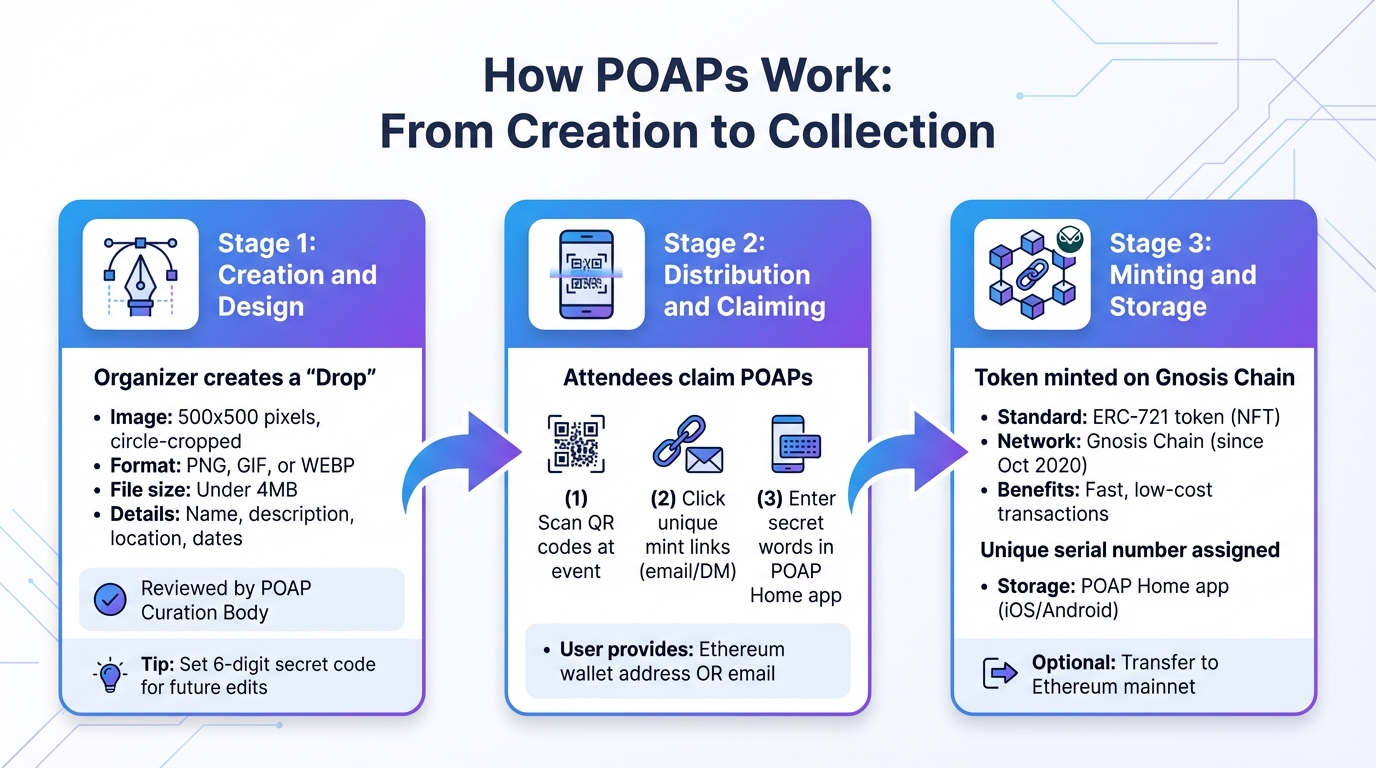
POAPs transform event participation into a permanent blockchain record. Here's a breakdown of how organizers and attendees interact with the system, from planning to claiming and minting. The process unfolds in three key stages: design, claiming, and minting.
Creation and Design
Event organizers start by creating a "Drop" that includes an image and essential event details. This can be done using a user-friendly web interface or programmatically through the POAP API's POST /events endpoint.
The image should be 500x500 pixels, circle-cropped, and in PNG, GIF, or WEBP format, with a file size under 4MB. Organizers also need to provide event details such as the name, description, location, start and end dates, and an expiry date.
Every new drop is reviewed by the POAP Curation Body to maintain quality and prevent spam or fraudulent activity. To make future edits easier, organizers are advised to set a 6-digit secret code when creating their drop.
Distribution and Claiming
Attendees can claim their POAPs through various methods, depending on how the event is organized. Common options include scanning QR codes at the event, clicking unique mint links shared via email or direct message, or entering secret words in the POAP Home mobile app during a specific time window.
For instance, at DevCon 2019 in October, POAP tokens were distributed using physical luggage tags with QR codes that led users to personalized redemption links. More recently, during NFT NYC 2023 in April, artist Jeremy Booth wore a custom Wrangler jacket with a chip-enabled patch, allowing attendees to scan it and collect a commemorative POAP.
To claim a POAP, attendees scan a QR code, click a link, or enter a secret word, then provide an Ethereum wallet address or email to receive their token.
Minting and Storage
After a POAP is claimed, it is minted as an ERC-721 token (NFT) via smart contracts, primarily on the Gnosis Chain. This Ethereum-based sidechain offers faster and more affordable transactions. The protocol transitioned from the Ethereum mainnet to Gnosis Chain in October 2020 to lower transaction costs for issuers.
Once minted, each POAP is given a unique serial number and permanently recorded on the blockchain. This ensures the token is tamper-proof and serves as cryptographically secure proof of attendance. Attendees can manage their collection through the POAP Home app, available on iOS and Android, where they can also add "Moments" (additional media that enhance the collectible). If desired, users can later transfer their POAPs to the Ethereum mainnet for storage in wallets like MetaMask.
These steps ensure that each POAP serves as a secure and permanent record of event participation, opening the door to a range of future uses.
Why POAPs Matter
POAPs are transforming how participation is tracked and engagement is maintained long after events end. By leveraging the secure, on-chain records created during minting, POAPs provide organizers with actionable data and verified community interactions. Let’s explore the advantages they bring to both organizers and attendees.
Benefits for Event Organizers
POAPs simplify attendance tracking and open up direct communication channels. Instead of relying on outdated mailing lists, organizers can connect directly with attendees through their wallets. This creates a dependable way to share updates, offer exclusive perks, or announce future events.
The protocol also delivers trustworthy engagement data. Each POAP is recorded on-chain with a unique serial number and timestamp, allowing organizers to verify attendance without concerns about forged records or inflated claims. This level of transparency is invaluable for sponsors and stakeholders.
Additionally, POAPs help organizers identify their most devoted community members. By analyzing wallets that hold multiple POAPs from past events, organizers can reward loyalty with early ticket access, exclusive perks, or special airdrops. This approach fosters long-term relationships, turning one-time attendees into dedicated participants. Platforms like Zenao make it easier to manage these connections through integrated tools for digital ticketing and governance.
Benefits for Attendees
While organizers gain valuable insights, attendees benefit from POAPs as digital mementos and more.
For participants, POAPs act as permanent digital keepsakes, securely stored on the blockchain. Unlike physical ticket stubs that can be lost or damaged, these tokens preserve your memories forever and remain entirely yours.
POAPs also serve as verified records of participation. They can showcase your expertise, educational achievements, or professional involvement to potential collaborators or employers. For instance, at ETHDenver in February 2019, the first POAPs rewarded hackers for their contributions to the Ethereum community, demonstrating their commitment and involvement.
Beyond being keepsakes, POAPs can unlock additional benefits. Holding specific POAPs might grant access to private discussion groups, exclusive content, token airdrops, or early registration for future events. Unlike traditional social media check-ins, POAPs provide this proof of participation without requiring personal information like age or nationality. This allows attendees to maintain control over their digital identity while building credibility within their communities.
Applications of POAPs
POAPs have grown far beyond their original purpose of tracking attendance. Today, they’re being used as creative tools across various industries, with major brands finding new ways to connect with their audiences through these digital tokens.
Event Attendance Verification
POAPs offer a reliable way to verify attendance at conferences, workshops, and live events. Each token comes with a unique identifier and timestamp, making it nearly impossible to falsify attendance. This functionality works for both in-person and virtual events. For example, organizers can share mint links or QR codes during live audio sessions on platforms like Twitter Spaces or Discord, allowing active listeners to claim their tokens.
Some brands take it a step further by integrating POAPs into physical items at events. Think QR codes paired with luggage tags or clothing patches - bridging the gap between the physical and digital worlds. Platforms like Zenao leverage this capability alongside digital ticketing systems, enabling event organizers to confirm attendance while fostering deeper community connections. This verification system also lays the groundwork for rewarding loyal participants in meaningful ways.
Community Engagement and Rewards
POAPs aren’t just about attendance - they’re a way to recognize and reward community participation. Organizations use them to acknowledge contributors who play active roles in decentralized governance, such as submitting or voting on proposals, attending workshops, or even identifying software bugs.
Owning specific POAPs can unlock perks like access to exclusive spaces. For instance, token-gating can grant entry to private Discord channels, special chat rooms, or restricted web content. In virtual environments like Decentraland, POAPs have been used to reward players for completing challenges, exploring new areas, or participating in gaming tournaments. Media companies have also gotten creative, organizing social scavenger hunts where participants follow clues on social media to earn POAPs and unlock collectible rewards.
Digital Art and Collectibles
POAPs aren’t just functional - they’re also cherished as digital keepsakes. Unlike physical tickets that can fade or get lost, these blockchain-based tokens preserve memories forever.
Many collectors view their POAP collections as digital scrapbooks, showcasing key moments and community involvement. The POAP Home app adds another layer by allowing users to attach images, videos, audio, or text to their tokens, turning them into rich, personalized mementos. While POAPs aren’t intended as investments, some rare tokens do trade on platforms like OpenSea, with certain collections maintaining a floor price of around 0.00095 ETH. Within the Web3 space, a well-curated POAP collection can even serve as a badge of honor, reflecting both professional achievements and active participation in online communities.
The Role of Blockchain in POAPs
Blockchain technology forms the backbone of POAPs, ensuring their reliability and authenticity. Each POAP is an ERC-721 token minted through smart contracts, creating a permanent and tamper-proof record of attendance. Once created, every POAP is assigned a unique serial number that cannot be altered, guaranteeing its legitimacy and safeguarding it against unauthorized modifications.
The decentralized nature of blockchain plays a critical role here. Ownership records are distributed across multiple nodes, allowing real-time auditing and enhancing both security and resilience. This decentralized framework transforms POAPs from simple digital mementos into trustworthy proof of participation.
Storage on Gnosis Chain
In October 2020, the protocol transitioned from Ethereum's mainnet to Gnosis Chain (formerly xDai) to reduce costs and improve transaction speeds. Gnosis Chain operates as an Ethereum-compatible sidechain, utilizing a Proof-of-Stake consensus mechanism that supports energy-efficient transactions while remaining compatible with Ethereum wallets. This shift made it possible for event organizers to mint POAPs with minimal costs. Since the migration, the protocol has experienced significant growth, with over 6,751,949 POAPs minted by 36,674 issuers as of May 2024.
Cross-Chain Compatibility
Cost savings are just one part of the equation. POAPs also benefit from the flexibility of operating across multiple networks. While Gnosis Chain serves as the default network, POAPs can be migrated to Ethereum's mainnet if owners choose. This opens the door to liquid marketplaces like OpenSea, where POAPs can be traded. Owners can decide whether to keep their POAPs on Gnosis for efficiency or move them to Ethereum for broader market access.
Moreover, different networks cater to distinct marketplaces: POAPs on Gnosis Chain are often traded on Rarible, while those on Ethereum appear on OpenSea. This cross-chain functionality allows the protocol to handle large-scale events while maintaining the security and decentralization of the Ethereum ecosystem. It ensures that POAPs remain accessible and adaptable, no matter how the blockchain landscape evolves.
How to Claim and Use POAPs
Steps to Claim POAPs
Claiming a POAP is simple, whether you're at an in-person event or joining online. Event organizers usually distribute these tokens via unique QR codes, claim links, email invites, or secret codes. Once you receive a claim link or scan a QR code, you'll land on a claim page with two choices: you can either reserve the POAP using just your email - no crypto wallet needed - or mint it directly to an Ethereum-compatible wallet. Reserving lets you hold the token until you're ready to transfer it to your blockchain wallet. If you prefer to mint right away, you can choose between the Gnosis Chain (free for attendees) or Ethereum Mainnet (which requires a gas fee).
For in-person events, simply scan the QR code using your smartphone camera or the POAP Home app. You'll be redirected to a link where you can enter your email or wallet address. Organizers are constantly coming up with new ways to make the claiming process even smoother.
Viewing and Showcasing POAPs
Once you've claimed your POAP, it's time to manage and show off your collection. The POAP Home app, available for both iOS and Android, is your go-to tool for this. With the app, you can view your collection, follow other collectors, and even add personal touches like photos or videos to your POAPs through the "Moments" feature. This turns each token into a keepsake with added memories.
If you prefer using a wallet, MetaMask Mobile is another option. Open the app, use the browser feature, go to https://explore.poap.xyz/, and connect your wallet to access your gallery. The POAP Gallery organizes your tokens, making it easy to browse through your attendance history. If you've moved your POAPs from Gnosis Chain to Ethereum Mainnet, you can showcase them on OpenSea alongside other NFTs. Always stick to official links like poap.xyz, and remember - never share your wallet's seed phrase when claiming or managing your tokens.
Conclusion
POAPs (Proof of Attendance Protocols) are reshaping how we think about event engagement. Unlike traditional tickets, these blockchain-based tokens provide a secure, verifiable way to prove attendance at events, big or small. Their adoption has grown significantly, emphasizing their value in creating lasting connections between organizers and attendees.
"The Proof of Attendance Protocol turns precious moments into collectibles. Using blockchain technology, POAP tokenizes your memories, so they can last forever and be truly yours." – POAP Inc
What truly sets POAPs apart is their ability to provide value long after the event ends. They can unlock exclusive perks like access to private Discord communities, governance voting rights, and loyalty rewards. For organizers, POAPs make it easier to identify and reward their most active supporters, creating opportunities for tiered rewards systems. Meanwhile, attendees gain a verifiable record of their participation - a kind of blockchain-based resume. This approach reinforces the idea of POAPs as tools for building strong, engaged communities.
Looking ahead, the potential of POAPs goes far beyond collectibles. As more organizations adopt them for professional development and community governance, they are becoming an integral part of decentralized event management. Whether you're hosting a workshop, a festival, or a community meetup, POAPs offer a smart way to recognize participation and deepen audience connections.
Platforms like Zenao are already leveraging POAPs to enhance community building, turning every event into a meaningful and verifiable experience.
FAQs
How do attendees receive their Proof of Attendance Protocol (POAP) at an event?
Attendees can easily get their POAP by scanning the event-specific QR code with the POAP app or clicking on a claim link sent to their email. After claiming, the token is either minted directly to their digital wallet or stored with their email address for later retrieval.
This process offers a straightforward and reliable way to celebrate your involvement in an event while tapping into the perks of blockchain technology.
How do event organizers benefit from using Proof of Attendance Protocols (POAPs)?
Proof of Attendance Protocols, or POAPs, offer event organizers a secure and efficient way to verify attendance using blockchain technology. Each POAP is a one-of-a-kind digital token that cannot be tampered with, acting as a reliable confirmation of participation. This eliminates the hassle of manual check-ins or paper tickets, cutting down on costs while maintaining precise attendance records.
But POAPs aren’t just about verification - they also double as digital collectibles that boost attendee engagement. Event organizers can reward participants with these tokens, which might later unlock perks like discounts, exclusive content, or access to special events. By adding a layer of gamification, POAPs help build a sense of community, encourage attendees to return for future events, and provide organizers with useful insights for planning. Platforms such as Zenao simplify the process of incorporating POAPs into event management, ensuring everything runs smoothly while keeping the focus on the user experience.
Can POAPs be transferred to other blockchains?
POAPs, or Proof of Attendance Protocol tokens, are a type of blockchain-based NFT linked exclusively to the network where they were created, such as Ethereum or Gnosis Chain. Once minted, these tokens remain tied to their original blockchain and cannot be moved elsewhere. This design preserves their authenticity and ensures each POAP maintains its unique identity within its native network.