

Governance
How Multi-Signature Wallets Improve DAO Governance
How multi-signature wallets secure DAO treasuries by requiring multiple approvals, boosting transparency, enforcing policies, and reducing single-key risk.

February 12th, 2026
•
15 min read
How Multi-Signature Wallets Improve DAO Governance
Managing DAO funds securely is one of the biggest challenges in decentralized governance. Multi-signature wallets solve this by requiring multiple approvals for transactions, reducing risks tied to single-key control. Here's why they matter:
- Shared Control: Unlike single-signature wallets, multi-sigs distribute authority among multiple signers, ensuring no single person has full control.
- Improved Security: They prevent single points of failure, reducing risks like hacks, lost keys, or misuse of funds.
- Transparency: Every transaction is recorded on-chain, creating an audit trail that holds signers accountable.
- Better Governance: Multi-sigs enforce collective decision-making, aligning with DAO principles of decentralization and accountability.
For example, the Safe protocol (formerly Gnosis Safe) has secured over $100 billion in assets, proving the effectiveness of multi-sig wallets in protecting treasuries. Tools like timelocks, role-based permissions, and hierarchical setups further enhance their functionality, making them essential for DAOs managing large-scale funds or critical operations.
In this article, we’ll explore how multi-signature wallets work, their role in DAO governance, and how they mitigate risks while promoting transparency and accountability.
Multi-Signature Wallets: Shared Control & Enhanced Security Explained
sbb-itb-8eb1bfa
How Multi-Signature Wallets Improve Transparency
Multi-signature wallets operate through smart contracts, making their rules, authorized signers, and approval thresholds publicly accessible and enforced by code. Unlike traditional financial systems, where processes are often hidden, every step of a multi-sig transaction - from proposal to final approval - is recorded on the blockchain.
Here’s how on-chain records and real-time visibility contribute to greater transparency.
On-Chain Transaction Records
The Safe protocol (formerly Gnosis Safe) has safeguarded over $100 billion in digital assets by ensuring every transaction leaves an audit trail. Each multi-sig transaction goes through four distinct states: NotFound (does not exist), Pending (exists but lacks quorum), Confirmed (quorum reached but not executed), and Executed (successfully completed). This structured process ensures every action is logged on the blockchain, making it impossible for any signer to deny their role in a decision later.
"The blockchain also provides an audit trail that shows which owners approved any action, so it is impossible for owners to later pretend they did not approve." - Ori Pomerantz, LogRocket
Block explorers like Etherscan allow anyone to verify transaction details, ensuring every action is auditable. This tamper-proof system reassures stakeholders that funds are handled in line with governance policies.
Beyond keeping detailed records, multi-sig wallets also enable proactive monitoring for stakeholders.
Real-Time Stakeholder Visibility
One major advantage of multi-sig wallets is their ability to keep transactions in a visible "pending" state before execution. This delay gives stakeholders an opportunity to review proposed actions and intervene if any suspicious activity arises. More than 100 DAOs currently use the Zodiac module to connect off-chain community voting (via platforms like Snapshot) with on-chain execution handled by multi-sig wallets.
"Community members can track the wallet on block explorers (such as Etherscan) and see precisely when trusted parties move assets." - Ledger Academy
For high-value transfers, DAOs often use time-lock modules to enforce a mandatory delay between the final signature and execution. This provides a final window for stakeholders to review the transaction. Additionally, tools like Tenderly allow users to simulate and share expected transaction outcomes with the community before signatures are collected, adding yet another layer of transparency to the process.
Accountability Through Distributed Authority
Multi-signature wallets don't just boost transparency - they also enhance accountability by spreading decision-making power across multiple parties. Instead of placing full control in the hands of one individual, these wallets require several stakeholders to approve actions. This ensures that important decisions are made collectively, reflecting group consensus rather than individual discretion. By distributing authority, multi-sig wallets address a major risk in decentralized organizations: the danger of concentrated power. This shared control also strengthens the system's resilience against failures.
Preventing Single Points of Failure
The QuadrigaCX incident serves as a cautionary tale about the dangers of centralized control. When a single person holds all the keys, the system becomes vulnerable to catastrophic failure, as seen when fund recoverability was paralyzed in that case.
Multi-signature wallets solve this problem by eliminating "key-person" risk. For example, a 3-of-5 configuration requires at least three signers to approve a transaction. If one signer loses their key, becomes unavailable, or acts maliciously, the remaining signers can still proceed with legitimate actions. This setup ensures the system keeps functioning, even if individual components fail.
"By equally distributing the power between signing authorities, multisig wallets eliminate 'key person' risks common with single-signature wallets." - Lipsa Das, Ledger
The Ronin Bridge hack in March 2022 is another example of why proper distribution matters. Attackers exploited a flaw in key management, gaining control of five out of nine validator keys - four from Sky Mavis and one from the Axie DAO. This allowed them to siphon off 173,600 ETH and 25.5 million USDC, worth about $625 million. The issue? Too many keys were controlled by a single entity, and the threshold for validation was set too low. A better-distributed multi-signature setup, with independent signers spread across organizations and locations, could have significantly reduced this risk.
These examples highlight how multi-signature wallets not only prevent failures but also enforce stronger governance practices.
Enforcing Governance Policies
Multi-signature wallets go beyond failure prevention - they actively enforce governance rules. In traditional organizations, policies rely on people following the rules. But with multi-sig wallets, unauthorized actions are automatically blocked unless the required approvals are met.
Take the Arbitrum Security Council, for instance. This council uses a 12-signer structure, requiring 9 approvals for emergency protocol actions. This high threshold ensures that no small group can force changes without widespread agreement. A transaction with only eight signatures? It simply won’t go through.
DAOs can also implement role-based permissions using tools like Zodiac Roles. These modules limit specific signers to certain tasks or addresses. For example, a treasury manager might only be able to approve grant payments up to $50,000, while lacking the authority to make protocol upgrades. These boundaries are coded directly into the smart contract, ensuring they’re followed without exception.
| Configuration | Threshold | Typical Use Case | Signer Unavailability Tolerance |
|---|---|---|---|
| 2-of-3 | 67% | Small teams, routine operations | 1 signer can be unavailable |
| 3-of-5 | 60% | Balanced DAO security | 2 signers can be unavailable |
| 4-of-7 | 57% | High-value treasury management | 3 signers can be unavailable |
| 9-of-12 | 75% | Maximum security (e.g., Arbitrum) | 3 signers can be unavailable |
Failing to implement strong governance structures can have serious consequences. In September 2022, the CFTC imposed a $250,000 civil penalty on bZerox (bZx) DAO co-founders Tom Bean and Kyle Kistner. The case demonstrated the legal risks that arise when decentralized organizations lack robust, independent decision-making systems. Properly configured multi-signature wallets not only meet regulatory expectations but also build trust among stakeholders by ensuring decisions are made transparently and securely.
How DAOs Use Multi-Signature Wallets
DAOs rely on multi-signature wallets to ensure transparency and accountability in their operations. These wallets manage billions of dollars in assets while coordinating complex governance processes, executing decisions approved by the community directly on-chain.
DAO Treasury Management
Multi-signature wallets play a critical role in managing DAO treasuries. For instance, Safe (formerly Gnosis Safe) has secured over $100 billion in assets across various blockchains. A notable example is the Arbitrum DAO, which employs a 9-of-12 Gnosis Safe configuration to safeguard its multi-billion-dollar treasury. To balance security with efficiency, DAOs often adopt hierarchical treasury structures. These structures feature layered controls:
- L0 (Strategic assets): High quorum requirements and long timelocks for maximum security.
- L1 (Operational funds): Medium quorum thresholds with daily spending limits for routine activities.
- L2 (Delegated funds): Smaller allowances for specific, routine tasks.
"Hierarchical multisig isn't just 'more signers'; it's policy‑as‑code that mirrors your org's real authority structure, with explicit slow/fast paths, delegated caps, and observability."
– Jay, Blockchain Engineer, 7Block Labs
Advanced tools like Zodiac Roles further refine this system by enabling granular permissions. These modules can cap transaction amounts or restrict signer actions to specific functions, reinforcing distributed authority and minimizing risks.
Grant Distribution Processes
Grant distribution in DAOs requires a careful balance of speed and accountability. Multi-signature wallets ensure that no single entity can unilaterally distribute funds or compromise governance. To minimize risks, DAOs often separate transaction proposal and approval roles. This reduces the likelihood of collusion while empowering experts to guide decision-making.
Dedicated wallets, such as "Program Safes" or "Ops Safes", are frequently used for grant committees. These wallets enforce scoped authorities, spending caps, and rate limits. For example:
- Routine payments: Use lower thresholds, like 2-of-3 or 3-of-5, to maintain efficiency.
- Larger, one-time payouts: Require higher thresholds, such as 5-of-9, for added security.
Timelock modules add another layer of oversight by introducing delays between grant approval and execution. This allows time for audits or community vetoes, ensuring decisions align with governance policies. Every transaction is recorded on-chain, creating a transparent and auditable trail.
Protocol Upgrades and Governance Voting
Multi-signature wallets also serve as the execution mechanism for DAO governance decisions. While token holders may cast votes off-chain using platforms like Snapshot, the actual implementation of these decisions relies on multisig signers with administrative privileges.
For example, Aave uses two elected 5-of-9 multisigs:
- Protocol Emergency Guardian: Can quickly freeze or pause markets.
- Governance Emergency Guardian: Has the authority to cancel malicious proposals.
These multisigs often pair with timelock contracts, introducing delays (typically 24–72 hours) between proposal approval and execution. This precaution prevents rushed or malicious upgrades. CoW DAO, for instance, ties its main Safe multisig on Ethereum Mainnet to COW token holder votes on Snapshot, while specialized Safes like the "Solver Controller" manage specific protocol functions.
"Multisig governance is usually paired with offchain voting... the vote itself doesn't trigger execution of the proposal's effects. Instead, the vote serves as instructions for the multisig signers to execute the proposal using their admin privileges."
– Tally
This separation between voting and execution ensures accountability, protecting DAOs from unauthorized or reckless actions.
Security and Risk Mitigation
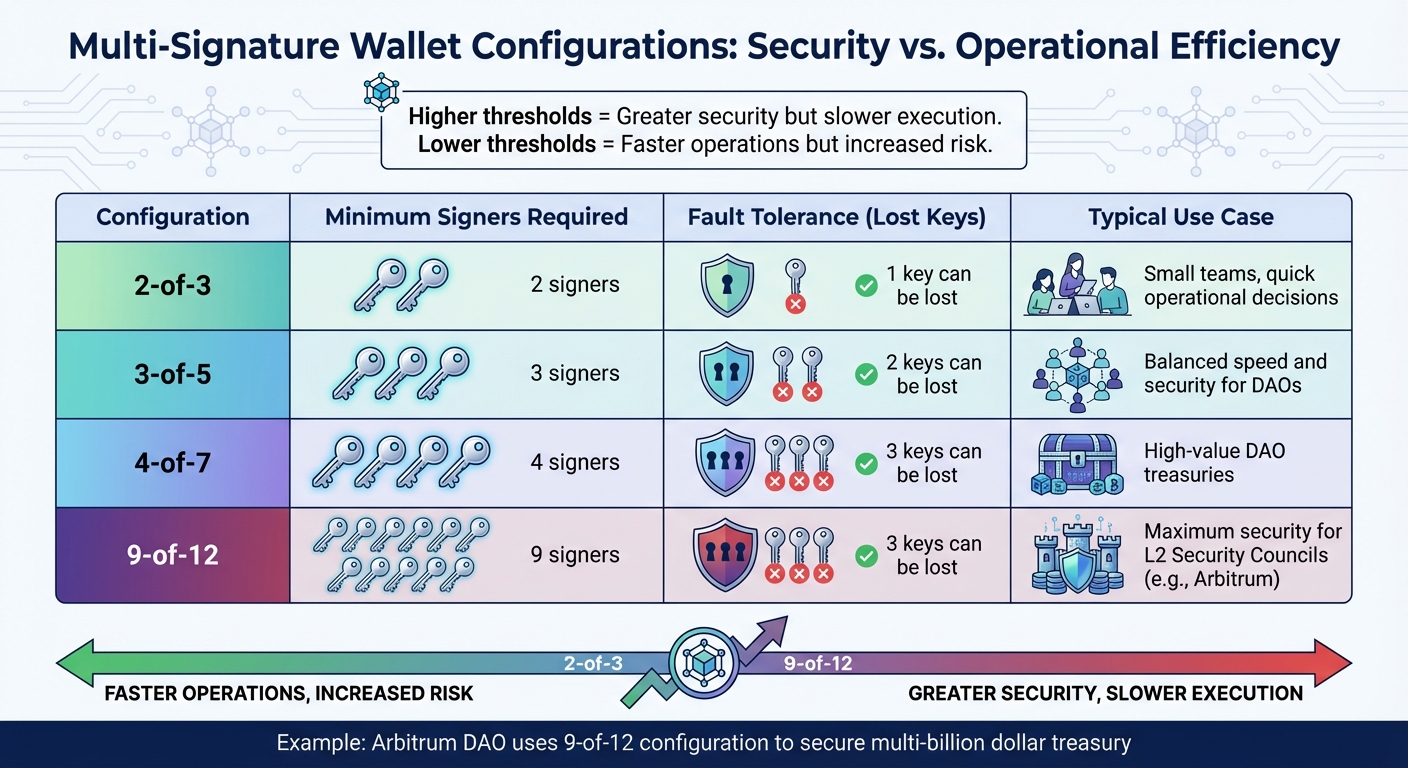
Multi-Signature Wallet Configuration Comparison for DAO Security
Multi-signature wallets do more than enforce governance policies - they act as a critical defense mechanism for DAO treasuries. By spreading control across multiple signers, they eliminate the risks associated with relying on a single private key. If one key is lost or stolen, the funds remain secure, thanks to built-in redundancy.
Key Redundancy and Thresholds
The strength of multi-signature wallets lies in their threshold-based design. For instance, a 3-of-5 configuration allows up to two keys to be lost without locking the funds permanently. This design is especially important for organizations handling large sums, ensuring that operations continue even if a signer loses access or becomes unavailable.
Advanced setups take this a step further. Using Bitcoin Miniscript, DAOs can create fallback recovery paths or hierarchical multisig structures to avoid treasury lockouts when several keys are lost. Some DAOs add escalation mechanisms, such as lowering the required number of signers (e.g., from 5 to 4) for transactions, but only after an extended delay - 14 days instead of the usual 2 days. Nested multisigs provide another layer of security. For example, in a 2-of-2 configuration, each "2" could itself be a multisig, ensuring that no single group losing their keys can paralyze the treasury. The Arbitrum Security Council has embraced this approach, using a 9-of-12 structure that tolerates up to three lost keys while maintaining functionality.
| Configuration | Minimum Signers | Fault Tolerance | Typical Use Case |
|---|---|---|---|
| 2-of-3 | 2 | 1 key | Small teams, quick operational decisions |
| 3-of-5 | 3 | 2 keys | Balanced speed and security for DAOs |
| 4-of-7 | 4 | 3 keys | High-value DAO treasuries |
| 9-of-12 | 9 | 3 keys | Maximum security for L2 Security Councils |
These safeguards are not just about redundancy - they also play a key role in preventing theft and hacking.
Protection Against Hacking and Theft
Multi-signature wallets make it significantly harder for hackers to succeed. In 2024, private key theft was the leading cause of cryptocurrency losses, with $2.2 billion stolen across 303 incidents. Multisigs counter this by requiring multiple independent approvals, making it far more difficult for attackers to compromise enough keys at once.
The Ronin Bridge hack highlighted the dangers of key concentration within a single organization. To avoid similar vulnerabilities, modern DAOs now distribute signers across various locations, organizations, and devices. This ensures that no single event - whether legal or physical - can compromise the majority of keys.
"A multi-signature wallet functions like a bank vault, requiring multiple private keys to unlock." – Built In
Timelock mechanisms enhance this protection further. Delays of 24–72 hours allow time to stop unauthorized transactions. For example, if an attacker uses a stolen key to initiate a transfer, other signers can cancel it before the funds are moved. MakerDAO demonstrated this by using a Governance Security Module with a pause delay of 16–30 hours, ensuring all updates were transparent and auditable.
Smart contracts add another layer of defense. DAOs can enforce daily spending limits, whitelist specific recipient addresses, and implement role-based access controls. These rules ensure that only authorized actions are taken, reducing the risk of both external attacks and insider threats. A rogue actor cannot execute a "rug pull" without collective approval.
"A 24–48h queue plus notifications catches fat-finger errors before they bite." – 7Block Labs
To further strengthen security, DAOs should adopt best practices such as requiring hardware wallets, conducting regular recovery drills, and establishing emergency protocols to halt treasury activity during coordinated attacks. These measures not only protect assets but also maintain trust in the DAO's governance system.
Coordination Challenges and Solutions
Operational agility is a critical element of effective DAO governance, building on the principles of transparency and accountability. While multi-signature wallets enhance security, they can introduce delays during urgent situations, such as market volatility or security threats. These delays become even more challenging when signers are spread across different time zones, organizations, and schedules.
Managing Multi-Party Approvals
One of the biggest hurdles DAOs face is coordinating signer availability, which can often be unpredictable. Without deliberate geographic diversity, assembling a quorum around the clock becomes difficult. For instance, if a treasury action requires five signatures and a few signers are unavailable, the process could stall for days, potentially leading to costly delays during critical moments like market downturns.
Another issue is signer fatigue. Frequent requests for signatures can lead to reduced attention to detail, increasing the risk of approvals being granted without proper scrutiny. As Solidity Developer Wisdom Uche Ijika wisely observed:
"The best control is the one your team can actually operate during stress." – Wisdom Uche Ijika
To address these challenges, many DAOs rely on asynchronous workflows using EIP-712. This approach allows signers to review and approve transactions at their own convenience. Once all signatures are collected, a final submitter bundles them for a single on-chain execution. Transaction batching further simplifies the process by consolidating multiple actions into one, reducing the number of interactions required from signers.
Another helpful practice is establishing "office hours" for transaction execution. By setting specific time windows for on-chain submissions, DAOs can ensure signers know when their involvement is expected, making coordination more predictable. Regular tabletop drills, where teams practice emergency scenarios, also help gauge how quickly a quorum can be assembled in high-pressure situations.
Tools That Simplify Multi-Party Signing
Safe{Wallet} (formerly Gnosis Safe) has become the go-to tool for managing multi-signature wallets. For example, the Arbitrum DAO uses a 9-of-12 Safe configuration to oversee its multi-billion-dollar treasury. Safe{Wallet} combines reliable smart contracts with a suite of modules and integrations, making it easier for non-technical signers to participate.
Automated notifications play a crucial role in preventing delays. By mirroring multisig events - such as new proposals, quorum updates, or pending signatures - to platforms like Slack, email, or Telegram, DAOs can ensure signers stay informed and responsive. Tools like OpenZeppelin Defender also provide real-time alerts for significant actions, such as large withdrawals or ownership changes, keeping stakeholders in the loop.
Simulation tools like Tenderly further enhance signer confidence by allowing users to preview transaction outcomes in plain language. These previews show token movements and state changes before signatures are applied, reducing the risk of errors and making the process more accessible for less technical participants.
For recurring transactions like payroll, platforms like Sablier automate payment streams, reducing the need for repeated manual approvals. Similarly, the Zodiac Reality Module connects off-chain governance (e.g., Snapshot votes) with on-chain execution, enabling community decisions to automatically trigger multisig actions. This reduces reliance on individual signers and ensures smoother execution of proposals.
"The ecosystem around a wallet is as important as the code itself - wallet connectors, transaction explorers, multisig UIs all make adoption realistic." – NBQSA
Role-based access tools, such as Zodiac Roles, allow DAOs to delegate specific tasks, like trading or payroll, to smaller sub-groups. By creating an "Ops Safe" with lower signature thresholds and defined spending limits, DAOs can reduce signer fatigue while maintaining oversight.
A layered approach to security and operations is often the best solution. For instance, DAOs can implement hierarchical multisig structures with a "Root Safe" for major decisions and "Program Safes" for routine activities. This setup enables quick action on day-to-day operations while keeping core treasury controls secure. Such strategies strike a balance between security and efficiency, ensuring that coordination challenges don't hinder progress.
Conclusion
Multi-signature wallets bring a new level of security and shared responsibility to DAO governance. By requiring multiple approvals for transactions, they eliminate the risk of single-point failures. Plus, every transaction is logged on-chain, giving community members real-time insight into treasury management and decision-making processes.
The use of hierarchical multisig structures reflects the growing sophistication of DAO governance. Many leading protocols now implement nested setups, with security councils and foundation multisigs, each tailored with specific thresholds and delays. This structure allows DAOs to handle routine tasks efficiently while maintaining tight control over critical treasury operations. As Tahem Verma, CEO of Mesha, explains:
"Multisignature wallets are a necessary step toward users and contributors viewing DAOs as a secure alternative to centralized corporate structures".
This approach not only safeguards assets but also builds trust among stakeholders. Multisigs ensure that no single individual can act alone, embedding accountability into DAO operations. They also send a message to the broader ecosystem - whether to exchanges, institutional partners, or other observers - that a DAO is committed to decentralization. Achieving milestones like L2BEAT's Stage-1 decentralization standard, which requires at least eight participants and a 75% approval threshold, further highlights this dedication.
While challenges like coordination and timelock management persist, practices like recovery drills ensure DAOs remain both agile and secure. The result? A governance model that is stronger, more reliable, and better equipped to earn long-term trust.
FAQs
What multisig setup fits my DAO?
The best multisignature (multisig) setup for your DAO will vary based on factors like its size, security requirements, and governance framework. For smaller DAOs, a straightforward threshold system - such as requiring 2 out of 3 signatures - can strike a good balance between security and operational efficiency. Larger DAOs, on the other hand, may find that hierarchical multisig configurations with role-based permissions and layered controls are better suited to their needs. These setups allow for smoother scalability, quicker responses to incidents, and more precise delegation of authority, aligning well with more complex governance structures.
How do timelocks stop bad transfers?
Timelocks add an extra layer of security by introducing a delay before executing function calls. This delay acts as a review period, giving users the opportunity to spot and cancel transactions that might be malicious or contain errors before they are completed. By doing so, timelocks help minimize risks and promote greater transparency in decentralized governance systems.
What happens if enough signers lose access?
If too many signers lose access, the multisignature wallet could become incapable of approving transactions. When this happens, a recovery process or extra safeguards may be required to regain control. To avoid this scenario, it’s essential to have solid backup plans and effective access management strategies in place for all signers.