

Governance
5 Hybrid DAO Governance Models Explained
Five hybrid DAO governance models compared - trade-offs in decentralization, decision speed, community involvement, and legal compliance.

March 2nd, 2026
•
14 min read
5 Hybrid DAO Governance Models Explained
DAOs face a challenge: how to stay decentralized while making decisions efficiently. Hybrid governance models solve this by blending community-driven decision-making with structured processes like councils, sub-committees, or legal entities. These models tackle issues like low voter turnout and dominance by large token holders, while ensuring DAOs can handle legal and financial responsibilities.
Here’s a quick look at five hybrid governance models:
- Token Voting with Elected Councils: Token holders decide on big issues, while elected councils manage daily operations. This speeds up decisions without losing community control.
- Foundation with DAO Structure: A legal entity handles execution and compliance, while the community votes on key strategies.
- Sub-DAO Delegation: Tasks are divided among smaller, specialized sub-DAOs, improving focus and scalability.
- Liquid Democracy: Members vote directly or delegate their votes to trusted experts, offering flexibility and reducing voter fatigue.
- On-Chain Intent with Off-Chain Execution: Decisions are made on-chain, but execution is handled off-chain by a legal entity or committee.
Quick Comparison
| Model | Decentralization | Efficiency | Community Involvement | Regulatory Compliance |
|---|---|---|---|---|
| Token Voting with Councils | Medium | High | Moderate | Low |
| Foundation with DAO Structure | High (intent only) | High | Moderate | Very High |
| Sub-DAO Delegation | High | High | High | Moderate |
| Liquid Democracy | High | Medium | High | Low |
| On-Chain Intent, Off-Chain Exec | High (intent only) | Very High | Moderate | Very High |
Each model has trade-offs. Smaller DAOs benefit from simpler structures, while larger ones need delegation or layered governance to avoid bottlenecks. Legal wrappers also play a critical role in ensuring compliance and protecting members from liability.
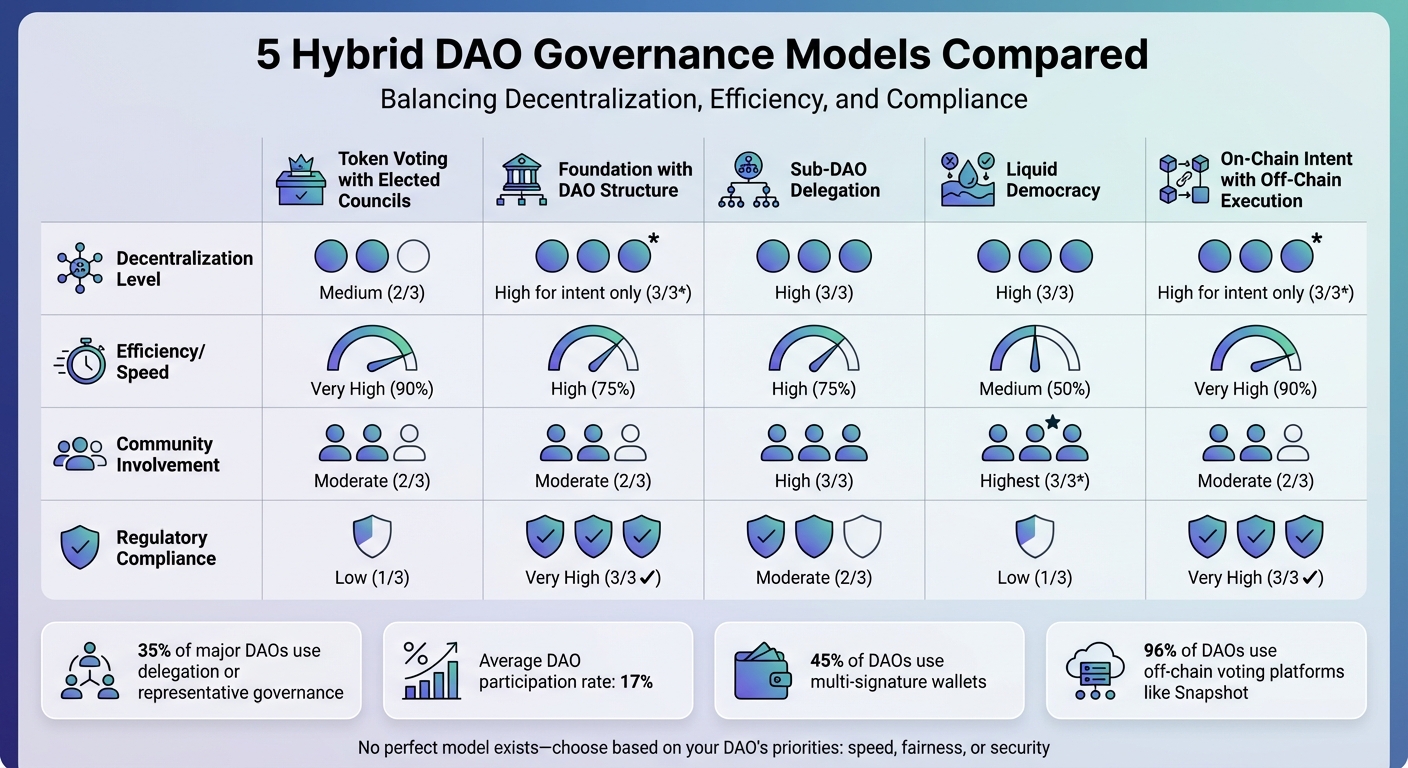
Comparison of 5 Hybrid DAO Governance Models: Decentralization, Efficiency, and Compliance
Governance Models for Tokenized Ecosystems | Exclusive Lesson
sbb-itb-8eb1bfa
1. Token Voting with Elected Councils
In this model, token holders set the big-picture direction, while elected councils handle the day-to-day operations - similar to how representative democracies function.
Decentralization vs. Centralization Balance
Token holders maintain control over major strategic decisions but delegate specific responsibilities - like budgets or operational tasks - to elected councils. This setup avoids the inefficiency of requiring community votes on every minor issue while preserving the decentralized ethos of DAOs. To prevent power from becoming concentrated, many DAOs introduce rotating leadership roles and enforce strict limits on council authority through constitutional guidelines. These safeguards ensure quicker decision-making without compromising core decentralization principles.
Efficiency in Decision-Making
Elected councils streamline processes, making decisions within hours - an essential capability during emergencies or market fluctuations. For example, ENS DAO has divided its governance into four workstreams: Governance, Community, ENS Ecosystem, and Public Welfare. Each is managed by five elected stewards who oversee daily operations and approve funding requests. Major proposals still go to the broader community for a vote, but stewards handle routine tasks, keeping operations smooth and responsive.
Community Participation and Representation
This model also addresses the issue of low voter engagement. By electing representatives, the community avoids being overwhelmed with every proposal. Instead, selected individuals with relevant expertise research and resolve complex matters. Currently, about 35% of major DAOs use some form of delegation or representative governance to improve functionality. A standout example is the Optimism Collective, which employs a bicameral system. The "Token House" represents OP token holders for protocol upgrades, while the "Citizens House" uses "Citizenship NFTs" to include non-token holders in decisions about funding public goods retroactively.
Regulatory and Legal Compliance
Another advantage of this model is its ability to navigate legal and regulatory requirements. Elected councils can act as a legal interface for DAOs, enabling them to sign contracts, open bank accounts, and meet tax or KYC/AML obligations - tasks that purely on-chain structures struggle to handle. Importantly, all council activities and treasury transactions are recorded on-chain, allowing the community to verify that representatives are acting in the DAO's best interest.
2. Foundation with DAO Structure
This framework separates decision-making from execution. The community votes on key issues using blockchain-based systems, while a registered legal entity - referred to as a Foundation - handles operations in the physical world. Essentially, the DAO sets the vision, and the Foundation ensures compliance with legal requirements. Picture it like a council setting policies while an administrative team executes them. This blend of on-chain governance and off-chain practicality strengthens both community participation and operational effectiveness.
Decentralization vs. Centralization Balance
The Foundation serves as a "legal wrapper", shielding individual DAO members from personal liability. For example, in February 2026, Ripple introduced XAO DAO as part of a strategic overhaul. This model combines blockchain-based voting with expert management, which has successfully overseen more than $550 million. By allowing a dedicated team to handle daily operations, this setup avoids bottlenecks, while the broader community retains control over overarching strategies.
Efficiency in Decision-Making
Foundations improve operational efficiency by using a two-tiered structure. For instance, JuiceboxDAO employs a core team to implement community decisions, charging a 5% fee and rewarding contributors with JBX tokens. This system ensures quick responses to market shifts while maintaining alignment with community goals.
Regulatory and Legal Compliance
Foundations also handle critical regulatory responsibilities, such as AML (Anti-Money Laundering) and KYC (Know Your Customer) processes for treasury distributions. In January 2026, BlackRock introduced tokenized ETFs governed by a hybrid DAO model. This approach enabled real-time settlements and minimized counterparty risk, all while meeting institutional compliance standards.
"A DAO legal wrapper enables DAOs to... sign enforceable contracts with partners and banks".
This legal framework is increasingly vital, especially as DAO treasuries dropped from a peak of $37 billion to roughly $24.5 billion by late 2024. It provides the necessary structure to adapt to evolving legal and financial landscapes.
3. Sub-DAO Delegation Model
The sub-DAO delegation model builds on existing frameworks where routine tasks are handed off to elected councils or foundations. This approach takes it a step further by dividing a DAO into smaller, specialized units, each focusing on a specific function. For example, one sub-DAO might handle grants, another oversees infrastructure, and a third focuses on community growth. While these sub-DAOs operate independently within their defined roles, the main DAO maintains overall oversight, ensuring smooth coordination and avoiding decision-making bottlenecks.
Decentralization vs. Centralization Balance
Sub-DAOs strike a balance between decentralization and centralization by giving independent teams limited authority while keeping them aligned with the main organization's vision. This structure ensures that the inefficiencies of excessive decentralization are avoided while minimizing risks tied to overly centralized control.
Efficiency in Decision-Making
Assigning specific responsibilities and budgets to sub-DAOs allows organizations to scale their operations without slowing down decision-making. For instance, Aave employs "Risk Stewards" who can adjust parameters like supply caps without waiting for a full community vote. This enables quick reactions to market changes. Similarly, Arbitrum DAO adopted a multi-layered structure in 2024 and 2025, where sub-DAOs manage tasks like ecosystem grants and infrastructure projects. By breaking large protocol decisions into smaller, manageable parts, this model allows experts to handle daily operations while the broader community focuses on strategic priorities. This setup ensures that focused teams can act efficiently without undermining the DAO's decentralized nature.
Community Participation and Representation
Delegating responsibilities to sub-DAOs also addresses the challenge of low participation rates among token holders, which averaged about 17% across DAOs in 2025. Some, like Decentraland, reported participation as low as 0.79%. Sub-DAOs allow members to assign voting power to experts, ensuring that decisions are made by those with the right expertise. For example, developers can handle technical issues, while treasury specialists manage financial decisions. Optimism’s bicameral model exemplifies this approach, with a Token House representing financial stakeholders and a Citizens' House for contributors based on reputation.
"The challenge is not eliminating structure but reimagining it for decentralized coordination." - DAObox
Accountability is a key feature of this model. Delegates and stewards regularly provide reports to maintain transparency, and token holders retain the authority to revoke delegated powers if necessary. MakerDAO demonstrates this with its "Core Units", which handle tasks like risk management and collateral onboarding. Token holders vote on the budgets and mandates for each unit, ensuring that these specialized teams operate within the DAO's broader vision.
4. Liquid Democracy and Delegative Voting
Liquid democracy strikes a middle ground between direct voting and representative systems. It gives members the ability to vote directly or delegate their voting power to trusted individuals or experts. Unlike traditional systems with fixed election cycles, liquid democracy offers flexibility - members can revoke or reassign their delegation at any time and rely on specialists for specific issues. This adaptability forms the foundation of its governance model.
Decentralization vs. Centralization Balance
Liquid democracy maintains decentralization by ensuring every member has the option to vote directly at any time. At the same time, it introduces efficiency by enabling the delegation of votes to specialists. As of April 2023, roughly 35% of major DAOs (Decentralized Autonomous Organizations) had adopted delegation as a core governance tool. A good example is the Ethereum Name Service (ENS) DAO, which requires only a 1% quorum for executable proposals. This setup allows a small group of active delegates to move decisions forward while still leaving the door open for passive token holders to participate. This balance between decentralization and efficiency is a hallmark of DAO governance.
Efficiency in Decision-Making
One of the standout benefits of liquid democracy is its ability to reduce voter fatigue. Members aren’t expected to research and vote on every proposal. Instead, they can delegate their votes on topics where they feel less knowledgeable or lack the time. A practical example of this is the Pirate Party of Germany, which has used the open-source LiquidFeedback software since 2006. This system lets members either vote directly or delegate their votes on specific policy issues, effectively channeling influence to those with expertise through re-delegation.
Community Participation and Representation
Beyond efficiency, liquid democracy addresses low participation rates often seen in DAOs. It allows members to decide their level of involvement. Those who lack technical expertise or time can still have their voices heard by delegating their votes to trusted peers. Platforms like Optimism and ENS have implemented delegation systems to ensure passive token holders can assign their votes to active delegates as their communities grow. This setup also keeps delegates accountable since members can withdraw their delegated votes if they feel misrepresented.
"Liquid democracy stands as a beacon of innovation in the realm of governance, merging the best elements of direct and representative democracies into a cohesive system that empowers individuals with both voice and flexibility." - FasterCapital
5. On-Chain Intent with Off-Chain Execution
This model addresses the challenge of balancing decentralized decision-making with efficient execution. It divides governance into two distinct phases: on-chain voting to define the community’s strategic goals (the "intent") and off-chain execution managed by a legal entity or dedicated committee (the "execution"). Essentially, the community decides what should happen, while a trusted body determines how to make it happen.
Decentralization vs. Centralization Balance
In this setup, token holders retain significant power through on-chain voting, where every decision is transparently recorded on the blockchain. However, the execution phase introduces a level of centralization. Tasks that cannot be automated by smart contracts are handled by a legal structure - such as a foundation or Special Purpose Vehicle (SPV) - to ensure compliance and operational efficiency.
"Many DAOs now separate on-chain intent from off-chain execution: communities vote on decisions, while a registered entity carries them out legally. This hybrid approach ensures compliance and operational clarity while preserving decentralization." - DAObox
As of 2025, 45% of DAOs utilize multi-signature wallets as a safeguard during the execution phase. This additional layer of security helps prevent "governance paralysis", where progress stalls because every operational detail requires a full community vote.
Efficiency in Decision-Making
Off-chain execution significantly speeds up operations. While the community establishes overarching goals through votes, specialized councils or sub-committees manage the daily operations without needing blockchain confirmations for every minor task. This is particularly useful for tasks like hiring, asset management, or interacting with traditional financial systems - areas where smart contracts fall short.
"Often, the execution of proposals, the distribution of funds from the DAO's treasury, or the distribution of governance rewards still rely on human intervention rather than being automated by smart contracts. This can be due to smart contract risks or legal and regulatory compliance." - Algorand Foundation
By 2025, 96% of DAOs had embraced off-chain voting platforms like Snapshot. These platforms eliminate gas fees and streamline the decision-making process before finalizing actions on-chain. This two-step approach ensures thorough deliberation and refinement without the costs or delays of recording every discussion on the blockchain. The result is an agile governance structure that still prioritizes community oversight.
Community Participation and Representation
This model enhances community engagement by creating multiple opportunities for input. Before any formal vote, members discuss proposals on platforms like Discord or Discourse and refine them on GitHub. This pre-vote process allows for collaborative planning and ensures that concerns are addressed early. Once a proposal is finalized, the on-chain vote serves as the immutable record of the community’s decision, which executors are obligated to follow.
Not every decision requires full community involvement, and this structure acknowledges that reality. Token holders focus on setting strategic priorities, while trusted stewards handle the finer details of execution. The on-chain records provide transparency, enabling the community to verify that the execution aligns with their approved intent. Participation rates for major proposals range from 22% to 28% for leading protocols, with an ecosystem average of around 17%.
Regulatory and Legal Compliance
Separating intent from execution also helps DAOs navigate legal complexities. Legal wrappers ensure compliance with jurisdictional rules, tax obligations, and KYC/AML requirements while protecting individual members from personal liability. Without this framework, contributors could face personal financial or legal risks stemming from the DAO’s actions.
This structure also facilitates real-world transactions, such as owning intellectual property, entering enforceable contracts, or donating to organizations that don’t accept cryptocurrency. The Harmony Framework, developed by DAObox, offers a jurisdiction-neutral guide for creating these legal wrappers, supporting the on-chain intent/off-chain execution model.
Comparison Table
The table below highlights the core attributes of various governance models, summarizing their levels of decentralization, efficiency, community involvement, and regulatory alignment. Hybrid models offer different strengths and trade-offs, helping DAOs decide which structure best suits their goals.
| Governance Model | Decentralization Level | Efficiency/Speed | Community Involvement | Regulatory Compliance |
|---|---|---|---|---|
| Token Voting with Elected Councils | Medium (tiered structure) | Very High (multisig enables quick decisions) | Moderate (focused on oversight) | Low |
| Foundation with DAO Structure | High for intent, Low for execution | High (legal entity manages operations) | Moderate (votes on direction only) | Very High |
| Sub-DAO Delegation Model | High (distributed across teams) | High (parallel workstreams) | High (specialized participation) | Moderate |
| Liquid Democracy and Delegative Voting | High (fluid power distribution) | Medium (requires delegate coordination) | Highest (flexible participation) | Low |
| On-Chain Intent with Off-Chain Execution | High for decisions, Low for implementation | Very High (voting separated from execution) | Moderate (strategic focus) | Very High |
This table captures the trade-offs between these models, connecting their unique characteristics to the broader strategic considerations of DAOs. For instance, 35% of major DAOs offer delegation options, with top protocols achieving 22-28% participation in key proposals.
"No perfect DAO voting scheme exists. Choose based on your DAO's priorities: speed, fairness, or security." - DAOTimes
Conclusion
Selecting a hybrid governance model for your DAO requires aligning its structure with your goals, community size, and operational needs. Token Voting with Elected Councils is ideal when quick decision-making is essential. On the other hand, a Foundation with DAO Structure offers the legal framework necessary for handling contracts and working with institutions. For larger communities with specialized workstreams, Sub-DAO Delegation provides scalability, while Liquid Democracy ensures flexibility for members who prefer to stay involved without voting on every issue. Lastly, On-Chain Intent with Off-Chain Execution connects community aspirations with practical, real-world implementation.
With average DAO participation hovering at 17% and 60% relying on token-based quorums, many organizations face challenges in balancing efficiency and decentralization. No single voting model solves every issue - each involves trade-offs between speed, fairness, and decentralization.
Every hybrid model comes with its own set of compromises, and these need to align with your DAO’s specific challenges. Smaller DAOs often benefit from consensus-based approaches, while larger ones may require delegation or layered structures to address voter apathy. Tailor decision-making mechanisms to the situation: a simple majority works for routine tasks, supermajority votes suit constitutional changes, and multi-sig wallets are effective for emergencies. To prevent issues like whale dominance and Sybil attacks, consider implementing quadratic voting paired with strong identity verification measures.
In addition to operational and decision-making strategies, legal considerations are vital. Ensuring your governance model adheres to legal requirements protects members from personal liability and enables enforceable contracts. This becomes particularly important for DAOs involved in real-world activities, such as managing tokenized assets or coordinating events.
For communities focused on decentralized event organization and social coordination, tools like Zenao.io (https://zenao.io) simplify hybrid governance. By offering digital ticketing and community management solutions, Zenao.io helps bridge the gap between governance and real-world execution, empowering communities to turn their visions into action.
FAQs
Which hybrid DAO governance model fits my DAO’s size and goals?
The best hybrid DAO governance model hinges on your DAO’s size, objectives, and how you want to balance decentralization with efficiency. For smaller DAOs, democratic voting or liquid democracy can work well, offering inclusivity and adaptability. On the other hand, larger DAOs with more resources might lean toward token-based or hybrid models, which help manage decisions at scale while maintaining a mix of decentralization and effective operations. Tools like Zenao.io can assist in streamlining governance and boosting community engagement.
How can a DAO reduce whale control and low voter turnout?
A DAO can address issues like whale control and low voter turnout by implementing hybrid governance models. For example, quadratic voting helps curb the dominance of large token holders by giving smaller members a more balanced voice. Reputation-based systems and delegation mechanisms can further empower smaller participants, ensuring their contributions carry weight. Tools such as quorum requirements also play a role, as they ensure proposals only move forward with adequate participation, fostering fairness and encouraging more active involvement across the community.
When should a DAO use a legal wrapper or foundation?
When a DAO operates within traditional legal and financial systems - like holding assets, managing liabilities, or meeting regulatory requirements - it’s wise to use a legal wrapper or foundation. Structures such as foundations or LLCs offer limited liability and legal protections, making it easier to interact with institutions. This becomes especially crucial as the DAO expands, manages a treasury, and takes on off-chain responsibilities beyond its on-chain community.