

Governance
DAO Conflict Resolution: Key Frameworks
Compare on-chain tools, Kleros, Aragon Court, UMA oracle and hybrid models to resolve DAO disputes by type, cost, speed, and privacy.

January 31st, 2026
•
11 min read
DAO Conflict Resolution: Key Frameworks
DAOs (Decentralized Autonomous Organizations) are reshaping collaboration but face unique challenges with conflicts. These disputes can range from financial disagreements to governance, technical, and even behavioral issues. Traditional legal systems don’t work well for DAOs due to their decentralized, global, and often anonymous nature. This has led to the rise of specialized frameworks for resolving disputes.
Key DAO Conflict Resolution Frameworks:
- On-Chain Resolution: Automates decisions using smart contracts for objective conflicts but struggles with subjective issues.
- Kleros: A decentralized court with crowdsourced jurors incentivized to resolve disputes.
- Aragon Court: Uses token-staking Guardians to decide governance-related conflicts with penalties for non-participation or minority voting.
- UMA Optimistic Oracle: Assumes outcomes are valid unless challenged, ideal for straightforward, low-complexity cases.
- Vitalik Buterin’s Hybrid Model: Combines on-chain tools with privacy-focused voting (MACI) and AI for dispute resolution.
Each framework offers unique strengths depending on the type of conflict and the DAO's needs. For example, Kleros and Aragon Court are better for disputes requiring human judgment, while UMA’s oracle system is faster and cost-effective for simpler issues. Choosing the right system ensures smoother operations and trust within the DAO.
Quick Comparison:
| Framework | Best For | Timeframe | Cost | Involvement Level |
|---|---|---|---|---|
| On-Chain Resolution | Objective smart contract issues | Instant | Low (Gas) | Automated |
| Kleros | Specialized disputes (NFTs, etc.) | 7–21 days | Low | Crowdsourced jurors |
| Aragon Court | Governance conflicts | 11–14+ days | Moderate | Token-staking Guardians |
| UMA Optimistic Oracle | Simple DeFi disputes | 24–72 hours | Very Low | Challenge-based |
| Vitalik’s Hybrid Framework | Privacy-sensitive cases | Case-dependent | Moderate–High | Mixed (MACI, AI) |
To ensure smooth operations, DAOs should establish clear dispute policies, use escalation triggers, and select frameworks that align with their specific needs.
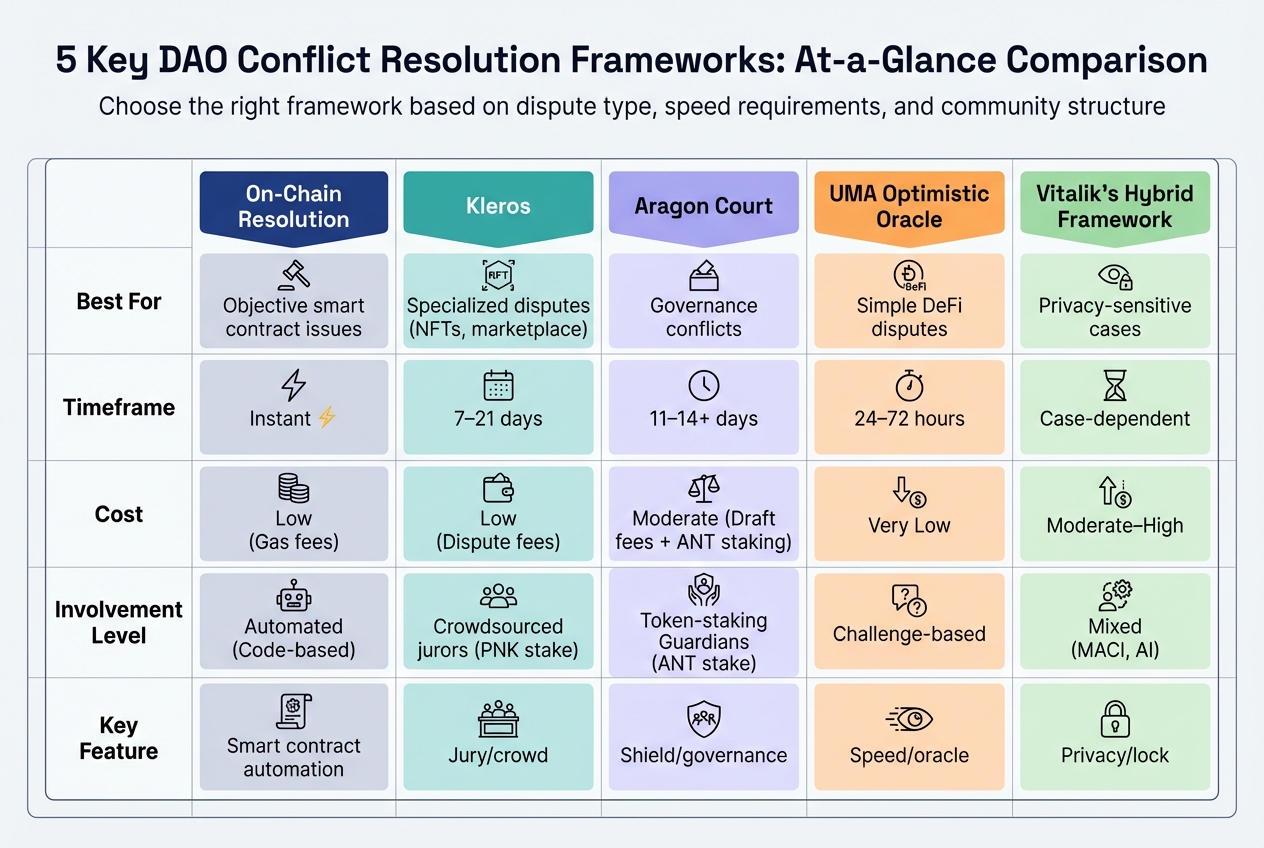
DAO Conflict Resolution Frameworks Comparison Chart
Understanding Conflicts in DAOs
Common Types of DAO Conflicts
DAOs encounter six main types of disputes, setting them apart from traditional organizations.
Financial disputes arise when members clash over how to manage the treasury, determine compensation, or allocate tokens. These disagreements are significant in ecosystems that collectively managed about $16 billion in assets in 2022.
Governance disputes often stem from "plutocracy" concerns, where large token holders (commonly referred to as whales) dominate decision-making. This is especially problematic in DAOs where token distribution allows a few individuals to control outcomes, sidelining smaller participants.
Technical disputes revolve around disagreements on code changes, software updates, or security protocols. These issues can stall progress if not addressed collaboratively.
Intellectual property disputes focus on ownership and usage rights, including NFTs, licensing agreements, and code repositories.
Social and behavioral disputes cover interpersonal issues or violations of community standards. These conflicts can damage trust and morale within the DAO.
Strategic and alignment disputes occur when members question whether certain actions or decisions align with the DAO's core mission.
These diverse challenges highlight the importance of having effective resolution mechanisms in place.
Why Conflict Resolution Matters
Unresolved disputes can cripple a DAO's ability to function smoothly, reducing member participation and undermining cohesion. The transparency that makes DAOs appealing can also expose vulnerabilities. A notable example is ConstitutionDAO's participation in a public auction for a rare copy of the U.S. Constitution in November 2021. Competitors could see the DAO's treasury on the blockchain, giving them insight into its bidding capacity.
The absence of a central authority further complicates these issues. MolochDAO’s guidelines reflect this decentralized ethos:
"MolochDAO does not recognize a singular sovereign authority in such matters and shall encourage the offending parties to take it upon themselves to work out their own tensions".
While this approach may work for smaller groups, it becomes less effective as DAOs grow. Between 2019 and late 2020, DAO deployment surged by 660%, bringing 1.6 million participants into systems that often lacked structured conflict resolution processes.
Without proper frameworks, disputes can lead to reduced participation, fragmented communities, and operational inefficiencies. Traditional legal systems fall short in addressing these challenges, as DAO participants are often anonymous and operate across borders without conventional legal structures. Tackling these conflicts head-on is essential for maintaining the integrity and functionality of DAOs.
5 Frameworks for DAO Conflict Resolution
Efficient conflict resolution is crucial for maintaining the smooth operation of DAOs and preserving trust within their communities.
On-Chain Dispute Resolution
This method relies on smart contracts to settle disputes by automatically executing pre-defined conditions. For example, funds might be released or transactions reversed once certain criteria are met. This approach works well for objective, code-based issues. Tools like Snapshot facilitate collective decision-making, while oracle networks provide external data verification - such as confirming a contractor's work or market prices. However, this method struggles with conflicts that involve social or behavioral nuances, which require human judgment. To bridge this gap, models like crowdsourced arbitration introduce human oversight when necessary.
Kleros: Crowdsourced Arbitration
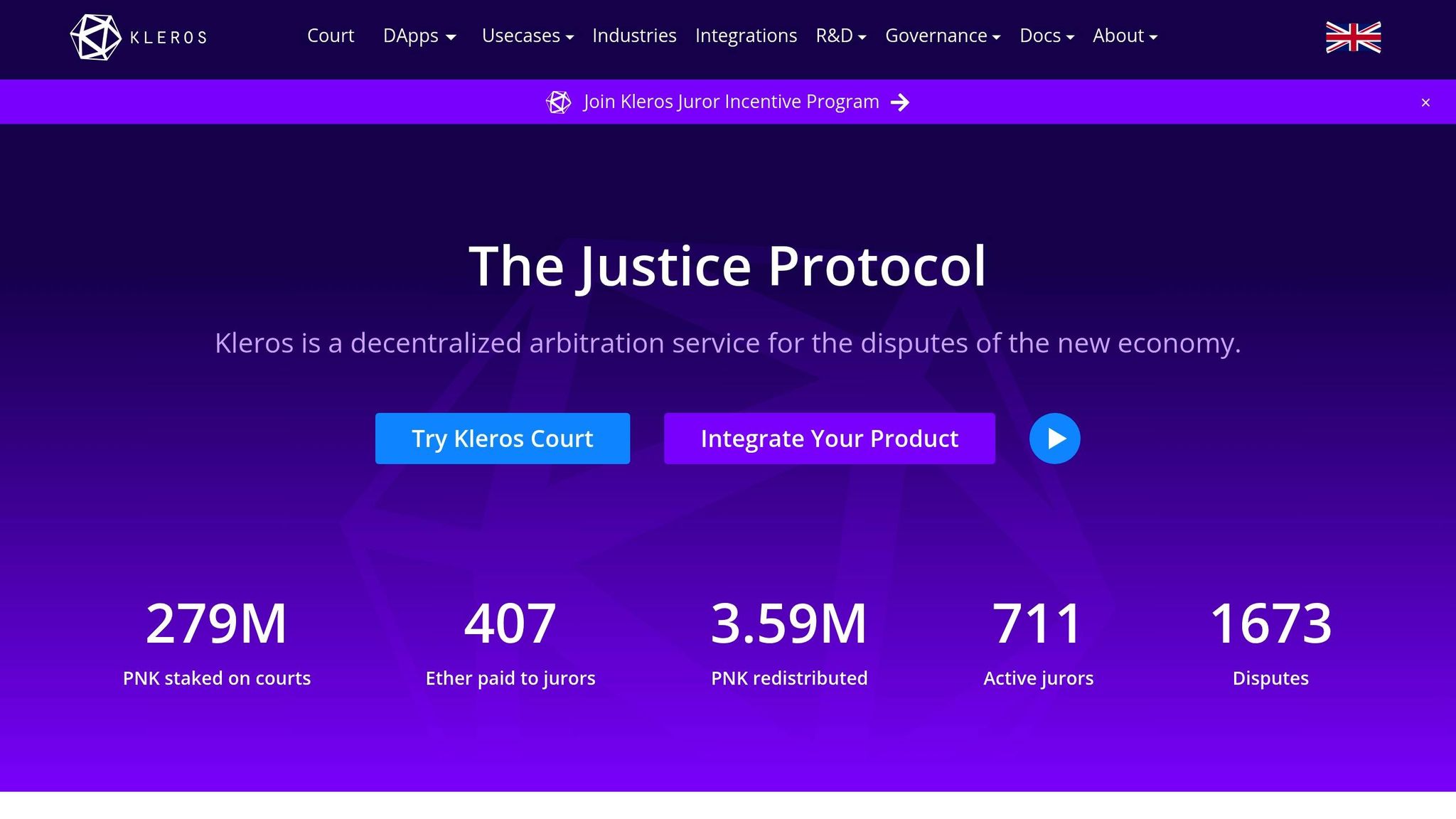
Kleros operates as a decentralized court system. It selects jurors randomly and incentivizes them through game-theory mechanisms to resolve disputes. Specialized sub-courts ensure that jurors with relevant expertise handle specific cases, such as those involving software development or insurance claims. Jurors vote "Yes", "No", or "Refuse to Arbitrate", typically resolving disputes within 7–21 days.
Aragon Court: DAO-Governed Jurors
Aragon Court uses Guardians - participants chosen based on their active token stake - to resolve governance-related conflicts. A Schelling point mechanism promotes consensus, while penalties discourage non-participation or minority voting. According to Aragon's documentation:
"Guardians are incentivized to reach consensus and are rewarded or penalized accordingly... failing to cast a vote will result in your locked tokens getting slashed."
The system enforces voting phases, with penalties of up to 30% token slashing for failure or minority votes. There can be up to four appeal rounds. In 2024, Aragon collaborated with Morpho to launch Guardians V2, allowing vault depositors to veto asset curation decisions in DeFi protocols.
UMA Optimistic Oracle: Challenge-Based Resolution
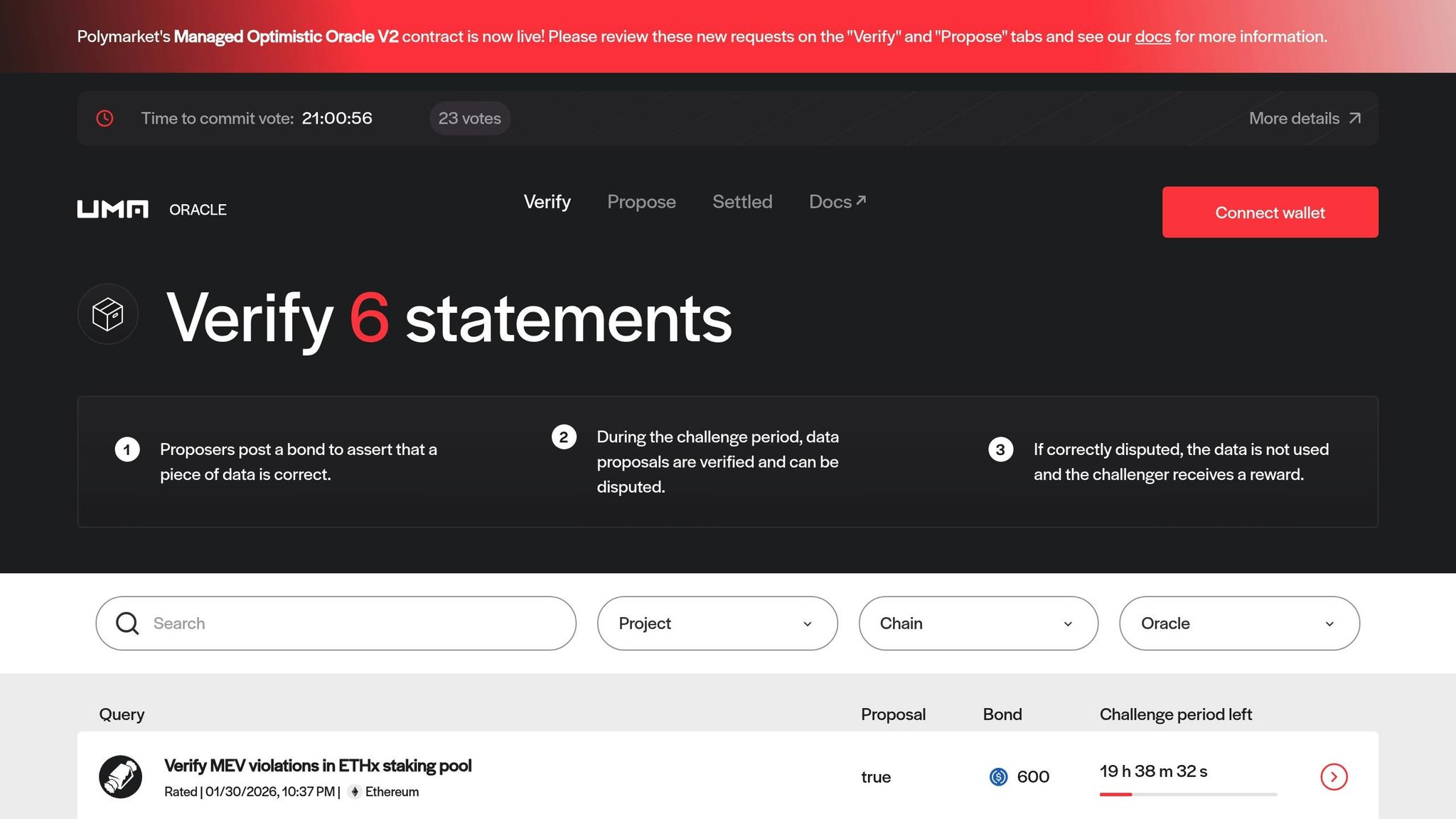
The UMA Optimistic Oracle provides a fast and cost-effective way to handle straightforward disputes. It assumes a proposed outcome is correct unless challenged within 24–72 hours. By acting as an oracle network, it feeds external data into smart contracts to validate real-world information. This framework is particularly useful for verifying service milestones or market data in low-complexity cases.
Vitalik Buterin's Hybrid Framework
Vitalik Buterin’s model combines on-chain resolution with cryptographic privacy. Using MACI (Minimum Anti-Collusion Infrastructure) for private, verifiable voting and AI to handle simple, recurring disputes, it aims to balance transparency with confidentiality. In 2024, Aragon teamed up with the MACI team to develop scalable private voting, aiming to reduce voter intimidation and collusion. Each of these frameworks addresses unique challenges in DAO governance, offering tailored solutions for resolving conflicts effectively.
How to Integrate Conflict Resolution into DAO Governance
Integration Steps
Planning for conflict resolution in your DAO is essential to maintaining trust and avoiding unnecessary escalation. Here's how to get started:
Begin with a clear Dispute Policy - this will act as the foundation for how your DAO handles conflicts. According to Aragon's documentation:
"All Aragon Govern DAOs MUST have a human-readable agreement that states how the DAO intends to operate, and what actions should be allowed or forbidden."
To ensure the policy remains tamper-proof, store it on an immutable platform like IPFS. This prevents any retroactive changes during disputes.
Next, establish escalation triggers. Define specific conditions for when a conflict should move from informal discussions to formal arbitration. For example, you might escalate disputes involving large transactions or unresolved mediation attempts. Then, outline your court parameters by picking an arbitration framework, deciding on the number of jurors for initial cases, and balancing costs with resolution speed.
For enforcement, consider integrating arbitration through trustless smart contracts (ERC-792) or a Recognition-of-Jurisdiction arrangement, where the DAO manually enforces rulings.
Lastly, make the process transparent and accessible. Share the details publicly and train your community members on how to submit evidence or file appeals. This preparation ensures everyone knows how to navigate the system when needed.
These steps create a structured and efficient alternative to traditional conflict resolution methods.
Differences from Corporate Governance
The way DAOs handle conflict resolution is fundamentally different from corporate governance models. In traditional systems, centralized boards or judges backed by state authority typically resolve disputes. DAOs, on the other hand, rely on decentralized mechanisms like crowdsourced jurors or "guardians", often selected through token staking.
Enforcement is another key difference. Corporate disputes typically require manual intervention via courts, while DAOs often use smart contracts or decentralized protocols to automate enforcement. Additionally, the incentives for participants vary greatly. Corporate arbiters are guided by professional fees and legal ethics, whereas DAO jurors operate under game-theoretic principles. For example, in Aragon Court, jurors are rewarded for reaching consensus but risk token slashing (up to 30%) for minority or malicious rulings.
As Aragon's documentation highlights:
"Unlike traditional courts, Aragon Court guardians are not asked to rule impartially on disputes but instead are asked to rule the way they expect the plurality of guardians to rule."
This creates a Schelling point, where honest participation is incentivized through economic rationality. Furthermore, while corporate disputes often unfold behind closed doors, DAO resolutions are radically transparent. Evidence, justifications, and rulings are publicly accessible, either on-chain or through IPFS, making the entire process verifiable and open.
sbb-itb-8eb1bfa
Framework Comparison
Here's a breakdown of the key differences between the frameworks, focusing on speed, cost, and human involvement.
On-chain resolution operates through smart contracts, offering instant settlement for objective disputes at a minimal cost (gas fees). However, it struggles with resolving subjective conflicts effectively.
For subjective issues, frameworks like Kleros and Aragon Court bring human arbitration into the mix. Kleros uses a pool of randomly selected, crowdsourced jurors staking PNK tokens. According to their documentation:
"Kleros provides judgments in an inexpensive, reliable, typically fast, and decentralized way."
Aragon Court, on the other hand, relies on Guardians who stake ANT tokens. Guardians are paid a draft fee in DAI but risk losing 30% of their staked balance if they vote against the majority decision.
UMA Optimistic Oracle offers a simpler and cost-effective solution for DeFi-related disputes by assuming transactions are valid unless contested.
Lastly, Vitalik Buterin's Hybrid Framework targets privacy-sensitive governance by incorporating technologies like MACI (Minimum Anti-Collusion Infrastructure). This approach tends to have moderate to high costs, depending on the case.
Below is a table summarizing the key distinctions in these frameworks, making it easier to identify which one aligns with your DAO's specific needs.
Comparison Table
| Framework | Best For | Average Time | Cost Range | User Involvement |
|---|---|---|---|---|
| On-Chain Resolution | Smart contract execution | Instant | Low (Gas fees) | Automated (Code-based) |
| Kleros | NFT, marketplace, and specialized disputes | 7–21 days | Low (Dispute fees) | Crowdsourced jurors (PNK stake) |
| Aragon Court | Governance and treasury decisions | 11–14+ days | Moderate (Draft fees + ANT staking) | Guardians (ANT stake) |
| UMA Optimistic Oracle | Low-complexity DeFi issues | 24–72 hours | Very Low | Challenge-based |
| Vitalik Buterin's Hybrid Framework | Privacy-focused hybrid models | Case-dependent | Moderate–High | Varies (MACI-enabled) |
This table provides a clear overview to help you decide which framework best matches your DAO's conflict resolution requirements.
Choosing the Right Framework for Your DAO
Selecting the right conflict resolution framework for your DAO depends on the types of disputes you expect to encounter. Financial and technical conflicts are often best addressed with on-chain solutions or specialized tools like UMA Optimistic Oracle, while social or behavioral disputes may require the nuanced judgment offered by systems such as Kleros or Aragon Court. For decisions that occur frequently but carry low stakes, it’s wise to avoid excessive gas fees. Consider hybrid approaches that use cost-free signaling tools to gauge community sentiment before committing to expensive on-chain actions. By aligning your framework with the nature of disputes and cost factors, you can embed these protocols early in your DAO’s lifecycle.
Establishing conflict resolution protocols from the outset is crucial for maintaining trust and preventing issues from escalating. Make sure to define clear evidence standards for documenting disputes.
From these foundational choices, focus on integrating solid governance measures. Carolyn Wilkins, former Senior Deputy Governor of the Bank of Canada, emphasized the importance of governance by stating:
"Governance matters because it establishes rules of engagement and controls that produce organisational effectiveness and efficiency".
A flexible, modular governance structure is a smart choice for DAOs. Tools like Zenao.io provide DAO templates that allow you to upgrade conflict resolution components as your community grows and evolves. This modular approach also supports a separation of powers, ensuring that the judicial branch operates independently from day-to-day functions.
To strike a balance between participation and efficiency, consider using delegation or reputation-weighted voting systems. A recent analysis of ten major DAOs revealed that less than 1% of token holders control 90% of the voting power. Your framework should ensure that complex disputes are handled by experts while still remaining accessible to the broader community.
FAQs
How can DAOs select the best conflict resolution framework?
For DAOs, picking the right conflict resolution framework starts with a deep dive into their unique structure, decision-making approach, and the types of disputes they’re most likely to encounter. Traditional legal systems often don’t align well with the decentralized nature of these organizations, which is why many DAOs turn to solutions designed specifically for blockchain and decentralized governance.
To make the best choice, DAOs should consider the nature of their common disputes - whether they’re financial disagreements, governance-related issues, or technical challenges. Frameworks that use tools like voting mechanisms, arbitration, or smart contract-based resolutions tend to stand out for their transparency and efficiency. For instance, platforms like Zenao.io can enhance community engagement and minimize conflicts by improving communication and organizing events more effectively.
The goal is to find a framework that strikes the right balance between decentralization, transparency, and the specific needs of the DAO’s community.
What are the biggest challenges in resolving disputes within DAOs?
Resolving disputes within DAOs can be tricky, largely due to their global reach and decentralized structure. Unlike traditional organizations, DAOs aren't bound by a single legal jurisdiction, and this lack of clear legal boundaries makes it tough to determine which laws apply.
Disputes in DAOs can stem from several areas, including financial disagreements, governance challenges, or technical issues. Each type of conflict often demands a tailored approach. Without a central authority to step in, the responsibility for resolution typically falls on community-driven governance or decentralized arbitration. However, these methods come with their own hurdles, such as scalability and ensuring decisions can be enforced effectively.
To navigate these challenges, DAOs must implement frameworks that prioritize transparency and fairness while staying true to their decentralized principles. Having such systems in place can help balance the need for order with the ethos of decentralization.
What are the key differences between Kleros and Aragon Court in resolving disputes?
Kleros and Aragon Court both aim to resolve disputes in decentralized systems, but their purposes and approaches set them apart.
Kleros functions as a general-purpose arbitration platform built on Ethereum. It uses game theory to motivate jurors to deliver fair and unbiased decisions. This system is highly adaptable, capable of managing a wide range of disputes, all while prioritizing decentralization and transparency.
Aragon Court, in contrast, is designed specifically for governance-related conflicts within DAOs. It works seamlessly within the Aragon ecosystem, focusing on resolving issues tied to decision-making processes. Its emphasis is on automation and protocols that align with DAO governance principles.
To put it simply, Kleros provides a flexible arbitration tool for diverse disputes, whereas Aragon Court is crafted to address governance challenges within decentralized organizations.